
Fortfahren mit
SRP2091

FGF-1 human
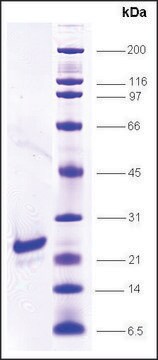
recombinant, expressed in insect cells, ≥85% (SDS-PAGE)
Synonym(e):
AFGF, ECGF, ECGF-beta, ECGFA, ECGFB, FGF-alpha, FGFA, GLIO703, HBGF1
zur Ansicht der Organisations- und Vertragspreise.
Größe auswählen
Ansicht ändern
| Ihnen/SKU | Verfügbarkeit | Preis |
|---|---|---|
5 μg | Versand in der Regel in 2 Wochen. | € 466,00 |
Über diesen Artikel
NACRES:
NA.26
UNSPSC Code:
12352202
€ 466,00
Versand in der Regel in 2 Wochen.
Technischer Dienst
Benötigen Sie Hilfe? Unser Team von erfahrenen Wissenschaftlern ist für Sie da.
Unterstützung erhaltenbiological source
human
recombinant
expressed in insect cells
assay
≥85% (SDS-PAGE)
form
frozen liquid
mol wt
~19.2 kDa
packaging
pkg of 5 μg
storage condition
avoid repeated freeze/thaw cycles
concentration
500 μg/mL
color
colorless to clear
NCBI accession no.
UniProt accession no.
shipped in
dry ice
storage temp.
−70°C
Gene Information
human ... FGF1(2246)
General description
The gene FGF1 (fibroblast growth factor 1) encodes a member of the fibroblast growth factor (FGF) family. It encodes a pro-angiogenic protein that is ubiquitously expressed and is secreted via transmembrane translocation from the cells through a nonclassical secretory pathway in response to stress. It has the ability to permeate membranes composed of acidic phospholipids.
Application
FGF-1 (fibroblast growth factor 1) has been used as a growth factor to study the effect of FGF1 on early branching events in isolated endoderm obtained from embryonic mouse lung.[1] It has also been used to study the neuroprotection effect of FGF1 on cerebellar granule neurons obtained from rats.
Biochem/physiol Actions
Acidic fibroblast growth factor (FGF-1) and basic fibroblast growth factor (FGF-2) are ubiquitous cytokines found in many tissues. They have effects on multiple cell types derived from mesoderm and neuroectoderm, including endothelial cells. FGF proteins are small peptides of 155 to 268 amino acid residues. The degree of sequence identity between different family members is 30-60 % in a "central domain" of approx. 120 amino acids. This domain confers to FGFs a common tertiary structure and the ability to bind to heparin. Secreted FGFs signal to target cells by binding and activating cell-surface tyrosine kinase FGF receptors (FGFRs; 6, 7). The function of FGFs and FGFRs during embryonic development and adult physiology has been addressed by gain- and loss-of-function experiments in several animal model organisms. These studies have shown that FGFs act as key regulators of developmental events.
The protein fibroblast growth factor 1, functions intracellularly to protect cells against stress.[2] The protein functions as an angiogenic factor that participates in tissue repair, carcinogenesis, and maintenance of vasculature stability. Its expression is found to be upregulated in in patients with rheumatic arthritis. It serves as a prognostic biomarker in several cancers and a potential therapeutic target for patients with non-small cell lung cancer.[3]
Physical form
Clear and colorless frozen liquid solution
Preparation Note
Use a manual defrost freezer and avoid repeated freeze-thaw cycles. While working, please keep sample on ice.
1 of 1
Dieser Artikel | |||
|---|---|---|---|
| biological source human | biological source human | biological source human | biological source mouse |
| assay ≥85% (SDS-PAGE) | assay ≥97% (SDS-PAGE) | assay ≥85% (SDS-PAGE) | assay ≥95% (HPLC), ≥95% (SDS-PAGE) |
| recombinant expressed in insect cells | recombinant expressed in E. coli | recombinant expressed in insect cells | recombinant expressed in E. coli |
| form frozen liquid | form lyophilized powder | form frozen liquid | form lyophilized |
| UniProt accession no. | UniProt accession no. | UniProt accession no. | UniProt accession no. |
| storage temp. −70°C | storage temp. −20°C | storage temp. −70°C | storage temp. −20°C |


Lagerklasse
10 - Combustible liquids
wgk
WGK 1
flash_point_f
Not applicable
flash_point_c
Not applicable
Hier finden Sie alle aktuellen Versionen:
Besitzen Sie dieses Produkt bereits?
In der Dokumentenbibliothek finden Sie die Dokumentation zu den Produkten, die Sie kürzlich erworben haben.