Direkt zum Inhalt
Merck

Fortfahren mit

S1444

Anti-Sprouty 2 (N-Terminal) from rabbit

affinity isolated antibody, buffered aqueous solution

Synonym(e):

Anti-IGAN3, Anti-hSPRY2

Anmelden zur Ansicht der Organisations- und Vertragspreise.

Größe auswählen

Ansicht ändern
PackungsgrößeSKUVerfügbarkeitPreis
200 μL
Warenkorb auf Verfügbarkeit prüfen
€ 501,00
€ 425,85

Über diesen Artikel

UNSPSC Code:
12352203
NACRES:
NA.44
MDL number:
Conjugate:
unconjugated
Clone:
polyclonal
Application:
IF, IP, WB
Citations:
12

€ 425,85

Listenpreis€ 501,00Sparen Sie 15%
Aktion nur im Web

Warenkorb auf Verfügbarkeit prüfen

Großbestellung anfragen
Technischer Dienst
Benötigen Sie Hilfe? Unser Team von erfahrenen Wissenschaftlern ist für Sie da.
Unterstützung erhalten


biological source

rabbit

Quality Level

conjugate

unconjugated

antibody form

affinity isolated antibody

antibody product type

primary antibodies

clone

polyclonal

form

buffered aqueous solution

mol wt

antigen 32-35 kDa (doublet)

species reactivity

human, canine

technique(s)

immunoprecipitation (IP): 5-10 μg using 293-T transfected with human Sprouty 2., indirect immunofluorescence: 2-4 μg/mL using 293-T cells transfected with human Sprouty 2., western blot: 0.5-1.0 μg/mL using MDCK (Madin Darby canine kidney) cells.

UniProt accession no.

storage temp.

−20°C

target post-translational modification

unmodified

Gene Information

human ... SPRY2(10253)

General description

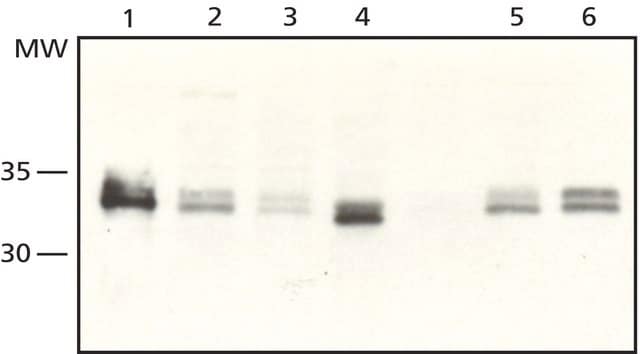
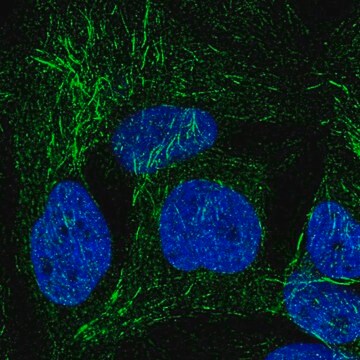
Rabbit polyclonal anti Sprouty 2 (N-Terminal) antibody recognizes Sprouty 2 by immunoblotting (doublet at approx 32-35 kDa), immunofluorescence and immunoprecipitation.
Sprouty 2 was first isolated in Drosophila as a negative regulator of receptor tyrosine kinase signaling (RTK). In vertebrates, the family is composed of four members, Sprouty 1, 2, 3 and 4. Human Spry2 encodes 315 amino acids protein, postranslationally modified by palmytoilation, and by phosphorylation of serine and tyrosine residues. When expressed in COS cells, Spry2 is localized to the cytoplasm and co-localized with microtubule proteins. Upon EGF stimulation, it is translocated to membrane ruffles. Sprouty 1 and 2 inhibit FGF- and VEGF-induced endothelial cell proliferation, at least in part, by repressing pathways leading to p42/44 MAP kinase activation. The role of Sprouty 2 in EGF-mediated MAP kinase signaling is less clear. It was recently shown that Spry can function both as a negative and positive regulator of EGFR mediated MAP kinase signaling. Interaction of Spry2 with Cbl (an E3-ubiquitin ligase) interferes with the ability of hSpry2 to inhibit EGF signaling by specifically intercepting c-Cbl mediated effects on receptor down regulation. Phosphorylation of Spry 2 on Tyr55 leads to its association with c-Cbl. This association prevents formation of an EGF receptor-Cbl complex, consequently inhibiting ubiquitination and down regulation of the latter.
Sprouty proteins are ligand-inducible, negative regulators of RTK signaling pathways that modulate cellular growth, differentiation, and movement. Sprouty 2 (Spry2) mediates apoptosis control by c-Cbl sequestration and growth factor receptor signaling. Additionally, Spry2 downregulates EGFR ubiquitination and endocytosis, and thereby potentiates Ras/ERK signaling. Decreased Spry2 expression has been associated with poor prognosis in breast cancers . Anti-Sprouty 2 (N-Terminal) is specific for Sprouty 2 (doublet at approx. 32-35 kDa). The antibody reacts with human, dog and mouse Spry2.

Immunogen

This sequence differs in one amino acid from the human sequence.
synthetic peptide corresponding to amino acids 79-98 of mouse Sprouty 2 (Spry 2), conjugated to KLH via a C-terminal added lysine residue.

Application

Anti-Sprouty 2 (N-Terminal) is suitable for use in immunoblotting using MEF lysates [1]. The antibody can also be used for immunoprecipitation (5-10 μg using 293-T transfected with human Sprouty 2) and indirect immunofluorescence (2-4 μg/mL using 293-T cells transfected with human Sprouty 2).
Rabbit polyclonal anti Sprouty 2 (N-Terminal) antibody is used to tag Sprouty 2 for detection and quantitation by immunocytochemical and immunohistochemical (IHC) techniques. It is used as a probe to determine the presence and roles of Sprouty 2 in cell signaling cascades such as the EGFR mediate MAP kinase pathway.

Physical form

Solution in 0.01 M phosphate buffered saline, pH 7.4, containing 1% BSA and 15 mM sodium azide.

Disclaimer

Unless otherwise stated in our catalog or other company documentation accompanying the product(s), our products are intended for research use only and are not to be used for any other purpose, which includes but is not limited to, unauthorized commercial uses, in vitro diagnostic uses, ex vivo or in vivo therapeutic uses or any type of consumption or application to humans or animals.

Ähnliche Artikel vergleichen

Vollständigen Vergleich anzeigen

Unterschiede anzeigen

1 of 1

Dieser Artikel
AV50523HPA042198SAB4200346
biological source

rabbit

biological source

rabbit

biological source

rabbit

biological source

rabbit

Quality Level

200

Quality Level

100

Quality Level

100

Quality Level

200

antibody form

affinity isolated antibody

antibody form

affinity isolated antibody

antibody form

affinity isolated antibody

antibody form

affinity isolated antibody

conjugate

unconjugated

conjugate

unconjugated

conjugate

unconjugated

conjugate

unconjugated

form

buffered aqueous solution

form

buffered aqueous solution

form

buffered aqueous glycerol solution

form

buffered aqueous solution

technique(s)

immunoprecipitation (IP): 5-10 μg using 293-T transfected with human Sprouty 2., western blot: 0.5-1.0 μg/mL using MDCK (Madin Darby canine kidney) cells., indirect immunofluorescence: 2-4 μg/mL using 293-T cells transfected with human Sprouty 2.

technique(s)

immunohistochemistry: suitable, western blot: suitable

technique(s)

immunofluorescence: 0.25-2 μg/mL

technique(s)

indirect immunofluorescence: 1-2 μg/mL using human A549 cells., western blot: 2-4 μg/mL using whole extracts of HEK-293 cells over-expressing human SMAD7.


Still not finding the right product?

Probieren Sie unser Produkt-Auswahlhilfe, um Ihre Auswahl einzugrenzen


Lagerklasse

12 - Non Combustible Liquids

wgk

nwg

flash_point_f

Not applicable

flash_point_c

Not applicable


Hier finden Sie alle aktuellen Versionen:

Analysenzertifikate (COA)

Lot/Batch Number

Die passende Version wird nicht angezeigt?

Wenn Sie eine bestimmte Version benötigen, können Sie anhand der Lot- oder Chargennummer nach einem spezifischen Zertifikat suchen.

Besitzen Sie dieses Produkt bereits?

In der Dokumentenbibliothek finden Sie die Dokumentation zu den Produkten, die Sie kürzlich erworben haben.

Die Dokumentenbibliothek aufrufen


Verwandter Inhalt


Marta Vaquero et al.
Journal of the American Society of Nephrology : JASN, 30(8), 1398-1411 (2019-07-14)
Studies in mice suggest that perturbations of the GDNF-Ret signaling pathway are a major genetic cause of congenital anomalies of the kidney and urinary tract (CAKUT). Mutations in Sprouty1, an intracellular Ret inhibitor, results in supernumerary kidneys, megaureters, and hydronephrosis
Jung-Chien Cheng et al.
Oncotarget, 7(49), 81645-81660 (2016-11-12)
Similar to Drosophila Sprouty (SPRY), mammalian SPRY proteins inhibit the receptor tyrosine kinase-mediated activation of cellular signaling pathways. SPRY2 expression levels have been shown to be down-regulated in human ovarian cancer, and patients with low SPRY2 expression have significantly poorer
Gisela Altés et al.
Scientific reports, 14(1), 19479-19479 (2024-08-23)
Genes of the Sprouty family (Spry1-4) are feedback inhibitors of receptor tyrosine kinases, especially of Ret and the FGF receptors. As such, they play distinct and overlapping roles in embryo morphogenesis and are considered to be tumor suppressors in adult


Global Trade Item Number

SKUGTIN
S1444-200UL04061838107435

Questions

Reviews

No rating value

Active Filters