Direkt zum Inhalt
Merck

P0058

Anti-Peroxiredoxin 6 (C-terminal) antibody produced in rabbit

~1.0 mg/mL, affinity isolated antibody, buffered aqueous solution

Synonym(e):

Anti-1-Cys peroxiredoxin, Anti-Acidic calcium-independent phospholipase A2, Anti-Antioxidant protein 2, Anti-Non-selenium glutathione peroxidase, AOP2, Anti-PRDX6

Anmelden zur Ansicht der Organisations- und Vertragspreise.

Größe auswählen

200 μL

€ 528,00

€ 528,00


Warenkorb auf Verfügbarkeit prüfen

Großbestellung anfragen

Über diesen Artikel

NACRES:
NA.41
UNSPSC Code:
12352203
Conjugate:
unconjugated
Clone:
polyclonal
Application:
IP, WB
Citations:
10

Fortfahren mit

Technischer Dienst
Benötigen Sie Hilfe? Unser Team von erfahrenen Wissenschaftlern ist für Sie da.
Unterstützung erhalten

biological source

rabbit

conjugate

unconjugated

antibody form

affinity isolated antibody

antibody product type

primary antibodies

clone

polyclonal

form

buffered aqueous solution

mol wt

antigen ~25 kDa

species reactivity

human, rat, mouse

concentration

~1.0 mg/mL

technique(s)

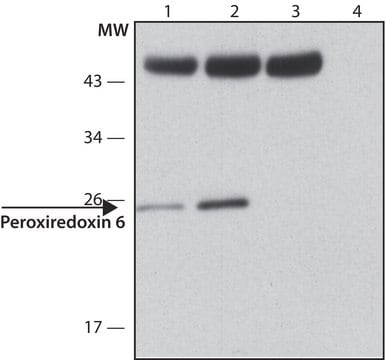
immunoprecipitation (IP): 2-5 μg using whole extract of mouse brain, western blot: 0.5-1.0 μg/mL using whole extract of human HeLa cells., western blot: 1-2 μg/mL using whole extract of rat brain

UniProt accession no.

shipped in

dry ice

storage temp.

−20°C

target post-translational modification

unmodified

Quality Level

Gene Information

human ... PRDX6(9588)
mouse ... Prdx6(11758)
rat ... Prdx6(94167)

Ähnliche Artikel vergleichen

Vollständigen Vergleich anzeigen

Unterschiede anzeigen

1 of 4

Dieser Artikel
P0068R0656WH0009588M1
conjugate

unconjugated

conjugate

unconjugated

conjugate

unconjugated

conjugate

unconjugated

antibody form

affinity isolated antibody

antibody form

affinity isolated antibody

antibody form

affinity isolated antibody

antibody form

purified immunoglobulin

Quality Level

200

Quality Level

200

Quality Level

200

Quality Level

100

biological source

rabbit

biological source

rabbit

biological source

rabbit

biological source

mouse

clone

polyclonal

clone

polyclonal

clone

polyclonal

clone

3A10-2A11, monoclonal

Gene Information

human ... PRDX6(9588)
mouse ... Prdx6(11758)
rat ... Prdx6(94167)

Gene Information

human ... SQSTM1(8878)
mouse ... Sqstm1(18412)
rat ... Sqstm1(113894)

Gene Information

human ... RAB14(51552)
mouse ... Rab14(68365)
rat ... Rab14(94197)

Gene Information

human ... PRDX6(9588)

General description

PRDX6 (peroxiredoxin 6) is a mammalian peroxidase belonging to the 1-Cys Prdx family, meaning it has 1-Cys at position 47 (Cys47). This protein is localized to cytoplasm, lysosomes, mitochondria, endoplasmic reticulum (ER) and plasma membrane. It is a homodimeric protein which is especially observed in mammalian lungs.†

Application

Anti-Peroxiredoxin 6 (C-terminal) antibody produced in rabbit has been used for Western Blotting.[1]

Biochem/physiol Actions

PRDX6 (peroxiredoxin 6) has both peroxidase and phospholipase A2 (PLA2) activities and thus, is a bifunctional protein. In liver, as a peroxidase it confers protection against damage from ROS (reactive oxygen species) during ischemia-reperfusion injury. As a PLA2 it is involved in lung surfactant metabolism. It is also essential for normal nicotinamide adenine dinucleotide phosphate-oxidase activity. In the livers of donors after brain death (DBD), this protein suppresses ischemia- and hypoxia-induced liver damage, and its expression is controlled by NF-κB (nuclear factor). In human and mouse neuronal cells, the delivery of PRDX6 protein leads to delay or suppression in oxidative stress-induced neuronal cell death.
Peroxiredoxin 6 contains a single redox-active cysteine and uses glutathione to catalyze the reduction of H2O2 and other organic peroxides. Overexpression of peroxiredoxin 6 in cells protects them against oxidative damage, whereas knockdown of this enzyme results in oxidative stress and apoptosis. The phospholipase A2 activity plays an important role in surfactant homeostasis. Peroxiredoxin 6 is a major antioxidant enzyme which functions in antioxidant defense and lung phospholipid metabolism.

Physical form

Solution in 0.01 M phosphate buffered saline, pH 7.4, containing 15 mM sodium azide.

Disclaimer

Unless otherwise stated in our catalog or other company documentation accompanying the product(s), our products are intended for research use only and are not to be used for any other purpose, which includes but is not limited to, unauthorized commercial uses, in vitro diagnostic uses, ex vivo or in vivo therapeutic uses or any type of consumption or application to humans or animals.

Sie haben nicht das passende Produkt gefunden?  

Probieren Sie unser Produkt-Auswahlhilfe. aus.

Lagerklasse

10 - Combustible liquids

flash_point_f

Not applicable

flash_point_c

Not applicable

ppe

Eyeshields, Gloves, multi-purpose combination respirator cartridge (US)


Hier finden Sie alle aktuellen Versionen:

Analysenzertifikate (COA)

Lot/Batch Number

Die passende Version wird nicht angezeigt?

Wenn Sie eine bestimmte Version benötigen, können Sie anhand der Lot- oder Chargennummer nach einem spezifischen Zertifikat suchen.

Besitzen Sie dieses Produkt bereits?

In der Dokumentenbibliothek finden Sie die Dokumentation zu den Produkten, die Sie kürzlich erworben haben.

Die Dokumentenbibliothek aufrufen

Gaetano Calabrese et al.
The EMBO journal, 38(18), e101552-e101552 (2019-08-08)
Hydrogen peroxide (H2 O2 ) plays important roles in cellular signaling, yet nonetheless is toxic at higher concentrations. Surprisingly, the mechanism(s) of cellular H2 O2 toxicity remain poorly understood. Here, we reveal an important role for mitochondrial 1-Cys peroxiredoxin from
Yuichiro J Suzuki et al.
F1000Research, 6, 594-594 (2017-04-28)
Reactive oxygen species (ROS) play an important role in the development of various pathological conditions as well as aging. ROS oxidize DNA, proteins, lipids, and small molecules. Carbonylation is one mode of protein oxidation that occurs in response to the
Delivery of a protein transduction domain-mediated Prdx6 protein ameliorates oxidative stress-induced injury in human and mouse neuronal cells.
Singh SP et al
American Journal of Physiology. Cell Physiology, 310(1), :C1-:16 (2016)
Yuichiro J Suzuki et al.
F1000Research, 6, 455-455 (2017-06-06)
Reactive oxygen species (ROS) have been recognized as second messengers, however, targeting mechanisms for ROS in cell signaling have not been defined. While ROS oxidizing protein cysteine thiols has been the most popular proposed mechanism, our laboratory proposed that ligand/receptor-mediated
Peroxiredoxin 6 is a potent cytoprotective enzyme in the epidermis
Kumin A, et al.
The American Journal of Pathology, 169(4), 1194-1205 (2006)

Verwandter Inhalt

Instructions

Questions

Reviews

No rating value

Active Filters

Unser Team von Wissenschaftlern verfügt über Erfahrung in allen Forschungsbereichen einschließlich Life Science, Materialwissenschaften, chemischer Synthese, Chromatographie, Analytik und vielen mehr..

Setzen Sie sich mit dem technischen Dienst in Verbindung