
Fortfahren mit
MSP05

Membrane Scaffold Protein 1E1D1 D73C
recombinant, expressed in E. coli, Cysteine substituted at position 73
Anmelden zur Ansicht der Organisations- und Vertragspreise.
Größe auswählen
Ansicht ändern
| Ihnen/SKU | Verfügbarkeit | Preis |
|---|---|---|
5 mg | Warenkorb auf Verfügbarkeit prüfen | € 519,00 |
Über diesen Artikel
NACRES:
NA.26
UNSPSC Code:
12352200
Form:
buffered aqueous solution
Assay:
≥90% (SDS-GE)
Recombinant:
expressed in E. coli
Technischer Dienst
Benötigen Sie Hilfe? Unser Team von erfahrenen Wissenschaftlern ist für Sie da.
Unterstützung erhaltenrecombinant
expressed in E. coli
Quality Segment
assay
≥90% (SDS-GE)
form
buffered aqueous solution
shipped in
ambient
storage temp.
−20°C
General description
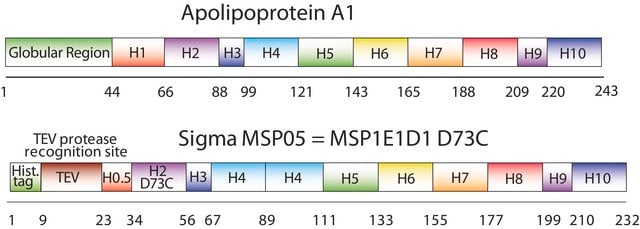
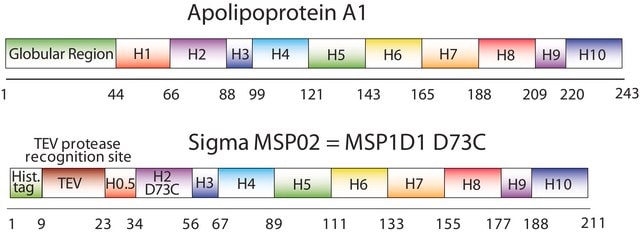
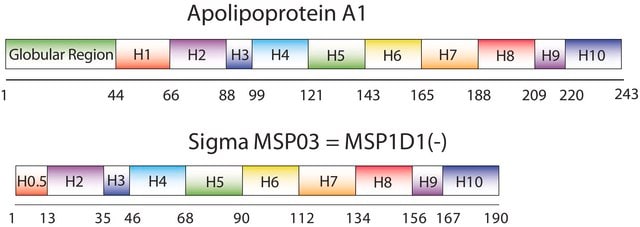
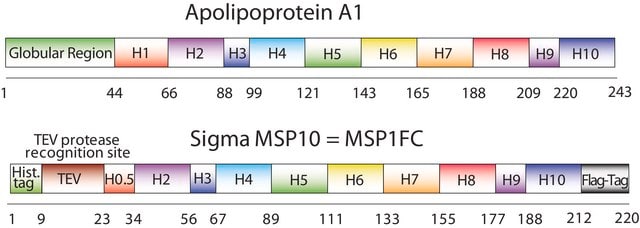
Nanodisc technology is an approach to render membrane proteins soluble in aqueous solutions in a native-like bilayer environment, where the membrane proteins remain stable and active. The Nanodisc concept is derived from high density lipoprotein (HDL) particles and their primary protein component, apolipoprotein. The Nanodisc is a non-covalent structure of phospholipid bilayer and membrane scaffold protein (MSP), a genetically engineered protein, which mimics the function of Apolipoprotein A-1 (ApoA-1).
The first MSP, MSP1, was engineered with its sequence based on the sequence of A-1, but without the globular N-terminal domain of native A-1. The MSP1E1D1 D73C variant of MSP1 differs from MSP1 in the following facets:
The first MSP, MSP1, was engineered with its sequence based on the sequence of A-1, but without the globular N-terminal domain of native A-1. The MSP1E1D1 D73C variant of MSP1 differs from MSP1 in the following facets:
- It deletes the first 11 amino acids in the Helix 1 portion (referred to as “H0.5” in the accompanying figure) of the original MSP1 sequence (which is known separately as MSP1D1).
- It repeats the Helix 4 portion (H4) of the original MSP1 sequence between the parent Helix 4 (H4) and Helix 5 (H5) segments of MSP1D1.
- It replaces one aspartic acid residue (D) with a cysteine (C) at position 73 of the original native A-1 sequence, located within the Helix 2 segment (H2).
Application
For guidelines on the use of this and other MSP′s to prepare Nanodiscs, please visit our Protocols for Membrane Scaffold Proteins and Nanodisc Formation page.
Legal Information
Nanodisc technology, and many of its uses, are covered by the following patents held by the University of Illinois.
- 7,691,414 Membrane scaffold proteins
- 7,662,410 Membrane scaffold proteins and embedded membrane proteins
- 7,622,437 Tissue factor compositions and methods
- 7,592,008 Membrane scaffold proteins
- 7,575,763 Membrane scaffold proteins and tethered membrane proteins
- 7,083,958 Membrane scaffold proteins
- 7,048,949 Membrane scaffold proteins
1 of 1
Dieser Artikel | |||
|---|---|---|---|
| recombinant expressed in E. coli | recombinant expressed in E. coli | recombinant expressed in E. coli | recombinant expressed in E. coli |
| assay ≥90% (SDS-GE) | assay ≥90% (SDS-GE) | assay ≥90% (SDS-GE) | assay ≥90% (SDS-GE) |
| form buffered aqueous solution | form buffered aqueous solution | form buffered aqueous solution | form buffered aqueous solution |
| storage temp. −20°C | storage temp. −20°C | storage temp. −20°C | storage temp. −20°C |
| shipped in ambient | shipped in ambient | shipped in ambient | shipped in ambient |
| Quality Level 200 | Quality Level 200 | Quality Level 200 | Quality Level 200 |
Lagerklasse
12 - Non Combustible Liquids
wgk
WGK 2
flash_point_f
Not applicable
flash_point_c
Not applicable
Hier finden Sie alle aktuellen Versionen:
Besitzen Sie dieses Produkt bereits?
In der Dokumentenbibliothek finden Sie die Dokumentation zu den Produkten, die Sie kürzlich erworben haben.