
Fortfahren mit
MBD0049

Escherichia coli FISH probe -ATTO488
Probe for fluorescence in situ hybridization (FISH), 20µM in water
zur Ansicht der Organisations- und Vertragspreise.
Größe auswählen
Ansicht ändern
| Ihnen/SKU | Verfügbarkeit | Preis |
|---|
Über diesen Artikel
NACRES:
NA.54
UNSPSC Code:
12352200
Preise und Verfügbarkeit sind derzeit nicht verfügbar.
Technischer Dienst
Benötigen Sie Hilfe? Unser Team von erfahrenen Wissenschaftlern ist für Sie da.
Unterstützung erhaltenQuality Segment
technique(s)
FISH: suitable
fluorescence
λex 504 nm; λem 521 nm (ATTO488)
shipped in
dry ice
storage temp.
−20°C
General description
Fluorescent In Situ Hybridization technique (FISH) is based on the hybridization of fluorescent labeled oligonucleotide probe to a specific complementary DNA or RNA sequence in whole and intact cells.1 Microbial FISH allows the visualization, identification and isolation of bacteria due to recognition of ribosomal RNA also in unculturable samples.2
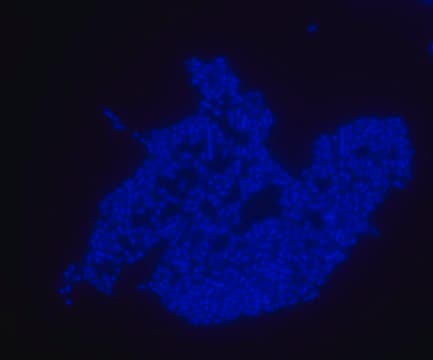
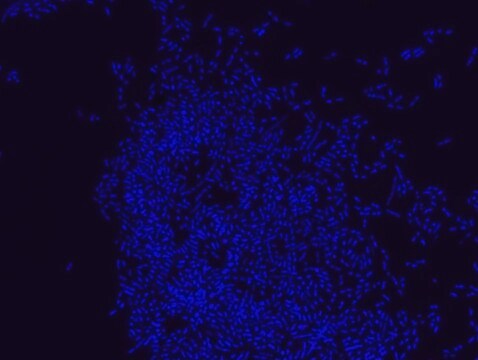
The FISH technique was successfully used to identify E.coli with the probe in various samples such as pure culture (as described in the figure legends and11,13), large and small intestines samples14-16, fecal samples17-21, colonic biopsies18, urine samples, bladder, and kidney sections embedded in paraffin22 and in E.coli biofilm23. It is strongly recommended to include positive and negative controls in FISH assays to ensure specific binding of the probe of interest and appropriate protocol conditions. We offer positive (MBD0032/33) and negative control (MBD0034/35) probes, that accompany the specific probe of interest.
Escherichia coli is a gram negative, facultative aerobic, rod-shaped coliform bacterium. E. coli colonizes the infant gut within hours of birth and establishes itself as the most abundant facultative anaerobe of the human intestinal microflora for the remainder of life, equipped with the abilities to grow in the ever-changing environment in the gut and cope with the mammalian host interaction.8,9 Nevertheless, E. coli can survive in many different ecological habitats, including abiotic environments, and is considered a highly versatile species. Known habitats of E. coli include soil, water, sediment, and food. Some strains of E. coli have evolved and adapted to a pathogenic lifestyle and can cause different disease pathologies.10
Escherichia coli probe specifically recognizes Escherichia coli cells. Yet some reports describe the recognition of other bacteria with this probe, such as, Shigella boydii, Citrobacter davisae, Citrobacter lapagei, Citrobacter neteri11 and Klebsiella pneumoniae12.
The FISH technique was successfully used to identify E.coli with the probe in various samples such as pure culture (as described in the figure legends and11,13), large and small intestines samples14-16, fecal samples17-21, colonic biopsies18, urine samples, bladder, and kidney sections embedded in paraffin22 and in E.coli biofilm23. It is strongly recommended to include positive and negative controls in FISH assays to ensure specific binding of the probe of interest and appropriate protocol conditions. We offer positive (MBD0032/33) and negative control (MBD0034/35) probes, that accompany the specific probe of interest.
Escherichia coli is a gram negative, facultative aerobic, rod-shaped coliform bacterium. E. coli colonizes the infant gut within hours of birth and establishes itself as the most abundant facultative anaerobe of the human intestinal microflora for the remainder of life, equipped with the abilities to grow in the ever-changing environment in the gut and cope with the mammalian host interaction.8,9 Nevertheless, E. coli can survive in many different ecological habitats, including abiotic environments, and is considered a highly versatile species. Known habitats of E. coli include soil, water, sediment, and food. Some strains of E. coli have evolved and adapted to a pathogenic lifestyle and can cause different disease pathologies.10
Escherichia coli probe specifically recognizes Escherichia coli cells. Yet some reports describe the recognition of other bacteria with this probe, such as, Shigella boydii, Citrobacter davisae, Citrobacter lapagei, Citrobacter neteri11 and Klebsiella pneumoniae12.
Application
Probe for fluorescence in situ hybridization (FISH), recognizes Escherichia coli cells
Features and Benefits
- Visualize, identify and isolate Escherichia coli cells.
- Observe native E. coli cell populations in diverse microbiome environments.
- Specific, sensitive and robust identification of E. coli in bacterial mixed population.
- Specific, sensitive and robust identification even when E. coli is in low abundance in the sample.
- FISH can complete PCR based detection methods by avoiding contaminant bacteria detection.
- Provides information on E. coli morphology and allows to study biofilm architecture.
- Identify E. coli in clinical samples such as, urine samples, bladder and kidney sections (formalin-fixed paraffin-embedded (FFPE) samples), fecal samples and colon tissue.
- The ability to detect E. coli in its natural habitat is an essential tool for studying host-microbiome interaction.
1 of 1
Dieser Artikel | |||
|---|---|---|---|
| technique(s) FISH: suitable | technique(s) FISH: suitable | technique(s) FISH: suitable | technique(s) FISH: suitable |
| shipped in dry ice | shipped in dry ice | shipped in dry ice | shipped in dry ice |
| storage temp. −20°C | storage temp. −20°C | storage temp. −20°C | storage temp. −20°C |
| Quality Level 200 | Quality Level 200 | Quality Level 200 | Quality Level 200 |
| fluorescence λex 504 nm; λem 521 nm (ATTO488) | fluorescence λex 550 nm; λem 570 nm | fluorescence - | fluorescence λex 504 nm; λem 521 nm (ATTO488) |


Lagerklasse
12 - Non Combustible Liquids
wgk
WGK 1
Hier finden Sie alle aktuellen Versionen:
Besitzen Sie dieses Produkt bereits?
In der Dokumentenbibliothek finden Sie die Dokumentation zu den Produkten, die Sie kürzlich erworben haben.