Direkt zum Inhalt
Merck

M265

Anti-Glutamate Receptor NMDAR2B (NR2B) antibody produced in rabbit

affinity isolated antibody, lyophilized powder

Synonym(e):

Anti-DEE27, Anti-EIEE27, Anti-GluN2B, Anti-MRD6, Anti-NMDAR2B, Anti-NR2B, Anti-NR3, Anti-hNR3

Anmelden zur Ansicht der Organisations- und Vertragspreise.

Größe auswählen

10 μG

€ 733,00

€ 733,00


Warenkorb auf Verfügbarkeit prüfen
Für Ihr Target ist ein rekombinanter, konservierungsmittelfreier Antikörper verfügbar. Probieren Sie ZRB1242


Über diesen Artikel

UNSPSC Code:
12352203
NACRES:
NA.41
MDL number:
Conjugate:
unconjugated
Clone:
polyclonal
Application:
IHC (f), IP, WB
Citations:
12

Fortfahren mit

Technischer Dienst
Benötigen Sie Hilfe? Unser Team von erfahrenen Wissenschaftlern ist für Sie da.
Unterstützung erhalten

biological source

rabbit

Quality Level

conjugate

unconjugated

antibody form

affinity isolated antibody

antibody product type

primary antibodies

clone

polyclonal

form

lyophilized powder

mol wt

antigen 180 kDa

species reactivity

rat, human, mouse

technique(s)

immunohistochemistry (frozen sections): 1:1,000, immunoprecipitation (IP): 3 μL using 200 μg of rat brain, western blot: 1 μg/mL using 35S-Protein A (with ECL dilutions may be higher)

UniProt accession no.

storage temp.

−20°C

target post-translational modification

unmodified

Gene Information

human ... GRIN2B(2904)
mouse ... Grin2b(14812)
rat ... Grin2b(24410)

Verwandte Kategorien

Ähnliche Artikel vergleichen

Vollständigen Vergleich anzeigen

Unterschiede anzeigen

1 of 4

Dieser Artikel
M266SAB4501306SAB4300425
conjugate

unconjugated

conjugate

unconjugated

conjugate

unconjugated

conjugate

unconjugated

antibody form

affinity isolated antibody

antibody form

affinity isolated antibody

antibody form

affinity isolated antibody

antibody form

affinity isolated antibody

biological source

rabbit

biological source

rabbit

biological source

rabbit

biological source

rabbit

Quality Level

100

Quality Level

200

Quality Level

100

Quality Level

100

mol wt

antigen 180 kDa

mol wt

antigen 140 kDa (NR2C subunit), antigen 180 kDa (NR2A and NR2B bands)

mol wt

antigen 166 kDa

mol wt

~190 kDa

Gene Information

human ... GRIN2B(2904)
mouse ... Grin2b(14812)
rat ... Grin2b(24410)

Gene Information

human ... GRIN2C(2905)
mouse ... Grin2c(14813)
rat ... Grin2c(24411)

Gene Information

human ... GRIN2B(2904)

Gene Information

human ... GRIN2B(2904)

General description

Glutamate ionotropic receptor N-methyl-D-aspartate (NMDA) type subunit 2B (GRIN2B) codes for N-methyl D-aspartate receptor subtype 2B (GluN2B). It is an important constituent of the N-methyl D-aspartate receptor protein. GRIN2B gene is located on human chromosome 12p13.1.

Immunogen

C-terminal portion of NR2B (amino acids 984-1104).

Application

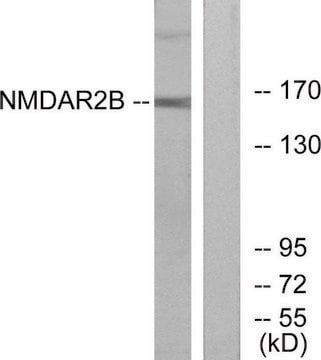
Anti-Glutamate Receptor NMDAR2B (NR2B) antibody is suitable for use in immunohistochemistry (1:1,000 dilution, using frozen sections), immunoprecipitation (3 μL using 200 μg of rat brain), and indirect ELISA. The antibody may also be used for western blot (1 μg/mL using (35S)-Protein A) and immunoblot (180 kDa).
Anti-Glutamate Receptor NMDAR2B (NR2B) antibody produced in rabbit has been used in western blotting.

Biochem/physiol Actions

Glutamate ionotropic receptor N-methyl-D-aspartate (NMDA) type subunit 2B (GRIN2B) plays a key role in synaptic plasticity, language acquisition, neural pattern formation and short-term memory. Mutations on GRIN2B gene results in Parkinson′s disease, schizophrenia, bipolar disorder, Alzheimer′s disease and obsessive-compulsive disorder.
The functional N-Methyl-D-Aspartate (NMDA) receptor complex consists of a NMDAR1 (NR1) subunit and atleast one NMDAR2 subunit ranging from NR2A-NR2D. These receptor complexes have been implicated in cochlear functions and neuronal plasticity. The C-terminal end of NR2B receptor may regulate synaptic localization.

Physical form

Lyophilized from ammonium bicarbonate (5 mM).

Disclaimer

Unless otherwise stated in our catalog or other company documentation accompanying the product(s), our products are intended for research use only and are not to be used for any other purpose, which includes but is not limited to, unauthorized commercial uses, in vitro diagnostic uses, ex vivo or in vivo therapeutic uses or any type of consumption or application to humans or animals.

Sie haben nicht das passende Produkt gefunden?  

Probieren Sie unser Produkt-Auswahlhilfe. aus.

related product

Lagerklasse

11 - Combustible Solids

wgk

WGK 2

flash_point_f

Not applicable

flash_point_c

Not applicable

ppe

Eyeshields, Gloves, type N95 (US)


Hier finden Sie alle aktuellen Versionen:

Analysenzertifikate (COA)

Lot/Batch Number

Die passende Version wird nicht angezeigt?

Wenn Sie eine bestimmte Version benötigen, können Sie anhand der Lot- oder Chargennummer nach einem spezifischen Zertifikat suchen.

Besitzen Sie dieses Produkt bereits?

In der Dokumentenbibliothek finden Sie die Dokumentation zu den Produkten, die Sie kürzlich erworben haben.

Die Dokumentenbibliothek aufrufen

D Joelson et al.
Microscopy research and technique, 41(3), 246-262 (1998-05-30)
The distribution of immunoreactivity for the ionotropic N-methyl-D-aspartate (NMDA) receptor subunits was mapped in the cochlear nucleus of postnatal day (P) 7, P14, P21, and P28 gerbils. Frozen sections and serial plastic sections of tissue were incubated with antibodies to
Maowen Ba et al.
Behavioural brain research, 356, 41-45 (2018-08-22)
Augmented function of N-methyl-d-aspartate receptor subunit 2B (NR2B) and Src protein tyrosine kinase have been demonstrated to get involved in the pathological mechanisms of dyskinesia. In view of functional interactions between NR2B and Src, we investigated the effects of uncoupling
Steve Standley et al.
PloS one, 7(6), e39585-e39585 (2012-07-05)
NMDA receptor NR2A/B subunits have PDZ-binding domains on their extreme C-termini that are known to interact with the PSD-95 family and other PDZ proteins. We explore the interactions between PSD-95 family proteins and the NR2A/B cytoplasmic tails, and the consequences
Mi Zhou et al.
Neuroscience, 376, 24-39 (2018-02-17)
The amygdala plays a key role in the pathophysiology of depression, but the molecular mechanisms underlying amygdalar hyperactivity in depression remain unclear. In this study, we used a chronic mild stress (CMS) protocol to separate susceptible and insusceptible rat subgroups.
R S Petralia et al.
The Journal of neuroscience : the official journal of the Society for Neuroscience, 14(10), 6102-6120 (1994-10-01)
Neuronal plasticity associated with learning, memory and development is controlled, in part, by NMDA receptors, which are complexes consisting of the subunit NMDAR1 (NR1) and one or more NMDAR2 subunits (NR2A-NR2D). We made a polyclonal antibody to a C-terminus peptide

Verwandter Inhalt

Global Trade Item Number

SKUGTIN
M265-10UG04061834045908

Questions

Reviews

No rating value

Active Filters

Unser Team von Wissenschaftlern verfügt über Erfahrung in allen Forschungsbereichen einschließlich Life Science, Materialwissenschaften, chemischer Synthese, Chromatographie, Analytik und vielen mehr..

Setzen Sie sich mit dem technischen Dienst in Verbindung