

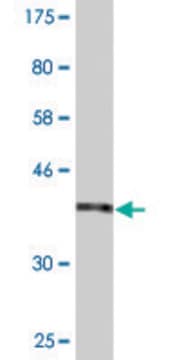
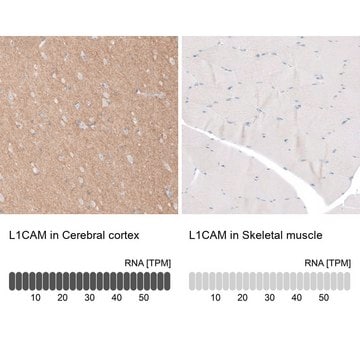
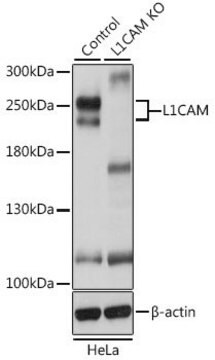
This product is quite robust and versatile. It has been found suitable for use in a number of applications - flow cytometry, immunocytochemistry, immunohistochemistry, immunoprecipitation, microarray and western blot - however it has not tested for use in electron microscopy. It would be up to the end user to determine suitability. Should this be of interest, please see the link below to learn more about the Antibody Guarantee program:
https://www.sigmaaldrich.com/US/en/technical-documents/technical-article/protein-biology/immunohistochemistry/bioguarantee-antibodies
Fortfahren mit
L4543

Anti-L1CAM antibody, Mouse monoclonal
clone UJ127.11, purified from hybridoma cell culture
Synonym(e):
L1CAM Antibody - Anti-L1CAM antibody, Mouse monoclonal, L1Cam Antibody, Anti-CAML1, Anti-L1 Cell Adhesion Molecule, Anti-MIC5, Anti-Neural Cell Adhesion Molecule L1
Anmelden zur Ansicht der Organisations- und Vertragspreise.
Größe auswählen
Ansicht ändern
| Ihnen/SKU | Verfügbarkeit | Preis |
|---|---|---|
25 μL | Warenkorb auf Verfügbarkeit prüfen | € 166,00 |
200 μL | Warenkorb auf Verfügbarkeit prüfen | € 694,00 |
Über diesen Artikel
Conjugate:
unconjugated
Clone:
UJ127.11, monoclonal
Application:
ARR, FACS, ICC, IHC, IP, WB
Citations:
19
€ 166,00
Warenkorb auf Verfügbarkeit prüfen
Für Ihr Target ist ein rekombinanter, konservierungsmittelfreier Antikörper verfügbar. Probieren Sie ZRB2752
Technischer Dienst
Benötigen Sie Hilfe? Unser Team von erfahrenen Wissenschaftlern ist für Sie da.
Unterstützung erhaltenbiological source
mouse
Quality Segment
conjugate
unconjugated
antibody form
purified immunoglobulin
antibody product type
primary antibodies
clone
UJ127.11, monoclonal
form
buffered aqueous solution
mol wt
antigen 220-240 kDa
species reactivity
human
packaging
antibody small pack of 25 μL
concentration
~2 mg/mL
technique(s)
flow cytometry: suitable, immunocytochemistry: suitable, immunohistochemistry: suitable, immunoprecipitation (IP): suitable, microarray: suitable, western blot: 0.25-0.5 μg/mL using cell extracts of G361 cells (human melanoma)
isotype
IgG1
UniProt accession no.
shipped in
dry ice
storage temp.
−20°C
target post-translational modification
unmodified
Gene Information
human ... L1CAM(3897)
General description
Anti-L1CAM antibody, Mouse monoclonal (mouse IgG1 isotype) is derived from the hybridoma UJ127.11 produced by the fusion of mouse myeloma cells (P3- X63-Ag8-653 cells) and splenocytes from mice immunized with human fetal brain. L1 cell adhesion molecule (L1CAM) protein belongs to the family of cell adhesion molecules (CAM).
The gene L1CAM (L1 cell adhesion molecule) encodes a member of the immunoglobulin supergene family. The encoded protein contains a cytoplasmic intracellular domain, one single-pass transmembrane region and an extracellular domain containing six immunoglobulin- (Ig) and five fibronectin (Fn) III-like motifs. The gene is mapped to human chromosome Xq28. It contains 29 exons that encode a protein of 1257 amino acids containing a 19 amino acid signal peptide and a functional L1 protein of 1238 amino acids. It is mainly expressed in the nervous system.
Immunogen
L1CAM from human fetal brain.
Application
Anti-L1CAM antibody, Mouse monoclonal has been used for:
- immunohistochemistry
- immunoprecipitation
- immunoblotting
- immunocytochemistry
- flow cytometry
Applications in which this antibody has been used successfully, and the associated peer-reviewed papers, are given below.
Immunohistochemistry (1 paper)
Western Blotting (1 paper)
Immunohistochemistry (1 paper)
Western Blotting (1 paper)
Biochem/physiol Actions
L1 cell adhesion molecule (L1CAM) is critical for central nervous system (CNS) development in humans. This protein is responsible for many activities among them: neurite outgrowth, adhesion, fasciculation and myelination. These activities are mediated by the interaction of L1CAM with various members of the CAM protein family, extracellular matrix molecules and signaling receptors, through interactions that involve the extracellular domain of L1CAM. Mutations in the L1CAM gene may be linked to several brain disorders such as type 1 X-linked spastic paraplegia (SPG1), MASA syndrome and ACC (agenesis of corpus callosum).
The gene L1CAM (L1 cell adhesion molecule) encodes a glycoprotein that functions in axon growth during development and axon bundling. It interacts with Schwann cells and axons, and mediates neuronal cell migration, and neuronal cell survival. Overexpression of this protein is associated with tumor progression. It has been found to mediate therapeutic resistance in ovarian and pancreatic cancer cells.
Physical form
Solution in 0.01 M phosphate buffered saline, pH 7.4, containing 15 mM sodium azide.
Disclaimer
Unless otherwise stated in our catalog or other company documentation accompanying the product(s), our products are intended for research use only and are not to be used for any other purpose, which includes but is not limited to, unauthorized commercial uses, in vitro diagnostic uses, ex vivo or in vivo therapeutic uses or any type of consumption or application to humans or animals.
1 of 1
Dieser Artikel | |||
|---|---|---|---|
| description clone UJ127.11, purified from hybridoma cell culture | description clone 3B10, purified immunoglobulin, buffered aqueous solution | description Prestige Antibodies® Powered by Atlas Antibodies, affinity isolated antibody, buffered aqueous glycerol solution | description - |
| biological source mouse | biological source mouse | biological source rabbit | biological source rabbit |
| antibody form purified immunoglobulin | antibody form purified immunoglobulin | antibody form affinity isolated antibody | antibody form affinity isolated antibody |
| conjugate unconjugated | conjugate unconjugated | conjugate unconjugated | conjugate unconjugated |
| clone UJ127.11, monoclonal | clone 3B10, monoclonal | clone polyclonal | clone polyclonal |
| Gene Information human ... L1CAM(3897) | Gene Information human ... L1CAM(3897) | Gene Information human ... L1CAM(3897) | Gene Information human ... L1CAM(3897) |
| species reactivity human | species reactivity human | species reactivity human | species reactivity mouse, rat, human |
Still not finding the right product?
Probieren Sie unser Produkt-Auswahlhilfe, um Ihre Auswahl einzugrenzen
Lagerklasse
10 - Combustible liquids
wgk
WGK 3
flash_point_f
Not applicable
flash_point_c
Not applicable
Hier finden Sie alle aktuellen Versionen:
Besitzen Sie dieses Produkt bereits?
In der Dokumentenbibliothek finden Sie die Dokumentation zu den Produkten, die Sie kürzlich erworben haben.
-
I can use this anthibody for electron microscopy? Or could you advise me how to try L1CAM in electron microscopy?
1 answer-
Helpful?
-