


This antibody is known to react with bovine, human, Caenorhabditis elegans, frog, mouse, rat, Drosophila, and chicken samples. While this product may be suitable for use with zebrafish, the reactivity has not been documented.
Fortfahren mit
H9286

Anti-acetyl-Histone H3 (Ac-Lys9) antibody produced in rabbit
2-2.5 mg/mL, affinity isolated antibody, buffered aqueous solution
Synonym(e):
Anti-H3K9ac
Anmelden zur Ansicht der Organisations- und Vertragspreise.
Größe auswählen
Ansicht ändern
| Ihnen/SKU | Verfügbarkeit | Preis |
|---|---|---|
200 μL | Warenkorb auf Verfügbarkeit prüfen | € 564,00 € 479,40 |
Über diesen Artikel
Conjugate:
unconjugated
Clone:
polyclonal
Application:
ARR, IF, WB
Citations:
29
€ 479,40
Listenpreis€ 564,00Sparen Sie 15%Aktion nur im Web
Warenkorb auf Verfügbarkeit prüfen
Technischer Dienst
Benötigen Sie Hilfe? Unser Team von erfahrenen Wissenschaftlern ist für Sie da.
Unterstützung erhaltenbiological source
rabbit
Quality Segment
conjugate
unconjugated
antibody form
affinity isolated antibody
antibody product type
primary antibodies
clone
polyclonal
form
buffered aqueous solution
mol wt
antigen ~17 kDa
species reactivity
bovine, human, Caenorhabditis elegans, frog, mouse, rat, Drosophila, chicken
concentration
2-2.5 mg/mL
technique(s)
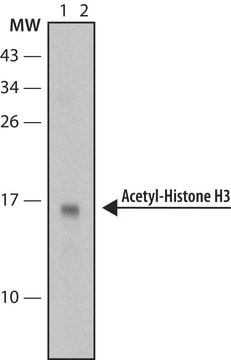
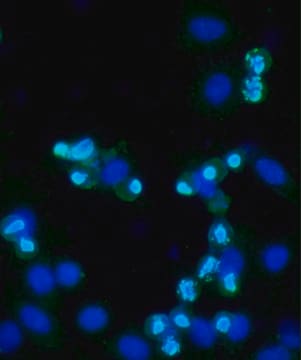
indirect immunofluorescence: 1:1,000 using NIH3T3 mouse fibroblast cell line treated with sodium butyrate, microarray: suitable, western blot: 1:1,000 using whole cell extract of the mouse fibroblast NIH3T3 cell line treated with sodium butyrate
UniProt accession no.
shipped in
dry ice
storage temp.
−20°C
target post-translational modification
acetylation (Lys9)
Gene Information
human ... H3F3A(3020), H3F3B(3021), HIST1H3A(8350), HIST1H3B(8358), HIST1H3C(8352), HIST1H3D(8351), HIST1H3E(8353), HIST1H3F(8968), HIST1H3G(8355), HIST1H3H(8357), HIST1H3I(8354), HIST1H3J(8356), HIST2H3A(333932), HIST2H3C(126961), HIST3H3(8290)
mouse ... H3f3a(15078), H3f3b(15081), Hist1h3a(360198), Hist1h3b(319150), Hist1h3c(319148), Hist1h3d(319149), Hist1h3e(319151), Hist1h3f(260423), Hist1h3g(97908), Hist1h3h(319152), Hist1h3i(319153), Hist2h3b(319154), Hist2h3c1(15077), Hist2h3c2(97114)
rat ... H3f3b(117056)
General description
Anti-acetyl-Histone H3 (Ac-Lys9) antibody produced in rabbit is suitable for:
- indirect immunofluorescence at a dilution of 1:1,000 using NIH3T3 mouse fibroblast cell line treated with sodium butyrate
- microarray
- western blot at a dilution of 1:1,000 using whole cell extract of the mouse fibroblast NIH3T3 cell line treated with sodium butyrate
Immunogen
synthetic acetylated [Ac-Lys9] histone H3 peptide (amino acids 7-20) corresponding to the N-terminus of human histone H3. The sequence is identical in many species including mouse, rat, bovine, chicken, frog, Drosophila, and C. elegans, and is highly conserved (single amino acid substitution) in Tetrahymena histone H3.
Application
Anti-acetyl-Histone H3 (Ac-Lys9) antibody produced in rabbit has been used in:
- indirect immunofluorescence
- immunoblotting
- immunohistochemistry
Biochem/physiol Actions
Histone proteins H3, H4, H2A, and H2B function as building blocks to package eukaryotic DNA into repeating nucleosome units that are folded in higher order chromatin fibers.
In most species, histone H3 is primarily acetylated at lysine 9, 14, 18, and 23. Acetylation at lysine 9 significantly influences histone deposition and chromatin assembly in some organisms. Acetylation of specific lysine residues in H3 is also associated with processes apart from transcription.
Physical form
Solution in 0.01 M phosphate buffered saline, pH 7.4, containing 15 mM sodium azide.
Disclaimer
Unless otherwise stated in our catalog or other company documentation accompanying the product(s), our products are intended for research use only and are not to be used for any other purpose, which includes but is not limited to, unauthorized commercial uses, in vitro diagnostic uses, ex vivo or in vivo therapeutic uses or any type of consumption or application to humans or animals.
1 of 1
Dieser Artikel | |||
|---|---|---|---|
| description 2-2.5 mg/mL, affinity isolated antibody, buffered aqueous solution | description clone AH3-120, purified from hybridoma cell culture | description IgG fraction of antiserum, buffered aqueous solution | description IgG fraction of antiserum, buffered aqueous solution |
| conjugate unconjugated | conjugate unconjugated | conjugate unconjugated | conjugate unconjugated |
| biological source rabbit | biological source mouse | biological source rabbit | biological source rabbit |
| Quality Level 200 | Quality Level 200 | Quality Level 200 | Quality Level 200 |
| antibody form affinity isolated antibody | antibody form purified immunoglobulin | antibody form IgG fraction of antiserum | antibody form IgG fraction of antiserum |
| technique(s) western blot: 1:1,000 using whole cell extract of the mouse fibroblast NIH3T3 cell line treated with sodium butyrate, indirect immunofluorescence: 1:1,000 using NIH3T3 mouse fibroblast cell line treated with sodium butyrate, microarray: suitable | technique(s) indirect ELISA: suitable, western blot: 1-2 μg/mL using whole cell extract of mouse fibroblasts 3T3 cell line treated with sodium butyrate, microarray: suitable, immunocytochemistry: suitable | technique(s) indirect immunofluorescence: 1:500 using human epitheloid carcinoma HeLa cell line treated with nocodazole., western blot: 1:2,000 using whole cell extract of human acute T cell leukemia Jurkat cell line treated with nocodazole., microarray: suitable | technique(s) indirect immunofluorescence: 1:250-1:500 using mouse fibroblast NIH3T3 cells, western blot: 1:2,500-1:5,000 using whole cell extract of the rat pheochromocytoma PC12 cell line, western blot: 1:5,000-1:10,000 using whole cell extract of the A431 human epidermoid carcinoma cell line or a whole cell extract of the mouse fibroblast NIH3T3 cell line |
| mol wt antigen ~17 kDa | mol wt antigen ~17 kDa | mol wt antigen 17 kDa | mol wt antigen 17 kDa |
Still not finding the right product?
Probieren Sie unser Produkt-Auswahlhilfe, um Ihre Auswahl einzugrenzen
Lagerklasse
12 - Non Combustible Liquids
wgk
nwg
flash_point_f
Not applicable
flash_point_c
Not applicable
Hier finden Sie alle aktuellen Versionen:
Besitzen Sie dieses Produkt bereits?
In der Dokumentenbibliothek finden Sie die Dokumentation zu den Produkten, die Sie kürzlich erworben haben.
-
Does this antibody (Anti-acetyl-Histone H3 (Ac-Lys9) produced in rabbit) reacts with zebrafish (Danio rerio) ?
1 answer-
Helpful?
-