Direkt zum Inhalt
Merck

Fortfahren mit

H6663

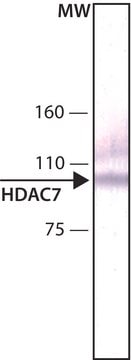
Anti-Histone Deacetylase 7 (HDAC7) antibody, Mouse monoclonal

clone HDAC7-97, purified from hybridoma cell culture

Synonym(e):

Anti-HDAC7

Anmelden zur Ansicht der Organisations- und Vertragspreise.

Größe auswählen

Ansicht ändern
Ihnen/SKUVerfügbarkeitPreis
200 μL
Warenkorb auf Verfügbarkeit prüfen
€ 564,00

Über diesen Artikel

UNSPSC Code:
12352203
NACRES:
NA.41
MDL number:
Conjugate:
unconjugated
Clone:
HDAC7-97, monoclonal
Application:
ARR, ELISA (i), ICC, IP, WB
Citations:
8

€ 564,00


Warenkorb auf Verfügbarkeit prüfen

Großbestellung anfragen
Technischer Dienst
Benötigen Sie Hilfe? Unser Team von erfahrenen Wissenschaftlern ist für Sie da.
Unterstützung erhalten


biological source

mouse

Quality Segment

conjugate

unconjugated

antibody form

purified from hybridoma cell culture

antibody product type

primary antibodies

clone

HDAC7-97, monoclonal

form

buffered aqueous solution

mol wt

antigen ~105 kDa

species reactivity

human, mouse

technique(s)

immunocytochemistry: suitable, immunoprecipitation (IP): suitable, indirect ELISA: suitable, microarray: suitable, western blot: 0.25-0.5 μg/mL using recombinant protein from embryonal kidney 293T cells over-expressing human HDAC7

isotype

IgG1

UniProt accession no.

shipped in

dry ice

storage temp.

−20°C

target post-translational modification

unmodified

Gene Information

human ... HDAC7(51564)
mouse ... Hdac7(56233)

General description

Histone deacetylases (HDACs) are competing enzymes, belonging to histone deacetylase family. There are two classes of HDACs with six to seven different types of HDACs proteins. HDAC1,HDAC2 and HDAC3 belong to Class I HDACs and HDAC4, HDAC6, and HDAC7 belong to Class II HDACs. Class I HDACs consists of a single deacetylase domain at the N-termini and diversified C-terminal regions, while Class II contains a deacetylase domain at C-terminal position. HDAC7 is predominantly found in the cell nucleus and slightly in cytoplasm. HDAC7 shuttles between these two regions and this is controlled by 14-3-3 protein and calmodulin-dependent kinase I (CaMKI)
Monoclonal Anti-Histone Deacetylase 7 (HDAC7) (mouse IgG1 isotype) is derived from the hybridoma HDAC7-97 produced by the fusion of mouse myeloma cells (NS1cells) and splenocytes from BALB/c mice. Histone deacetylases (HDACs) are part of transcriptional corepressor complexes. HDAC7 is a member of Mammalian HDAC family. It is localized mainly to the cell nucleus, it is also found in the cytoplasm.

Application

Anti-Histone Deacetylase 7 (HDAC7) antibody, Mouse monoclonal has been used in:
  • chromatin immunoprecipitation
  • immunoblotting
  • immunocytochemistry
  • immunoprecipitation
  • ELISA

Monoclonal Anti-Histone Deacetylase 7 (HDAC7) antibody produced in mouse is suitable for:
  • immunocytochemistry
  • immunoprecipitation
  • indirect ELISA
  • microarray
  • western blot at a concentration of 0.25-0.5μg/mL using cell extracts of human embryonal kidney 293T cells expressing recombinant human HDAC7

Biochem/physiol Actions

HDAC7 belongs to class II of HDAC family and combines with MEF2 group of transcription factors, which is facilitated by theN-terminal domain of HDAC7. [1] This binding blocks the transcriptional activity and prevents myogenesis. They are involved in development and differentiation processes in various tissues such as skeletal, cardiac, and smooth muscle, the bone, the immune system, the vascular system, and the brain. These signal-dependent co-repressors phosporylate at the regulatory N-terminal domain resulting in nuclear export. [1]
Shuttling of HDAC7 between the cell nucleus and the cytoplasm is controlled by a mechanism involving calmodulin dependent kinase I (CaMKI) and 14-3-3 proteins. The HDAC7 enzymatic activity depends on its interaction with the class I HDAC3, and the corepressors SMRT and N-CoR. HDAC7 also interacts with the transcriptional repressor BCL.

Physical form

Solution in 0.01 M phosphte buffered saline, pH 7.4, containing 15 mM sodium azide.

Disclaimer

Unless otherwise stated in our catalog or other company documentation accompanying the product(s), our products are intended for research use only and are not to be used for any other purpose, which includes but is not limited to, unauthorized commercial uses, in vitro diagnostic uses, ex vivo or in vivo therapeutic uses or any type of consumption or application to humans or animals.

Ähnliche Artikel vergleichen

Vollständigen Vergleich anzeigen

Unterschiede anzeigen

1 of 1

Dieser Artikel
H4538H4539H2287
Gene Information

human ... HDAC7(51564)
mouse ... Hdac7(56233)

Gene Information

human ... HDAC5(10014)
mouse ... Hdac5(15184)
rat ... Hdac5(84580)

Gene Information

human ... HDAC11(79885)
mouse ... Hdac11(232232)
rat ... Hdac11(297453)

Gene Information

human ... HDAC6(10013)
mouse ... Hdac6(15185)

clone

HDAC7-97, monoclonal

clone

HDAC5-35, monoclonal

clone

polyclonal

clone

polyclonal

conjugate

unconjugated

conjugate

unconjugated

conjugate

unconjugated

conjugate

unconjugated

species reactivity

human, mouse

species reactivity

rat, mouse, human

species reactivity

mouse, human

species reactivity

human, mouse

antibody form

purified from hybridoma cell culture

antibody form

purified from hybridoma cell culture

antibody form

affinity isolated antibody

antibody form

IgG fraction of antiserum

biological source

mouse

biological source

mouse

biological source

rabbit

biological source

rabbit


Still not finding the right product?

Probieren Sie unser Produkt-Auswahlhilfe, um Ihre Auswahl einzugrenzen


Lagerklasse

10 - Combustible liquids

wgk

nwg

flash_point_f

Not applicable

flash_point_c

Not applicable


Hier finden Sie alle aktuellen Versionen:

Analysenzertifikate (COA)

Lot/Batch Number

It looks like we've run into a problem, but you can still download Certificates of Analysis from our Dokumente section.

Wenn Sie Hilfe benötigen, wenden Sie sich bitte an Kundensupport

Besitzen Sie dieses Produkt bereits?

In der Dokumentenbibliothek finden Sie die Dokumentation zu den Produkten, die Sie kürzlich erworben haben.

Die Dokumentenbibliothek aufrufen


Questions

Reviews

No rating value

Active Filters