Direkt zum Inhalt
Merck

F2645

Anti-Factor IX antibody, Mouse monoclonal

clone HIX-1, purified from hybridma cell culture

Synonym(e):

Monoclonal Anti-Factor IX

Anmelden zur Ansicht der Organisations- und Vertragspreise.

Größe auswählen

0.2 ML

€ 508,00

€ 508,00


Warenkorb auf Verfügbarkeit prüfen
Für Ihr Target ist ein rekombinanter, konservierungsmittelfreier Antikörper verfügbar. Probieren Sie ZRB1537

Großbestellung anfragen

Über diesen Artikel

UNSPSC Code:
12352203
NACRES:
NA.41
MDL number:
Conjugate:
unconjugated
Clone:
HIX-1, monoclonal
Application:
ELISA (i), WB
Citations:
14

Fortfahren mit

Technischer Dienst
Benötigen Sie Hilfe? Unser Team von erfahrenen Wissenschaftlern ist für Sie da.
Unterstützung erhalten

biological source

mouse

conjugate

unconjugated

antibody form

purified immunoglobulin

antibody product type

primary antibodies

clone

HIX-1, monoclonal

form

buffered aqueous solution

species reactivity

human

technique(s)

indirect ELISA: suitable, western blot: 2-4 μg/mL

isotype

IgG1

UniProt accession no.

shipped in

dry ice

storage temp.

−20°C

target post-translational modification

unmodified

Quality Level

Gene Information

human ... F9(2158)

Suchen Sie nach ähnlichen Produkten? Aufrufen Leitfaden zum Produktvergleich

Ähnliche Artikel vergleichen

Vollständigen Vergleich anzeigen

Unterschiede anzeigen

1 of 4

Dieser Artikel
F1020F8146F8396
Gene Information

human ... F9(2158)

Gene Information

human ... F9(2158)

Gene Information

human ... F7(2155)

Gene Information

human ... F10(2159)

antibody form

purified immunoglobulin

antibody form

purified from hybridoma cell culture

antibody form

purified immunoglobulin

antibody form

purified immunoglobulin

conjugate

unconjugated

conjugate

unconjugated

conjugate

unconjugated

conjugate

unconjugated

species reactivity

human

species reactivity

human

species reactivity

human

species reactivity

human

clone

HIX-1, monoclonal

clone

HIX-5, monoclonal

clone

HVII-1, monoclonal

clone

HX-1, monoclonal

biological source

mouse

biological source

mouse

biological source

mouse

biological source

mouse

General description

Anti Factor IX antibody, Mouse monoclonal (mouse IgG1 isotype) is derived from the HIX-1 hybridoma produced by the fusion of mouse Sp2/0-Ag14 myeloma cells and splenocytes from BALB/c mice immunized with factor IX purified from human plasma. Factor IX concentration in human plasma ranges between 2.5-5 mg/ml and its half-life is approximately 24 hours. The human factor IX gene is about 40 Kb in size and is localized at the distal end of the X-chromosome.

Immunogen

Factor IX from pooled normal human plasma.

Application

Applications in which this antibody has been used successfully, and the associated peer-reviewed papers, are given below.
Enzyme-linked immunosorbent assay (1 paper)
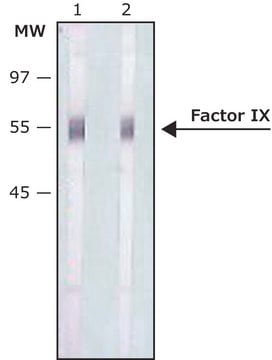
Monoclonal Anti-Factor IX antibody produced in mouse is suitable for ELISA-based assay in detection of FIX Inhibitors and it has been used as a positive control in ELISA.[1] It is also suitable for western blot at a concentration of 2-4μg/mL.

Biochem/physiol Actions

FIX plays a key role in the intrinsic and extrinsic blood coagulation systems. It is synthesized in liver and later upon activation in plasma it gets converted into a serine protease. In second step, FIX undergoes series of complex post-translation modifications such as γ-carboxylation of 12 N-terminal glutamic acid residues, N- and O-linked glycosylation, phosphorylation, β-hydroxylation, sulfation, disulfide bond formation etc. It is secreted into the plasma after completion of post-translation modifications. Hereditary deficiencies or dysfunctions of factor IX cause hemophilia B or "Christmas Disease" (the surname of the first family described). In haemophilia B, FIX showed impaired coagulation and increased tendency to bleed as a reason of mutation in the X chromosome linked FIX gene. Factor IX is synthesized in liver parenchymal cells and requires a post-translational vitamin K-dependent modification in order to become a mature plasma zymogen. When patients lack vitamin-K or take oral anticoagulants that interfere with the metabolism of vitamin-K, a hypocoagulable or antithrombotic state is induced.
Monoclonal Anti-Factor IX, a divalent cation-independent antibody, recognizes factor IX when used on immunoblots of non-denatured, non-reduced human plasma. It is also useful as paired labeled antibody in sandwich-type immunoassays with Monoclonal anti-Factor IX, clone HIX-5 (Product No. F1020).

This antibody may be used for purification of Factor IX and preparation of Factor IX depleted human plasma.

Physical form

Solution in 10 mM HEPES, pH 7.4, with 140 mM sodium chloride and 0.05% sodium azide.

Disclaimer

Unless otherwise stated in our catalog or other company documentation accompanying the product(s), our products are intended for research use only and are not to be used for any other purpose, which includes but is not limited to, unauthorized commercial uses, in vitro diagnostic uses, ex vivo or in vivo therapeutic uses or any type of consumption or application to humans or animals.

Sie haben nicht das passende Produkt gefunden?  

Probieren Sie unser Produkt-Auswahlhilfe. aus.

related product

Lagerklasse

12 - Non Combustible Liquids

wgk

nwg

flash_point_f

Not applicable

flash_point_c

Not applicable


Hier finden Sie alle aktuellen Versionen:

Analysenzertifikate (COA)

Lot/Batch Number

Die passende Version wird nicht angezeigt?

Wenn Sie eine bestimmte Version benötigen, können Sie anhand der Lot- oder Chargennummer nach einem spezifischen Zertifikat suchen.

Besitzen Sie dieses Produkt bereits?

In der Dokumentenbibliothek finden Sie die Dokumentation zu den Produkten, die Sie kürzlich erworben haben.

Die Dokumentenbibliothek aufrufen

Patricia Favaro et al.
Molecular therapy : the journal of the American Society of Gene Therapy, 17(6), 1022-1030 (2009-03-19)
The assessment of the risk of germline transmission of vector-coded sequences is critical for clinical translation of gene transfer strategies. We used rabbit models to analyze the risk of germline transmission of adeno-associated viral (AAV) vectors. Intravenous injection of AAV-2
Alex H Chang et al.
Molecular therapy : the journal of the American Society of Gene Therapy, 16(10), 1745-1752 (2008-08-07)
We have developed a lentiviral vector system for human factor IX (hFIX) gene transfer in hematopoietic stem cells (HSCs) that provides erythroid cell-derived systemic protein delivery following nonmyeloablative conditioning and in vivo methylguanine methyltransferase (MGMT) drug selection. After bone marrow
Jiamiao Lu et al.
Human gene therapy, 28(1), 125-134 (2016-12-03)
We previously developed a mini-intronic plasmid (MIP) expression system in which the essential bacterial elements for plasmid replication and selection are placed within an engineered intron contained within a universal 5' UTR noncoding exon. Like minicircle DNA plasmids (devoid of
Peter Milanov et al.
Blood, 119(2), 602-611 (2011-10-28)
The complex of the serine protease factor IX (FIX) and its cofactor, factor VIII (FVIII), is crucial for propagation of the intrinsic coagulation cascade. Absence of either factor leads to hemophilia, a disabling disorder marked by excessive hemorrhage after minor
Jun Zhang et al.
Blood, 103(1), 143-151 (2003-09-13)
The effect of neonatal gene transfer on antibody formation was determined using a retroviral vector (RV) expressing human factor IX (hFIX). Normal mice from different strains injected intravenously with RV as newborns achieved therapeutic levels of hFIX without antibody production

Verwandter Inhalt

Instructions

Questions

Reviews

No rating value

Active Filters

Unser Team von Wissenschaftlern verfügt über Erfahrung in allen Forschungsbereichen einschließlich Life Science, Materialwissenschaften, chemischer Synthese, Chromatographie, Analytik und vielen mehr..

Setzen Sie sich mit dem technischen Dienst in Verbindung