Direkt zum Inhalt
Merck

F0916

Anti-Fibronectin antibody, Mouse monoclonal

clone IST-4, purified from hybridoma cell culture

Synonym(e):

Monoclonal Anti-Fibronectin antibody produced in mouse, Anti-CIG, Anti-ED-B, Anti-FINC, Anti-FN, Anti-FNZ, Anti-GFND, Anti-GFND2, Anti-LETS, Anti-MSF, Anti-SMDCF

Anmelden zur Ansicht der Organisations- und Vertragspreise.

Größe auswählen

100 μL

€ 356,00

0.2 ML

€ 505,00

€ 356,00


Warenkorb auf Verfügbarkeit prüfen

Großbestellung anfragen

Über diesen Artikel

UNSPSC Code:
12352203
NACRES:
NA.41
MDL number:
Conjugate:
unconjugated
Clone:
IST-4, monoclonal
Application:
ELISA (i), ICC, IHC (f), IHC (p), RIA, WB
Citations:
40

Fortfahren mit

Technischer Dienst
Benötigen Sie Hilfe? Unser Team von erfahrenen Wissenschaftlern ist für Sie da.
Unterstützung erhalten

biological source

mouse

conjugate

unconjugated

antibody form

purified from hybridoma cell culture

antibody product type

primary antibodies

clone

IST-4, monoclonal

mol wt

antigen 240 kDa

contains

15 mM sodium azide

species reactivity

human

should not react with

rabbit, mouse, goat, bovine, canine, chicken

technique(s)

immunocytochemistry: 1:100 using cultured human fibroblasts, immunohistochemistry (formalin-fixed, paraffin-embedded sections): suitable, immunohistochemistry (frozen sections): suitable, indirect ELISA: suitable, radioimmunoassay: suitable, western blot: 1:500-1000 using human fibroblasts cell extract

isotype

IgG1

UniProt accession no.

shipped in

dry ice

storage temp.

−20°C

target post-translational modification

unmodified

Quality Level

Gene Information

human ... FN1(2335)

Ähnliche Artikel vergleichen

Vollständigen Vergleich anzeigen

Unterschiede anzeigen

1 of 4

Dieser Artikel
F6140SAB1405825SAB4200845
Gene Information

human ... FN1(2335)

Gene Information

human ... FN1(2335)
mouse ... Fn1(14268)

Gene Information

human ... FN1(2335)

Gene Information

-

clone

IST-4, monoclonal

clone

FN-3E2, monoclonal

clone

polyclonal

clone

IST-3

conjugate

unconjugated

conjugate

unconjugated

conjugate

unconjugated

conjugate

-

species reactivity

human

species reactivity

mouse, human, chicken

species reactivity

human

species reactivity

sheep, chicken, human, bovine, goat, dog, rabbit

biological source

mouse

biological source

mouse

biological source

mouse

biological source

-

antibody form

ascites fluid

antibody form

ascites fluid

antibody form

purified immunoglobulin

antibody form

purified from hybridoma cell culture

General description

Fibronectin (FN) is an extracellular matrix protein composed of two nearly-identical disulfide-bound polypeptides with typical molecular weights of 220-280 kDa. Cellular fibronectin is structurally and antigenically similar to cold insoluble globulin from plasma and antibodies to either form usually cross-react. Careful analysis of the FN molecule indicates that it contains several functionally and structurally distinct domains which may bind to cell surfaces and to a variety of molecules such as collagen, heparin, gelatin, fibrin and DNA. FN′s play an important role in diverse biological phenomena including cell adhesion, cell migration, hemostasis and thrombosis, wound healing and the ability to induce a more normal phenotype in transformed cells.
Fibronectin 1 is a glycoprotein of the extracellular matrix that is coded by FN1 gene. It is expressed in the plasma and at the cell surface. It is mapped to human chromosome 2q35.
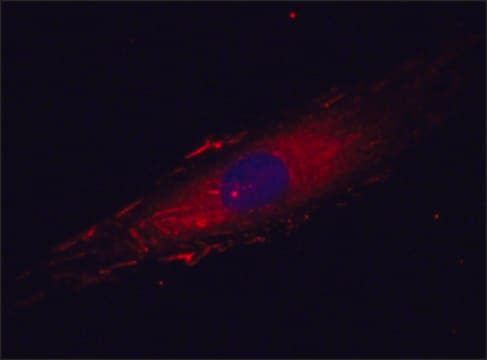
Mouse monoclonal clone IST-4 anti-Human Fibronectin antibody recognizes an epitope located within the 5th type III repeat of human plasma fibronectin. This epitope is common to all fibronectin forms. The antibody localizes plasma and cellular fibronectin both in its native and denatured-reduced forms (240 kDa) applying immunoblotting, RIA, ELISA, immunocytochemistry and immunohistochemistry. The product reacts with human fibronectin. No reactivity is observed with other species including goat, bovine, dog, rabbit, mouse and chicken.

Immunogen

human plasma fibronectin

Application

Applications in which this antibody has been used successfully, and the associated peer-reviewed papers, are given below.
Immunofluorescence (1 paper)
Immunohistochemistry (1 paper)
Western Blotting (1 paper)
Monoclonal Anti-Fibronectin antibody has been used :
  • in immunohistochemistry
  • in confocal microscopy[1]
  • in immunocytochemistry
  • western blotting analysis

Mouse monoclonal clone IST-4 anti-Human Fibronectin antibody may be used for the specific labeling of fibronectin in cultured cells and in frozen tissue sections. Staining of formalin-fixed, paraffin-embedded sections may require prolonged proteolytic unmasking (e.g., by pepsin but not by trypsin).

Biochem/physiol Actions

Fibronectin participates in growth, blood coagulation and metastasis. Mutations in FN1 results in glomerulopathy. It plays an important role in cell attachment and spreading, control of cell cytoskeleton, morphology and differentiation. FN1 is also involved in the formation of extracellular matrix.

Physical form

Solution in 0.01 M phosphate buffered saline, pH 7.4, containing 15 mM sodium azide.

Disclaimer

Unless otherwise stated in our catalog or other company documentation accompanying the product(s), our products are intended for research use only and are not to be used for any other purpose, which includes but is not limited to, unauthorized commercial uses, in vitro diagnostic uses, ex vivo or in vivo therapeutic uses or any type of consumption or application to humans or animals.

Sie haben nicht das passende Produkt gefunden?  

Probieren Sie unser Produkt-Auswahlhilfe. aus.

wgk

nwg

flash_point_f

Not applicable

flash_point_c

Not applicable

Lagerklasse

12 - Non Combustible Liquids


Hier finden Sie alle aktuellen Versionen:

Analysenzertifikate (COA)

Lot/Batch Number

Die passende Version wird nicht angezeigt?

Wenn Sie eine bestimmte Version benötigen, können Sie anhand der Lot- oder Chargennummer nach einem spezifischen Zertifikat suchen.

Besitzen Sie dieses Produkt bereits?

In der Dokumentenbibliothek finden Sie die Dokumentation zu den Produkten, die Sie kürzlich erworben haben.

Die Dokumentenbibliothek aufrufen

Clinicopathology of graft detachment after D escemet's membrane endothelial keratoplasty
Brockmann T, et al.
Acta Ophthalmologica, 92(7), e556-e561 (2014)
Francesca Di Modugno et al.
Oncogene, 37(42), 5605-5617 (2018-06-17)
We demonstrated previously that the splicing of the actin regulator, hMENA, generates two alternatively expressed isoforms, hMENA11a and hMENAΔv6, which have opposite functions in cell invasiveness. Their mechanisms of action have remained unclear. Here we report two major findings: (i)
TAZ promotes cell proliferation and epithelial-mesenchymal transition and is inhibited by the hippo pathway
Lei Q Y, et al.
Molecular and cellular biology, 28(7), 2426-2436 (2008)
Shanna A Arnold et al.
Clinical & experimental metastasis, 33(1), 29-44 (2015-10-13)
The extracellular matrix protein fibronectin (FN) contributes to the structural integrity of tissues as well as the adhesive and migratory functions of cells. While FN is abundantly expressed in adult tissues, the expression of several alternatively spliced FN isoforms is
Ryan J Nagao et al.
Journal of materials chemistry. B, 1(37), 4801-4808 (2013-10-02)
Promoting regeneration using scaffolds created by decellularizing native tissue is becoming a popular technique applied to a variety of tissues. We demonstrate a method to decellularize highly vascular tissue keeping the vascular structure intact down to the capillary scale. Using

Protokolle

TrueGel3D® Hydrogel Plate protocol guides high-throughput culture of human adipose MSCs for screening applications.

Verwandter Inhalt

Questions

  1. 해당 antibody가 rat에서 작동을 안 하는지 알고 싶습니다. human과 rat의 fibronectin을 구분할 수 있나요? I would like to know whether the antibody in question does not work in rats. Can you distinguish between human and rat fibronectin?

    1 answer
    1. This product is produced in mouse using human plasma fibronectin as an immunogen. The exact epitopes are not mapped. It specifically reacts with human fibronectin. It does not show reactivity with other species, including goat, bovine, dog, rabbit, mouse, and chicken. This antibody has not been tested on rat samples.

      According to the Literature for plasma fibronectin, as investigated by researchers, there was 91% homology between humans and rats. Based on such information, as well as the other species tested, it is unlikely that this antibody will detect rat fibronectin.
      (https://pubmed.ncbi.nlm.nih.gov/4019516/)

      Helpful?

Reviews

No rating value

Active Filters

Unser Team von Wissenschaftlern verfügt über Erfahrung in allen Forschungsbereichen einschließlich Life Science, Materialwissenschaften, chemischer Synthese, Chromatographie, Analytik und vielen mehr..

Setzen Sie sich mit dem technischen Dienst in Verbindung