
This product can be reconstituted in water at 01. mg/mL. The solubility in PBS has not been determined, but is expected to be similar. Please see the link below to review additional preparation instructions included in the product datasheet:
https://www.sigmaaldrich.com/deepweb/assets/sigmaaldrich/product/documents/272/751/d8935dat.pdf
D8935

Nidogen-1 (NID1) human
recombinant, expressed in HEK 293 cells, suitable for cell culture
Synonym(s):
Entactin, NID, NID-1, NID1
Sign In to View Organizational & Contract Pricing.
Select a Size
Change View
| Size/SKU | Availability | Price |
|---|---|---|
50 μg | Available to ship TODAYfromMILWAUKEE | $343.00 |
About This Item
NACRES:
NA.77
UNSPSC Code:
12352202
Form:
lyophilized powder
Assay:
95% (SDS-PAGE)
Recombinant:
expressed in HEK 293 cells
recombinant
expressed in HEK 293 cells
assay
95% (SDS-PAGE)
form
lyophilized powder
technique(s)
cell culture | mammalian: suitable
storage temp.
−20°C
General description
Nidogen-1 belongs to the nidogens family of glycoproteins. This family consists of nidogen-1 and nidogen-2, both of which are sulfated monomeric glycoproteins. Nidogen-1 is ubiquitously present in the synaptic and extra synaptic basal lamina. It is mapped to human chromosome 1q42.3. Nidogen-1 encodes a 139 kDa, three globular domains namely G1, G2 and G3 and has multiple epidermal growth factor repeats. Recombinant human nidogen-1 is expressed in human HEK 293 cells as a glycoprotein with a calculated molecular mass of 133.5 kDa (amino acids 29-1247). This protein is manufactured in human cells, with no serum. The human cells expression system allows human-like glycosylation and folding, and often supports higher specific activity of the protein. The protein is produced with no artificial tags.
Application
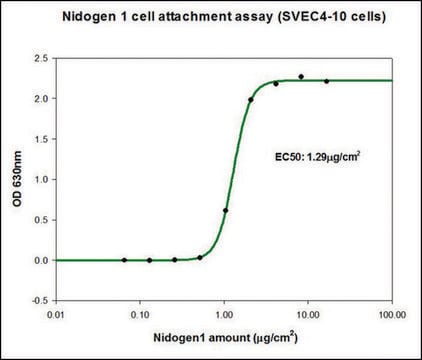
This recombinant human nidogen-1 product can be used as an attachment factor for cells adherence.
Biochem/physiol Actions
Nidogen-1 (NID-1) is thought to have an important role in the construction of basement membrane by linking between the networks of laminin and collagen IV. Genetic elimination of the nidogen-1 binding site on the mouse laminin γ1 chain leads to impaired deposition of basement membranes and hampers microvessel maturation. Nidogen 1 and 2 double knockout in mouse fibroblasts led to the loss of all major basal membrane components from the epidermal-collagen interface, and complete abolishment of hemidesmosomes. Supplementation by either recombinant nidogen-1 or -2 improved basal membrane formation. Mutations in NID1and laminin γ1 is implicated in pathogenesis of Dandy-Walker spectrum disorders.
1 of 1
This Item | |||
|---|---|---|---|
| recombinant expressed in HEK 293 cells | recombinant expressed in HEK 293 cells | recombinant expressed in HEK 293 cells | recombinant expressed in HEK 293 cells |
| assay 95% (SDS-PAGE) | assay ≥95% (SDS-PAGE) | assay ≥97% (HPLC), ≥97% (SDS-PAGE) | assay ≥95% (HPLC), ≥95% (SDS-PAGE) |
| technique(s) cell culture | mammalian: suitable | technique(s) cell culture | mammalian: suitable | technique(s) cell culture | mammalian: suitable | technique(s) cell culture | mammalian: suitable |
| form lyophilized powder | form lyophilized powder | form lyophilized | form lyophilized |
| storage temp. −20°C | storage temp. −20°C | storage temp. −20°C | storage temp. −20°C |
Storage Class
13 - Non Combustible Solids
wgk
WGK 1
flash_point_f
Not applicable
flash_point_c
Not applicable
Choose from one of the most recent versions:
Already Own This Product?
Find documentation for the products that you have recently purchased in the Document Library.
-
What is the solubility of this protein in water and PBS?
1 answer-
Helpful?
-