Direkt zum Inhalt
Merck

C5301

Monoclonal Anti-Cytokeratin Peptide 8 antibody produced in mouse

clone M20, ascites fluid

Synonym(e):

Anti-CARD2, Anti-CK-8, Anti-CK8, Anti-CYK8, Anti-K2C8, Anti-K8, Anti-KO

Anmelden zur Ansicht der Organisations- und Vertragspreise.

Größe auswählen

100 μL

€ 419,05

0.2 ML

€ 636,00

€ 419,05

Listenpreis€ 493,00Sparen Sie 15%
Aktion nur im Web

Warenkorb auf Verfügbarkeit prüfen
Für Ihr Target ist ein rekombinanter, konservierungsmittelfreier Antikörper verfügbar. Probieren Sie ZRB1688

Großbestellung anfragen

Über diesen Artikel

UNSPSC Code:
12352203
NACRES:
NA.41
MDL number:
Conjugate:
unconjugated
Clone:
M20, monoclonal
Application:
IF, IHC (f), WB
Citations:
24

Fortfahren mit

Technischer Dienst
Benötigen Sie Hilfe? Unser Team von erfahrenen Wissenschaftlern ist für Sie da.
Unterstützung erhalten

biological source

mouse

Quality Level

conjugate

unconjugated

antibody form

ascites fluid

antibody product type

primary antibodies

clone

M20, monoclonal

mol wt

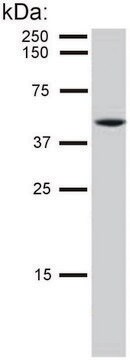
antigen 52 kDa

contains

15 mM sodium azide

species reactivity

feline, human, rabbit, canine, bovine

technique(s)

immunohistochemistry (frozen sections): suitable, indirect immunofluorescence: 1:200 using frozen sections of human or animal tissue, western blot: suitable

isotype

IgG1

UniProt accession no.

shipped in

dry ice

storage temp.

−20°C

target post-translational modification

unmodified

Gene Information

human ... KRT8(3856)

Ähnliche Artikel vergleichen

Vollständigen Vergleich anzeigen

Unterschiede anzeigen

1 of 4

Dieser Artikel
C8791C8541SAB4700777
antibody form

ascites fluid

antibody form

ascites fluid

antibody form

ascites fluid

antibody form

purified immunoglobulin

species reactivity

feline, human, rabbit, canine, bovine

species reactivity

human

species reactivity

wide range

species reactivity

sheep, pig, human, bovine

Gene Information

human ... KRT8(3856)

Gene Information

human ... KRT14(3861)

Gene Information

-

Gene Information

human ... KRT8(3856)

clone

M20, monoclonal

clone

CKB1, monoclonal

clone

CY-90, monoclonal

clone

C-51, monoclonal

conjugate

unconjugated

conjugate

unconjugated

conjugate

unconjugated

conjugate

unconjugated

biological source

mouse

biological source

mouse

biological source

mouse

biological source

mouse

General description

Cytokeratin is a 52.5kD cytoplasmic structural protein that belongs to type II, neutral-to-basic subfamily. It consists of 29 different proteins which is the characteristic of epithelial and trichocytic cells. Monoclonal anti-cytokeratin peptide 8 antibody can be used as a marker for epithelial cell differentiation as well as a tool for tumor identification and classification. It can also be used in western blotting. Mouse anti-cytokeratin peptide 8 antibody reacts specifically with various human simple and complex epithelia like- liver, intestine, pancreas, urinary bladder, salivary gland, thyroid, prostate, mesothel, and placenta but not with stratified squamous epithelia. The product also does not react with non-epithelial tissues (exceptions-certain smooth muscle cells). This product has also shown cross reactivity for cytokeratin of rabbit, cow, dog, and cat.Monoclonal Anti-Cytokeratin 8 (mouse IgG1 isotype) is derived from the M20 hybridoma produced by the fusion of mouse myeloma cells and splenocytes from BALB/c mice immunized with a cytokeratin preparation purified from the human breast carcinoma cell line MCF7.

Immunogen

cytokeratin from human breast carcinoma cell line MCF7.

Application

Monoclonal anti-cytokeratin peptide 8 antibody has been used in
  • immunofluorescence microscopy
  • immunohistochemistry
  • dot blotting
  • protein preparation from bovine epithelial cells
  • immunofluorescence[1]
  • western blotting

Biochem/physiol Actions

Monoclonal anti-cytokeratin peptide 8 antibody can be used as a marker for epithelial cell differentiation as well as a tool for tumor identification and classification. It can also be used in western blotting.
Mouse anti-cytokeratin peptide 8 antibody reacts specifically with various human simple and complex epithelia like- liver, intestine, pancreas, urinary bladder, salivary gland, thyroid, prostate, mesothel, and placenta but not with stratified squamous epithelia. The product also does not react with non-epithelial tissues (exceptions-certain smooth muscle cells). This product has also shown cross reactivity for cytokeratin of rabbit, cow, dog, and cat.

Disclaimer

Unless otherwise stated in our catalog or other company documentation accompanying the product(s), our products are intended for research use only and are not to be used for any other purpose, which includes but is not limited to, unauthorized commercial uses, in vitro diagnostic uses, ex vivo or in vivo therapeutic uses or any type of consumption or application to humans or animals.

Sie haben nicht das passende Produkt gefunden?  

Probieren Sie unser Produkt-Auswahlhilfe. aus.

related product

Lagerklasse

10 - Combustible liquids

flash_point_f

Not applicable

flash_point_c

Not applicable


Hier finden Sie alle aktuellen Versionen:

Analysenzertifikate (COA)

Lot/Batch Number

Die passende Version wird nicht angezeigt?

Wenn Sie eine bestimmte Version benötigen, können Sie anhand der Lot- oder Chargennummer nach einem spezifischen Zertifikat suchen.

Besitzen Sie dieses Produkt bereits?

In der Dokumentenbibliothek finden Sie die Dokumentation zu den Produkten, die Sie kürzlich erworben haben.

Die Dokumentenbibliothek aufrufen

Myoglobin: a promising exogenous reference marker using in proteomics analysis
Wang T, et al.
Food Science and Biotechnology, 22, 393-398 (2013)
K L Simpson et al.
Cell death & disease, 4, e613-e613 (2013-05-04)
Novel anticancer drugs targeting key apoptosis regulators have been developed and are undergoing clinical trials. Pharmacodynamic biomarkers to define the optimum dose of drug that provokes tumor apoptosis are in demand; acquisition of longitudinal tumor biopsies is a significant challenge
Mingxi Hua et al.
Journal of cell science, 125(Pt 23), 5800-5810 (2012-09-15)
The correct functioning of hepatocytes requires the establishment and maintenance of hepatocyte polarity. However, the mechanisms regulating the generation of hepatocyte polarity are not completely understood. The differentiation of human fetal hepatic progenitor cells (hFHPCs) into functional hepatocytes provides a
A Bader et al.
Differentiation; research in biological diversity, 68(1), 31-43 (2001-10-31)
In the vertebrate embryo the heart is the first organ to form. Embryonic and extra-embryonic tissues are supposed to contribute to cardiac lineage commitment before and during gastrulation in a paracrine fashion. Evidence has accumulated that factors secreted by the
L A Smith et al.
Frontiers in cell and developmental biology, 9, 667246-667246 (2021-05-25)
Various methods are currently used to investigate human tissue differentiation, including human embryo culture and studies utilising pluripotent stem cells (PSCs) such as in vitro embryoid body formation and in vivo teratoma assays. Each method has its own distinct advantages

Global Trade Item Number

SKUGTIN
C5301-.2ML04061838104373
C5301-100UL04061838030467

Questions

Reviews

No rating value

Active Filters

Unser Team von Wissenschaftlern verfügt über Erfahrung in allen Forschungsbereichen einschließlich Life Science, Materialwissenschaften, chemischer Synthese, Chromatographie, Analytik und vielen mehr..

Setzen Sie sich mit dem technischen Dienst in Verbindung