Direkt zum Inhalt
Merck

C4731

Anti-Calnexin antibody produced in rabbit

IgG fraction of antiserum, buffered aqueous solution

Synonym(e):

Anti-CNX, Anti-IP90, Anti-P90

Anmelden zur Ansicht der Organisations- und Vertragspreise.

Größe auswählen

25 μL

€ 172,00

0.2 ML

€ 512,00

€ 172,00


Warenkorb auf Verfügbarkeit prüfen
Für Ihr Target ist ein rekombinanter, konservierungsmittelfreier Antikörper verfügbar. Probieren Sie ZRB1147

Großbestellung anfragen

Über diesen Artikel

UNSPSC Code:
12352203
NACRES:
NA.44
MDL number:
Conjugate:
unconjugated
Clone:
polyclonal
Application:
ARR, IF, IP, WB
Citations:
206

Fortfahren mit

Technischer Dienst
Benötigen Sie Hilfe? Unser Team von erfahrenen Wissenschaftlern ist für Sie da.
Unterstützung erhalten

biological source

rabbit

conjugate

unconjugated

antibody form

IgG fraction of antiserum

antibody product type

primary antibodies

clone

polyclonal

form

buffered aqueous solution

mol wt

antigen 90 kDa

species reactivity

canine, rat, mouse, human

packaging

antibody small pack of 25 μL

enhanced validation

independent
Learn more about Antibody Enhanced Validation

technique(s)

immunoprecipitation (IP): 1:2,000 using whole cell RIPA lysate of the human epitheloid carcinoma HeLa cell line, indirect immunofluorescence: 1:200 using 3% paraformaldehyde-fixed, 0.5% Triton X-100 treated, Madin Darby canine kidney MDCK cell line, microarray: suitable, western blot: 1:2,000 using whole cell RIPA lysate of the human hepatocytoma HepG2 cell line

UniProt accession no.

shipped in

dry ice

storage temp.

−20°C

target post-translational modification

unmodified

Quality Level

Gene Information

human ... CANX(821)
mouse ... Canx(12330)
rat ... Canx(29144)

Verwandte Kategorien

Ähnliche Artikel vergleichen

Vollständigen Vergleich anzeigen

Unterschiede anzeigen

1 of 4

Dieser Artikel
C7617C4606C3237
conjugate

unconjugated

conjugate

unconjugated

conjugate

unconjugated

conjugate

unconjugated

Quality Level

200

Quality Level

200

Quality Level

200

Quality Level

200

biological source

rabbit

biological source

mouse

biological source

rabbit

biological source

rabbit

antibody form

IgG fraction of antiserum

antibody form

purified immunoglobulin

antibody form

IgG fraction of antiserum

antibody form

IgG fraction of antiserum

UniProt accession no.

P27824

UniProt accession no.

P27824

UniProt accession no.

P27797

UniProt accession no.

Q03135

mol wt

antigen 90 kDa

mol wt

antigen ~90 kDa

mol wt

antigen 50 kDa

mol wt

antigen 22 kDa

General description

Calnexin contains a long (461 amino acids) N-terminal Ca2+ -binding domain extending into the lumen of the endoplasmic reticulum (ER), a short (22 amino acids) transmembrane segment and an acidic cytosolic domain (96 amino acids).
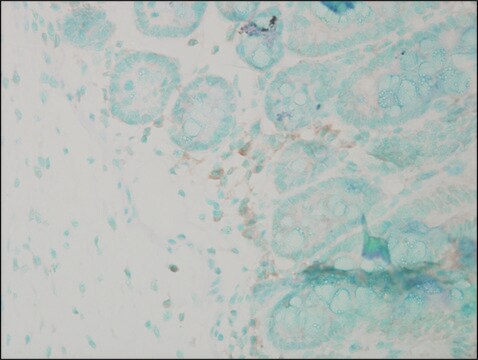
Calnexin, is a calcium binding type I integral membrane protein present mainly in the endoplasmic reticulum. It plays a pivotal role in quality control processes during protein synthesis and folding. Anti-calnexin antibody (diluted 1: 300) can be used in dual immunofluorescence staining to visualize TG2 transport.

Immunogen

Synthetic peptide corresponding to the c-terminus of human calnexin (amino acids 573-592) conjugated to KLH.

Application

Anti-Calnexin antibody produced in rabbit has been used in:
  • western blot analysis
  • immunofluorescence
  • dual immunofluorescence staining

Biochem/physiol Actions

Calnexin binds newly synthesized glycoproteins and misfolded proteins and is believed to play a critical role in quality control processes during protein synthesis and folding. Calnexin acts as a lectin-like chaperone that binds oligosaccharide residues of newly synthesized N-linked glycoproteins. Calnexin has been shown to be associated with several cell surface proteins, including major histocompatibility complex (MHC) class I heavy chain, T-cell receptor (TCR), and B cell membrane immunoglobulin during translocation through the endoplasmic reticulum (ER). It also forms complexes with other resident ER proteins involved in Ca2+ -dependent retention of proteins.
Rabbit anti-calnexin antibody reacts specifically with calnexin (90 kDa) of dog, mouse, rat and human.

Physical form

Solution in 0.01 M phosphate buffered saline, pH 7.4, containing 15 mM sodium azide.

Disclaimer

Unless otherwise stated in our catalog or other company documentation accompanying the product(s), our products are intended for research use only and are not to be used for any other purpose, which includes but is not limited to, unauthorized commercial uses, in vitro diagnostic uses, ex vivo or in vivo therapeutic uses or any type of consumption or application to humans or animals.

Sie haben nicht das passende Produkt gefunden?  

Probieren Sie unser Produkt-Auswahlhilfe. aus.

Lagerklasse

10 - Combustible liquids

wgk

WGK 2


Hier finden Sie alle aktuellen Versionen:

Analysenzertifikate (COA)

Lot/Batch Number

Die passende Version wird nicht angezeigt?

Wenn Sie eine bestimmte Version benötigen, können Sie anhand der Lot- oder Chargennummer nach einem spezifischen Zertifikat suchen.

Besitzen Sie dieses Produkt bereits?

In der Dokumentenbibliothek finden Sie die Dokumentation zu den Produkten, die Sie kürzlich erworben haben.

Die Dokumentenbibliothek aufrufen

Calnexin and calreticulin, molecular chaperones of the endoplasmic reticulum
Calreticulin, 49-62 (2003)
Quality control system of the endoplasmic reticulum and related diseases
Wu JC, et al.
Acta biochimica et biophysica Sinica, 38(4), 219-226 (2006)
Markus Düchler et al.
Cells, 8(7) (2019-07-05)
Cancer-induced immunosuppression is antigen-specific rather than systemic and the mechanisms for the antigen specificity are incompletely understood. Here we explore the option that tumor-associated antigens (TAAs) may be transferred to antigen-presenting cells (APCs), together with immunosuppressive molecules, through cancer-derived small
Valeria Uribe et al.
Human molecular genetics, 21(9), 1954-1967 (2012-01-21)
Apoptosis, or programmed cell death, is a cellular pathway involved in normal cell turnover, developmental tissue remodeling, embryonic development, cellular homeostasis maintenance and chemical-induced cell death. Caspases are a family of intracellular proteases that play a key role in apoptosis.
STARD3 or STARD3NL and VAP form a novel molecular tether between late endosomes and the ER
Alpy F, et al.
Journal of Cell Science, 126(23), 5500-5512 (2013)

Questions

Reviews

No rating value

Active Filters

Unser Team von Wissenschaftlern verfügt über Erfahrung in allen Forschungsbereichen einschließlich Life Science, Materialwissenschaften, chemischer Synthese, Chromatographie, Analytik und vielen mehr..

Setzen Sie sich mit dem technischen Dienst in Verbindung