
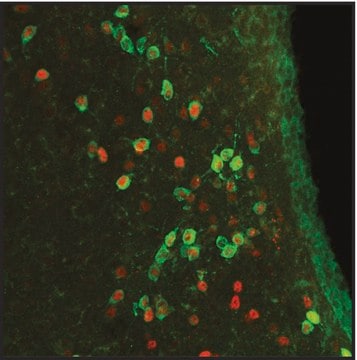

This product has not been tested for suitability in zebrafish.
Fortfahren mit
A6104

Anti-ARP2 antibody, Mouse monoclonal
clone FMS96, purified from hybridoma cell culture
Anmelden zur Ansicht der Organisations- und Vertragspreise.
Größe auswählen
Ansicht ändern
| Ihnen/SKU | Verfügbarkeit | Preis |
|---|---|---|
25 μL | Warenkorb auf Verfügbarkeit prüfen | € 168,00 € 142,80 |
200 μL | Warenkorb auf Verfügbarkeit prüfen | € 665,00 |
Über diesen Artikel
Conjugate:
unconjugated
Clone:
FMS96, monoclonal
Application:
ARR, ELISA (i), ICC, WB
Citations:
8
€ 142,80
Listenpreis€ 168,00Sparen Sie 15%Aktion nur im Web
Warenkorb auf Verfügbarkeit prüfen
Technischer Dienst
Benötigen Sie Hilfe? Unser Team von erfahrenen Wissenschaftlern ist für Sie da.
Unterstützung erhaltenbiological source
mouse
Quality Segment
conjugate
unconjugated
antibody form
purified immunoglobulin
antibody product type
primary antibodies
clone
FMS96, monoclonal
form
buffered aqueous solution
mol wt
antigen 40-45 kDa
species reactivity
mouse, human, rat, canine
packaging
antibody small pack of 25 μL
technique(s)
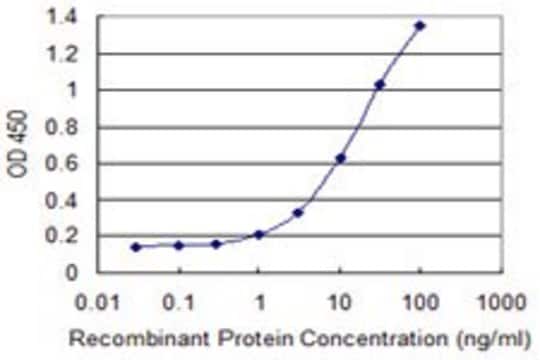
immunocytochemistry: suitable, indirect ELISA: suitable, microarray: suitable, western blot: 0.5-1 μg/mL using total cell extract of C2 mouse myoblast cells
isotype
IgG1
UniProt accession no.
shipped in
dry ice
storage temp.
−20°C
target post-translational modification
unmodified
Gene Information
human ... ACTR2(10097)
mouse ... Actr2(66713)
rat ... Actr2(289820)
General description
ARP2 is part of a complex with 7 subunits called ARP2/3. ARP2 is an actin-related protein that function to regulate the actin cytoskeleton.
Anti-ARP2 antibody, Mouse monoclonal, (mouse IgG1 isotype) is derived from the FMS96 hybridoma produced by the fusion of mouse myeloma cells (NS1 cells) and splenocytes from BALB/c mice immunized with recombinant human ARP2.
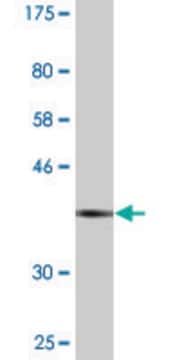
Mouse Monoclonal Anti-ARP2 antibody binds to human, canine, rat, and mouse ARP2, 40-45kDa.
Immunogen
recombinant human ARP2
Application
Anti-ARP2 antibody, Mouse monoclonal has been used in:
- Immunoblotting
- Immunocytochemistry
- Enzyme linked immuosorbent assay
Biochem/physiol Actions
Actin-related protein 2 (ARP2) is a part of ARP2/3 complex and play a key role in actin filament formation. It mediates changes in the polymerization state of actin filaments. The Wiskott-Aldrich Syndrome protein (WASP) regulates ARP2/3 complex of proteins. The ARP2/3 complex and its activator spinocerebellar ataxia, autosomal recessive 2 (Scar2) are involved in Golgi polarization in NIH 3T3 cells. However in primary astrocytes, Golgi polarization involves neither actin cytoskeleton or Arp2/3 complex nor any WASP-family of proteins. In a different model, it was found that the ARP2/3 complex was necessary for neutrophil chemotaxis and phagocytosis. By genetic and loss of function studies, it was demonstrated that Scar is the major regulator of the ARP2/3 complex rather than the WASP family of proteins, the latter having more restricted roles in specific cellular events.
Physical form
Solution in 0.01 M phosphate buffered saline, pH 7.4, containing 15 mM sodium azide.
Disclaimer
Unless otherwise stated in our catalog or other company documentation accompanying the product(s), our products are intended for research use only and are not to be used for any other purpose, which includes but is not limited to, unauthorized commercial uses, in vitro diagnostic uses, ex vivo or in vivo therapeutic uses or any type of consumption or application to humans or animals.
1 of 1
Dieser Artikel | |||
|---|---|---|---|
| species reactivity mouse, human, rat, canine | species reactivity human, mouse, rat, canine | species reactivity human | species reactivity human |
| biological source mouse | biological source mouse | biological source mouse | biological source mouse |
| clone FMS96, monoclonal | clone FMS338, monoclonal | clone 2D10, monoclonal | clone 1E5, monoclonal |
| conjugate unconjugated | conjugate unconjugated | conjugate unconjugated | conjugate unconjugated |
| antibody form purified immunoglobulin | antibody form purified immunoglobulin | antibody form purified immunoglobulin | antibody form purified immunoglobulin |
| Gene Information human ... ACTR2(10097) | Gene Information human ... ACTR3(10096) | Gene Information human ... ARPC5(10092) | Gene Information human ... ARPC4(10093) |
Still not finding the right product?
Probieren Sie unser Produkt-Auswahlhilfe, um Ihre Auswahl einzugrenzen
Lagerklasse
10 - Combustible liquids
wgk
WGK 3
flash_point_f
Not applicable
flash_point_c
Not applicable
Hier finden Sie alle aktuellen Versionen:
Besitzen Sie dieses Produkt bereits?
In der Dokumentenbibliothek finden Sie die Dokumentation zu den Produkten, die Sie kürzlich erworben haben.
-
Kann dieser Antikörper in IF-Experimenten mit Zebrafischen verwendet werden?
1 answer-
Helpful?
-