
3014-05A

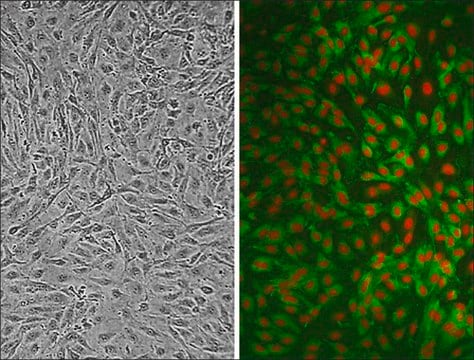
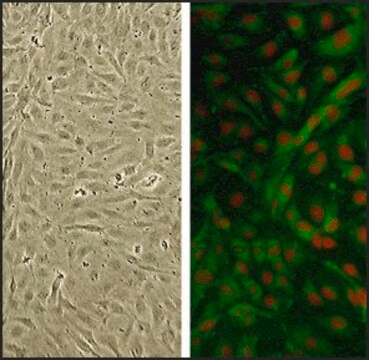
Human Carotid Artery Endothelial Cells: HCtAEC, adult
Select a Size
| Size/SKU | Availability | Price |
|---|---|---|
1 ea | Check Cart for Availability | $1,260.00 |
About This Item
$1,260.00
biological source
human carotid artery (normal)
Quality Segment
packaging
pkg of 500,000 cells
manufacturer/tradename
Cell Applications, Inc
growth mode
Adherent
karyotype
2n = 46
morphology
Endothelial
technique(s)
cell culture | mammalian: suitable
relevant disease(s)
cardiovascular diseases
shipped in
dry ice
storage temp.
−196°C
General description
HCtAEC has been used to elucidate molecular mechanisms of cerebral aneurism caused by haemodynamic (sheer) stress and inflammation, which were shown to act through PGE2-EP2 and NF-κB signaling (Aoki, 2011). Demonstrating a link between inflammation and neovascularization, serum amyloid A, a biomarker of inflammation, increased expression of TNF, F3 factor, NF-κB and VEGF leading to activated migration, wound healing and tube formation responses in HCtAEC; these pro-angiogenic activities could be prevented by pretreatment with the multi-angiokinase receptor inhibitor BIBF1120 (Cai, 2013). Additionally, CD40-CD154 signaling between endothelial cells and T cells leads to a stress response in endothelial cells via activation of NF-κB and MAPK/SAPK pathways and induces down-regulation of APLN, while at the same time activating viral immune surveillance system involving TLR3, IFIH1, RIG-I, and RNASEL (Pluvinet, 2008).
Also, HCtAEC, along with human aortic (HAOEC), brachiocephalic artery (HBcAEC), coronary artery (HCAEC) and subclavian artery (HScAEC) have been used to demonstrate that not only blood vessels from different tissues are highly heterogeneous, they also interact differently with leukocytes during the inflammation response (Scott, 2013). The authors further showed that differential N-glycosylation of commonly expressed vascular adhesion molecules may be responsible for this heterogeneity, as well as for modulation of signaling under resting and activated inflammatory conditions. This also explains why specific vascular beds may be more or less susceptible to particular diseases or stimuli. Importantly, if cells from different sources were used, these results could not be convincingly validated due to a number of uncontrolled variables, such as age, race, genetic variability or life style choices of the donors.
Because of the complex heterogeneity that exists not only between different donors, but even between different vascular beds in the same individual, it would be prudent to confirm any new findings on primary cell lots coming from several different origins.
Application
Biochem/physiol Actions
Preparation Note
- 2nd passage, >500,000 cells in Basal Medium containing 10% FBS & 10% DMSO
- Can be cultured at least 10 doublings
Other Notes
Disclaimer
1 of 1
This Item | |||
|---|---|---|---|
| growth mode Adherent | growth mode Adherent | growth mode Adherent | growth mode Adherent |
| technique(s) cell culture | mammalian: suitable | technique(s) cell culture | mammalian: suitable | technique(s) cell culture | mammalian: suitable | technique(s) cell culture | mammalian: suitable |
| biological source human carotid artery (normal) | biological source human subclavian artery (normal) | biological source human carotid artery (normal) | biological source human brachiocephalic artery (normal) |
| morphology Endothelial | morphology Endothelial | morphology - | morphology Endothelial |
| relevant disease(s) cardiovascular diseases | relevant disease(s) bipolar disorder; cardiovascular diseases; cancer | relevant disease(s) stroke; cardiovascular diseases | relevant disease(s) cardiovascular diseases |
| karyotype 2n = 46 | karyotype 2n = 46 | karyotype 23 | karyotype 2n = 46 |


Storage Class
11 - Combustible Solids
wgk
WGK 3
flash_point_f
Not applicable
flash_point_c
Not applicable
Choose from one of the most recent versions:
Already Own This Product?
Find documentation for the products that you have recently purchased in the Document Library.