Direkt zum Inhalt
Merck

ST1070

Anti-Tiam1 Rabbit pAb

liquid, Calbiochem®

Synonym(e):

Anti-T-Cell Lymphoma Invasion and Metastasis 1

Anmelden zur Ansicht der Organisations- und Vertragspreise.

Größe auswählen

Ansicht ändern

Über diesen Artikel

NACRES:
NA.41
UNSPSC Code:
12352203
Clone:
polyclonal
Species reactivity:
human, mouse
Application:
Citations:
6
Technischer Dienst
Benötigen Sie Hilfe? Unser Team von erfahrenen Wissenschaftlern ist für Sie da.
Unterstützung erhalten


biological source

rabbit

Quality Level

antibody form

affinity isolated antibody

antibody product type

primary antibodies

clone

polyclonal

form

liquid

contains

≤0.1% sodium azide as preservative

species reactivity

human, mouse

manufacturer/tradename

Calbiochem®

storage condition

OK to freeze

dilution

(Immunoblotting (1:1000))

isotype

IgG

storage temp.

2-8°C

target post-translational modification

unmodified

Gene Information

human ... TIAM1(7074)

General description

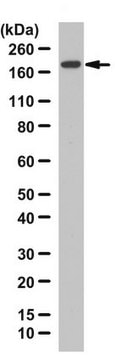
Immunoaffinity purified rabbit polyclonal antibody. Recognizes the ~200 kDa Tiam1 protein.
Recognizes the ~200 kDa Tiam1 protein in Jurkat and NIH3T3 cells.
This Anti-Tiam1 Rabbit pAb is validated for use in Immunoblotting for the detection of Tiam1.
Tiam1 (T-cell lymphoma invasion and metastasis 1) was originally identified by its ability to induce invasion by T-lymphoma cells when amplified. Tiam1 is a specific guanine nucleotide exchange factor (GEF) for the GTPase, Rac. By activating Rac1, Tiam1 regulates many cellular functions including actin cytoskeleton dynamics, cell proliferation, and cell survival. Tiam1 activity is regulated by its translocation to the membrane and the subsequent binding of its PH domain to phosphatidylinositol-3,4,5-triphosphate. Tiam1 is cleaved in a caspase-dependent manner in apoptotic cells, rendering it inactive as a result of an inability to translocate to the plasma membrane.

Immunogen

Human
a synthetic peptide corresponding to amino acids from the C-terminal domain of human Tiam1

Application

Immunoblotting (1:1000)

Packaging

Please refer to vial label for lot-specific concentration.

Physical form

In Tris-Citrate/phosphate, pH 7.0-8.0.

Preparation Note

Following initial use, aliquot and freeze (-20°C) for long-term storage. Avoid freeze/thaw cycles.

Analysis Note

Positive Control
Jurkat or NIH3T3 cells

Other Notes

Antibody should be titrated for optimal results in individual systems.
Mertens, A.E., et al. 2003. FEBS Lett.546, 11.
Qi, H., et al. 2001. Cell Growth Differ.12, 603.
Stam, J.C., et al. 1997. J. Biol. Chem.272, 28447.

Legal Information

CALBIOCHEM is a registered trademark of Merck KGaA, Darmstadt, Germany

Disclaimer

Toxicity: Highly Toxic (H)


Still not finding the right product?

Probieren Sie unser Produkt-Auswahlhilfe, um Ihre Auswahl einzugrenzen


Lagerklasse

12 - Non Combustible Liquids

wgk

WGK 1

flash_point_f

Not applicable

flash_point_c

Not applicable


Analysenzertifikate (COA)

Suchen Sie nach Analysenzertifikate (COA), indem Sie die Lot-/Chargennummer des Produkts eingeben. Lot- und Chargennummern sind auf dem Produktetikett hinter den Wörtern ‘Lot’ oder ‘Batch’ (Lot oder Charge) zu finden.

Besitzen Sie dieses Produkt bereits?

In der Dokumentenbibliothek finden Sie die Dokumentation zu den Produkten, die Sie kürzlich erworben haben.

Die Dokumentenbibliothek aufrufen


Axel Walch et al.
Modern pathology : an official journal of the United States and Canadian Academy of Pathology, Inc, 21(5), 544-552 (2008-02-05)
Rho GTPases are a family of major regulators of E-cadherin-mediated cell adhesion that are implicated in the carcinogenic process by deregulated expression of the family members itself or of upstream modulators or downstream effectors. Combined investigation of the Rho GTPase
Elena A Afanasyeva et al.
Life science alliance, 4(5) (2021-03-05)
The migrational propensity of neuroblastoma is affected by cell identity, but the mechanisms behind the divergence remain unknown. Using RNAi and time-lapse imaging, we show that ADRN-type NB cells exhibit RAC1- and kalirin-dependent nucleokinetic (NUC) migration that relies on several
Ramesh Chandra et al.
Frontiers in molecular neuroscience, 6, 13-13 (2013-06-08)
Exposure to psychostimulants results in structural and synaptic plasticity in striatal medium spiny neurons (MSNs). These cellular adaptations arise from alterations in genes that are highly implicated in the rearrangement of the actin-cytoskeleton, such as T-lymphoma invasion and metastasis 1


Global Trade Item Number

SKUGTIN
ST1070-50UG04055977224405