Direkt zum Inhalt
Merck

Fortfahren mit

MABT875

Anti-phospho-cytokeratin-18 (K18) (Ser33) Antibody, clone IB4

clone IB4, from mouse

Synonym(e):

Keratin type I cytoskeletal 18, Cell proliferation-inducing gene 46 protein, CK-18, Keratin-18, K18

Anmelden zur Ansicht der Organisations- und Vertragspreise.

Größe auswählen

Ansicht ändern
Ihnen/SKUVerfügbarkeitPreis
25 μg
Warenkorb auf Verfügbarkeit prüfen
€ 137,00
100 μg
Warenkorb auf Verfügbarkeit prüfen
€ 369,00

Über diesen Artikel

UNSPSC Code:
12352203
NACRES:
NA.43
eCl@ss:
32160702
Clone:
IB4, monoclonal
Species reactivity:
human
Application:
ICC, IF, IP, WB
Citations:
-

€ 137,00


Warenkorb auf Verfügbarkeit prüfen

Großbestellung anfragen
Technischer Dienst
Benötigen Sie Hilfe? Unser Team von erfahrenen Wissenschaftlern ist für Sie da.
Unterstützung erhalten


biological source

mouse

antibody form

purified immunoglobulin

antibody product type

primary antibodies

clone

IB4, monoclonal

species reactivity

human

packaging

antibody small pack of 25 μg

technique(s)

immunocytochemistry: suitable, immunofluorescence: suitable, immunoprecipitation (IP): suitable, western blot: suitable

isotype

IgG1κ

NCBI accession no.

UniProt accession no.

target post-translational modification

phosphorylation (pSer33)

Gene Information

human ... KRT18(3875)

General description

Keratin, type I cytoskeletal 18 (UniProt: P05783; also known as Cell proliferation-inducing gene 46 protein, Cytokeratin-18, CK-18, Keratin-18, K18) is encoded by the KRT18 (also known as CYK18, PIG46) gene (Gene ID: 3875) in human. Cytokeratin-18 is a type I, acidic, protein that is expressed in colon, placenta, and liver. Higher expression levels have been reported in lymph nodes of breast carcinoma. Cytokeratin-18 is involved in the uptake of thrombin-antithrombin complexes by hepatic cells. Upon phosphorylation, it plays a role in filament reorganization. It is proteolytically cleaved by caspases during epithelial cell apoptosis and this cleavage is shown to occur at Asp-238. Phosphorylation of cytokeratin-18 at serine 33 is shown to increase during mitosis in cultured cells and in regenerating liver. Serine 33 phosphorylation is considered to be essential for its association with 14-3-3 proteins and has a role in keratin organization and distribution. Cytokeratin-18 can undergo O-glycosylation, which results in its increased solubility and reduction in its stability. Mutations in KRT18 gene are known to cause liver cirrhosis characterized by severe panlobular liver-cell swelling with Mallory body formation, prominent pericellular fibrosis, and marked deposits of copper.
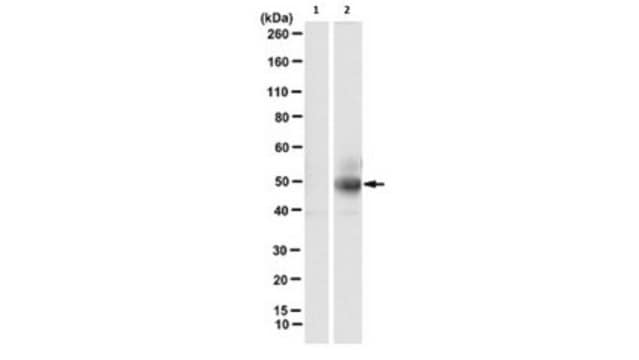
~48 kDa observed; 48.06 kDa calculated. Uncharacterized bands may be observed in some lysate(s).

Immunogen

KLH-conjugated linear peptide corresponding to 13 amino acids surrounding phosphorylated serine 33 (initiator methionine removed) from the N-terminal region of human cytokeratin-18.

Application

Anti-phospho-cytokeratin-18 (K18) (Ser33), clone IB4, Cat. No. MABT875, is a mouse monoclonal antibody that detects type I cytoskeletal-18 and has been tested for use in Immunocytochemistry, Immunofluorescence, Immunoprecipitation, and Western Blotting.
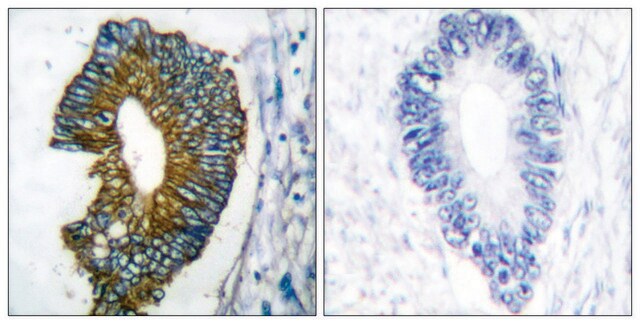
Immunocytochemistry Analysis: A representative lot detected phospho-cytokeratin-18 (K18) (Ser33) in immunocytochemistry applications (Ku, N.O., et. al. (1998). EMBO J. 17(7):1892-906).

Immunoprecipitation Analysis: A representative lot immunoprecipitated phospho-cytokeratin-18 (K18) (Ser33) in immunoprecipitation applications (Ku, N.O., et. al. (1998). EMBO J. 17(7):1892-906).

Immunofluorescence Analysis: A representative lot detected phospho-cytokeratin-18 (K18) (Ser33) in Immunofluorescence applications (Ku, N.O., et. al. (1998). EMBO J. 17(7):1892-906).

Western Blotting Analysis: A representative lot detected phospho-cytokeratin-18 (K18) (Ser33) in Western Blotting applications (Yoon, K.H., et. al. (2001). J Cell Biol. 153(3):503-16).
Research Category
Cell Structure

Biochem/physiol Actions

Clone IB4 specifically detects human cytokeratin-18 phosphorylated on serine 33.

Physical form

Format: Purified
Protein G purified
Purified mouse monoclonal antibody IgG1 in buffer containing 0.1 M Tris-Glycine (pH 7.4), 150 mM NaCl with 0.05% sodium azide.

Preparation Note

Stable for 1 year at 2-8°C from date of receipt.

Analysis Note

Evaluated by Western Blotting in lysates from HeLa cells treated with Calyculin A/Okadaic Acid.

Western Blotting Analysis: 2 µg/mL of this antibody detected phospho-cytokeratin-18 (K18) (Ser33) in lysate from HeLa cells treated with Calyculin A/Okadaic Acid.

Other Notes

Concentration: Please refer to lot specific datasheet.

Disclaimer

Unless otherwise stated in our catalog or other company documentation accompanying the product(s), our products are intended for research use only and are not to be used for any other purpose, which includes but is not limited to, unauthorized commercial uses, in vitro diagnostic uses, ex vivo or in vivo therapeutic uses or any type of consumption or application to humans or animals.

Ähnliche Artikel vergleichen

Vollständigen Vergleich anzeigen

Unterschiede anzeigen

1 of 1

Dieser Artikel
MABT844SAB4501665SAB4501663
antibody form

purified immunoglobulin

antibody form

purified antibody

antibody form

affinity isolated antibody

antibody form

affinity isolated antibody

biological source

mouse

biological source

mouse

biological source

rabbit

biological source

rabbit

clone

IB4, monoclonal

clone

L2A1, monoclonal

clone

polyclonal

clone

polyclonal

species reactivity

human

species reactivity

human

species reactivity

mouse, rat, human

species reactivity

human, rat, mouse

Gene Information

human ... KRT18(3875)

Gene Information

human ... KRT18(3875)

Gene Information

human ... KRT18(3875)

Gene Information

human ... KRT18(3875)

isotype

IgG1κ

isotype

IgGκ

isotype

-

isotype

-


Still not finding the right product?

Probieren Sie unser Produkt-Auswahlhilfe, um Ihre Auswahl einzugrenzen


Analysenzertifikate (COA)

Suchen Sie nach Analysenzertifikate (COA), indem Sie die Lot-/Chargennummer des Produkts eingeben. Lot- und Chargennummern sind auf dem Produktetikett hinter den Wörtern ‘Lot’ oder ‘Batch’ (Lot oder Charge) zu finden.

Besitzen Sie dieses Produkt bereits?

In der Dokumentenbibliothek finden Sie die Dokumentation zu den Produkten, die Sie kürzlich erworben haben.

Die Dokumentenbibliothek aufrufen


Questions

Reviews

No rating value

Active Filters