Direkt zum Inhalt
Merck

Fortfahren mit

MABS1250

Anti-Mineralocorticoid Receptor Antibody, clone 2D6

clone 2D6, from mouse

Synonym(e):

MR, Nuclear receptor subfamily 3 group C member 2, Mineralocorticoid Receptor

Anmelden zur Ansicht der Organisations- und Vertragspreise.

Größe auswählen

Ansicht ändern
Ihnen/SKUVerfügbarkeitPreis

Über diesen Artikel

UNSPSC Code:
12352203
NACRES:
NA.43
eCl@ss:
32160702
Conjugate:
unconjugated
Clone:
2D6, monoclonal
Application:
ICC, IHC, WB
Citations:
-
Preise und Verfügbarkeit sind derzeit nicht verfügbar.
Technischer Dienst
Benötigen Sie Hilfe? Unser Team von erfahrenen Wissenschaftlern ist für Sie da.
Unterstützung erhalten


biological source

mouse

Quality Segment

conjugate

unconjugated

antibody form

purified immunoglobulin

antibody product type

primary antibodies

clone

2D6, monoclonal

species reactivity

rat

technique(s)

immunocytochemistry: suitable, immunohistochemistry: suitable, western blot: suitable

isotype

IgG2aκ

NCBI accession no.

UniProt accession no.

shipped in

wet ice

target post-translational modification

unmodified

Gene Information

rat ... Nr3C2(25672)

General description

Mineralocorticoid receptor (UniProt P22199; also known as MR, Nuclear receptor subfamily 3 group C member 2) is encoded by the Nr3c2 (also known as MCR, Mlr) gene (Gene ID 25672) in rats. Mineralocorticoid receptor (MR) is expressed in multiple tissues, including renal epithelia, smooth muscle, endothelium, cardiomyocytes, and hippocampal neurons, where it mediates diverse functions. MR is activated by aldosterone and also by cortisol in cells that do not express 11β-hydroxysteroid dehydrogenase type 2 (11βHSD2). MR is normally activated by aldosterone, which is produced by adrenal glomerulosa in response to intravascular volume depletion and hyperkalemia. Consistently, gain of function mutations in MR lead to severe hypertension, often with hypokalemia, while loss of function mutations result in neonatal hypotension. Ser843 phosphorylation in the MR ligand-binding domain is reported to prevent MR ligand binding and activation. MR pS843 is found exclusively in intercalated cells of the distal nephrons in the kidney. Intravascular volume depletion, angiotensin II and WNK4 signaling reduce MR pS843 levels, whereas hyperkalemia increases MR pS843.
~107 kDa observed

Immunogen

Conjugated linear peptide corresponding to the N-terminus of rat Mineralocorticoid Receptor.
Epitope: Near N-terminus

Application

Detect Mineralocorticoid Receptor using this Anti-Mineralocorticoid Receptor Antibody, clone 2D6 validated for use in Western Blotting, Immunohistochemistry and Immunocytochemistry.
Immunohistochemistry Analysis: A representative lot detected Mineralocorticoid Receptor in hippocampus, dentate gyrate, choroid plexus, heart, and rat kidney (Gomez-Sanchez, C.E., et al. (2006). Endocrinology. 147(3):1343-1348).
Immunocytochemistry Analysis: A representative lot detected Mineralocorticoid Receptor in mouse kidney (Shibata, S., et al. (2013). Cell Metabolism. 18:660-671).
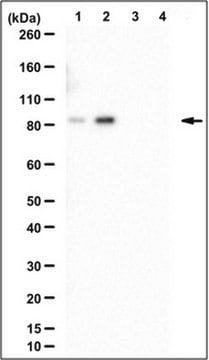
Western Blotting Analysis: A representative lot detected endogenous Mineralocorticoid Receptor (MR) in rat hippocampal cytosolic preparation and exogenously expressed EGFP-rat MR fusion protein in CHO cells (Gomez-Sanchez, C.E., et al. (2006). Endocrinology. 147(3):1343-1348).
Western Blotting Analysis: A representative lot detected endogenous Mineralocorticoid Receptor (MR) in mouse kidney cytosolic fraction and exogenously expressed human MR in COS-7 cells (Shibata, S., et al. (2013) Cell Metab. 18(5):660-671)
Research Category
Signaling
Research Sub Category
Signaling Neuroscience

Biochem/physiol Actions

Epitope is present in all 3 alternative spliced isoforms

Physical form

Format: Purified
Protein G Purified
Purified mouse monoclonal IgG2aκ in buffer containing 0.1 M Tris-Glycine (pH 7.4), 150 mM NaCl with 0.05% sodium azide.

Preparation Note

Stable for 1 year at 2-8°C from date of receipt.

Analysis Note

Evaluated by Western Blotting in rat brain cytosol tissue lysate.

Western Blotting Analysis: A 1:500 dilution of this antibody detected Mineralocorticoid Receptor in 10 µg of rat brain cytosol tissue lysate.

Other Notes

Concentration: Please refer to lot specific datasheet.

Disclaimer

Unless otherwise stated in our catalog or other company documentation accompanying the product(s), our products are intended for research use only and are not to be used for any other purpose, which includes but is not limited to, unauthorized commercial uses, in vitro diagnostic uses, ex vivo or in vivo therapeutic uses or any type of consumption or application to humans or animals.

Ähnliche Artikel vergleichen

Vollständigen Vergleich anzeigen

Unterschiede anzeigen

1 of 1

Dieser Artikel
AV45599ABS994MABE215
biological source

mouse

biological source

rabbit

biological source

rabbit

biological source

mouse

species reactivity

rat

species reactivity

human, rabbit

species reactivity

human

species reactivity

mouse

Gene Information

rat ... Nr3C2(25672)

Gene Information

human ... NR3C2(4306)

Gene Information

human ... NR3C1(2908)

Gene Information

mouse ... Nr5A2(26424)

clone

2D6, monoclonal

clone

polyclonal

clone

polyclonal

clone

1LRH-2E1, monoclonal

antibody form

purified immunoglobulin

antibody form

IgG fraction of antiserum

antibody form

affinity isolated antibody

antibody form

ascites fluid

conjugate

unconjugated

conjugate

unconjugated

conjugate

-

conjugate

unconjugated


Still not finding the right product?

Probieren Sie unser Produkt-Auswahlhilfe, um Ihre Auswahl einzugrenzen


Lagerklasse

12 - Non Combustible Liquids

wgk

WGK 1

flash_point_f

Not applicable

flash_point_c

Not applicable


Analysenzertifikate (COA)

Suchen Sie nach Analysenzertifikate (COA), indem Sie die Lot-/Chargennummer des Produkts eingeben. Lot- und Chargennummern sind auf dem Produktetikett hinter den Wörtern ‘Lot’ oder ‘Batch’ (Lot oder Charge) zu finden.

Besitzen Sie dieses Produkt bereits?

In der Dokumentenbibliothek finden Sie die Dokumentation zu den Produkten, die Sie kürzlich erworben haben.

Die Dokumentenbibliothek aufrufen


Questions

Reviews

No rating value

Active Filters