Direkt zum Inhalt
Merck

Fortfahren mit

MABF2787

Anti-SARS-CoV-2 nucleocapsid Antibody, clone 6H3-G1

Anmelden zur Ansicht der Organisations- und Vertragspreise.

Größe auswählen

Ansicht ändern
Ihnen/SKUVerfügbarkeitPreis
25 μg
Warenkorb auf Verfügbarkeit prüfen
€ 159,00
100 μg
Warenkorb auf Verfügbarkeit prüfen
€ 399,00

Über diesen Artikel

NACRES:
NA.41
UNSPSC Code:
12352203
Conjugate:
unconjugated
Clone:
6H3-G1, monoclonal
Application:
ELISA, IF, IP, WB
Citations:
-

€ 159,00


Warenkorb auf Verfügbarkeit prüfen
Für Ihr Target ist ein rekombinanter, konservierungsmittelfreier Antikörper verfügbar. Probieren Sie ZMS1075

Großbestellung anfragen
Technischer Dienst
Benötigen Sie Hilfe? Unser Team von erfahrenen Wissenschaftlern ist für Sie da.
Unterstützung erhalten


biological source

mouse

Quality Segment

conjugate

unconjugated

antibody form

purified antibody

antibody product type

primary antibodies

clone

6H3-G1, monoclonal

mol wt

calculated mol wt 45.63 kDa, observed mol wt ~53 kDa

species reactivity

virus

packaging

antibody small pack of 100 μg

technique(s)

ELISA: suitable, immunofluorescence: suitable, immunoprecipitation (IP): suitable, western blot: suitable

isotype

IgG1κ

UniProt accession no.

shipped in

dry ice

storage temp.

2-8°C

target post-translational modification

unmodified

General description

SARS-CoV-2 Nucleoprotein (UniProt: P0DTC9; also known as N, Nucleocapsid protein, NC, Protein N) is encoded by the N gene (Gene ID: 43740575) in SARS-CoV-2 virus. The SARS-CoV-2 is a positive-strand RNA virus that causes severe respiratory syndrome in human. The mature SARS-CoV-2 contains 4 structural proteins: Envelope (E), Membrane (M), Nucleocapsid (N), and the Spike protein (S). E and M proteins help in viral assembly and N protein is needed for RNA synthesis. The S protein is a single-pass type I, homotrimeric, membrane glycoprotein that is responsible for virus binding and entry into host cell. The N protein packages the positive strand viral genome RNA into a helical ribonucleocapsid (RNP) and plays a fundamental role during virion assembly through its interactions with the viral genome and membrane protein M. It plays an important role in enhancing the efficiency of subgenomic viral RNA transcription as well as viral replication. The RNA binding region of SARS-CoV-2 is localized to amino acids 41-186 and its dimerization domain is in amino acids 258-361. Lack of cysteine is one of the common features in nucleoprotein from different coronaviruses. The complete N protein of SARS-CoV and COV-2 is a highly basic with positive net charges and high pI (10.11). Its N-terminal region is more basic with positive charge, while the C-terminal region is acidic with negative charge. The middle region of nucleoprotein displays relatively higher hydrophobicity and the two termini display greater hydrophilicity. Nucleoprotein can undergo phosphorylation at multiple serines and threonines and some of these phosphorylation events are essential for RNA binding, oligomerization and localization to nucleoli. Phosphorylation is also required for recruitment of host RNA helicase DDX1 (DEAD-Box Helicase 1) that facilitates template readthrough and enables longer subgenomic mRNA synthesis. Clone 6H3-G1 shows reactivity with both SARS-CoV-2 and SARS-CoV-1.

Immunogen

His-tagged full-length nucleocapsid protein from Severe acute respiratory syndrome coronavirus 2 (SARS-CoV-2).

Application

Quality Control Testing

Evaluated by Western Blotting in lysates from HEK293T cells expressing SARS-CoV-2 Nucleocapsid protein.

Western Blotting Analysis (WB): A 1:1,000 dilution of this antibody detected Nucleocapsid protein in lysates from HEK293T cells expressing SARS-CoV-2 Nucleocapsid protein, but not in lysates from the wild type HEK293 T cells.

Tested Applications

Immunoprecipitation Analysis: A representative lot immunoprecipitated SARS-CoV-2 nucleocapsid protein. (Courtesy of Stefan Schüchner, Ingrid Mudrak, Ingrid Frohner, and Egon Ogris (Max Perutz Labs, Medical University of Vienna, Austria).

ELISA Analysis: A 1:3 dilution from a representative lot detected SARS-CoV-2 nucleocapsid protein (Courtesy of Stefan Schüchner, Ingrid Mudrak, Ingrid Frohner, and Egon Ogris (Max Perutz Labs, Medical University of Vienna, Austria).

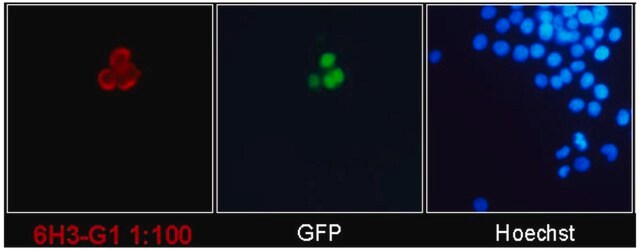
Immunofluorescence Analysis: A 1:100 dilution from a representative lot detected SARS-CoV-2 nucleocapsid in HeLa cells transiently transfected with SARS-CoV-2 NC-P2A-GFP (Courtesy of Stefan Schüchner, Ingrid Mudrak, Ingrid Frohner, and Egon Ogris (Max Perutz Labs, Medical University of Vienna, Austria).

Western Blotting Analysis: A 1:1,000 dilution from a representative lot detected SARS-CoV-2 nucleocapsid protein in whole cell lysates of HEK293T cells expressing the nucleocapsid (NC) proteins of various human coronaviruses (Courtesy of Stefan Schüchner, Ingrid Mudrak, Ingrid Frohner, and Egon Ogris (Max Perutz Labs, Medical University of Vienna, Austria).

Note: Actual optimal working dilutions must be determined by end user as specimens, and experimental conditions may vary with the end user
Anti-SARS-CoV-2 nucleocapsid, clone 6H3-G1, Cat. No. MABF2787, is a mouse monoclonal antibody that detects Nucleoprotein of SARS-CoV-2 virus and is tested for use in ELISA, Immunofluorescence, Immunoprecipitation, and Western Blotting.

Biochem/physiol Actions

Clone 6H3-G1 is a mouse monoclonal antibody that detects nucleocapsid protein of Severe acute respiratory syndrome coronavirus 2 (SARS-CoV-2). It targets an epitope within the C-terminal domain. It also detects nucleoprotein of SARS-CoV-1.

Physical form

Purified mouse monoclonal antibody IgG1 in buffer containing 0.1 M Tris-Glycine (pH 7.4), 150 mM NaCl with 0.05% sodium azide.

Preparation Note

Recommend storage at +2°C to +8°C. For long term storage antibodies can be kept at -20°C. Avoid repeated freeze-thaws.

Other Notes

Concentration: Please refer to the Certificate of Analysis for the lot-specific concentration.

Disclaimer

Unless otherwise stated in our catalog or other company documentation accompanying the product(s), our products are intended for research use only and are not to be used for any other purpose, which includes but is not limited to, unauthorized commercial uses, in vitro diagnostic uses, ex vivo or in vivo therapeutic uses or any type of consumption or application to humans or animals.

Ähnliche Artikel vergleichen

Vollständigen Vergleich anzeigen

Unterschiede anzeigen

1 of 1

Dieser Artikel
MABF2788MABF2815MABF2784
biological source

mouse

biological source

mouse

biological source

mouse

biological source

mouse

species reactivity

virus

species reactivity

virus

species reactivity

virus

species reactivity

SARS coronavirus

conjugate

unconjugated

conjugate

unconjugated

conjugate

unconjugated

conjugate

unconjugated

clone

6H3-G1, monoclonal

clone

7B10-3E4, monoclonal

clone

6C2-G9, monoclonal

clone

6E4-C5, monoclonal

antibody form

purified antibody

antibody form

purified antibody

antibody form

purified antibody

antibody form

purified antibody

mol wt

calculated mol wt 45.63 kDa, observed mol wt ~53 kDa

mol wt

calculated mol wt 45.63 kDa, observed mol wt ~50 kDa

mol wt

calculated mol wt 141.18 kDa, observed mol wt ~200 kDa

mol wt

calculated mol wt 141.18 kDa, observed mol wt ~200 kDa


Still not finding the right product?

Probieren Sie unser Produkt-Auswahlhilfe, um Ihre Auswahl einzugrenzen


Lagerklasse

12 - Non Combustible Liquids

wgk

WGK 1

flash_point_f

Not applicable

flash_point_c

Not applicable


Analysenzertifikate (COA)

Suchen Sie nach Analysenzertifikate (COA), indem Sie die Lot-/Chargennummer des Produkts eingeben. Lot- und Chargennummern sind auf dem Produktetikett hinter den Wörtern ‘Lot’ oder ‘Batch’ (Lot oder Charge) zu finden.

Besitzen Sie dieses Produkt bereits?

In der Dokumentenbibliothek finden Sie die Dokumentation zu den Produkten, die Sie kürzlich erworben haben.

Die Dokumentenbibliothek aufrufen


Questions

Reviews

No rating value

Active Filters