Direkt zum Inhalt
Merck

Fortfahren mit

MABC1824

Anti-phospho-MYO10 (Ser1060/1062/1066) Antibody, clone 2C10-6

Synonym(e):

Unconventional myosin-10, Unconventional myosin-X

zur Ansicht der Organisations- und Vertragspreise.

Größe auswählen

Ansicht ändern
Ihnen/SKUVerfügbarkeitPreis

Über diesen Artikel

NACRES:
NA.41
UNSPSC Code:
12352203
Conjugate:
unconjugated
Clone:
2C10-6, monoclonal
Application:
ICC, WB
Citations:
-
Preise und Verfügbarkeit sind derzeit nicht verfügbar.
Technischer Dienst
Benötigen Sie Hilfe? Unser Team von erfahrenen Wissenschaftlern ist für Sie da.
Unterstützung erhalten


biological source

mouse

Quality Segment

conjugate

unconjugated

antibody form

purified antibody

antibody product type

primary antibodies

clone

2C10-6, monoclonal

mol wt

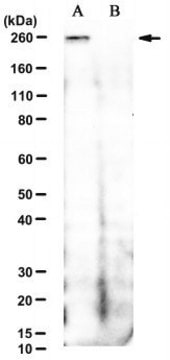
calculated mol wt 237.35 kDa, observed mol wt ~260 kDa

purified by

using protein G

species reactivity

human

packaging

antibody small pack of 100 μL

technique(s)

immunocytochemistry: suitable, western blot: suitable

isotype

IgG1κ

epitope sequence

Unknown

Protein ID accession no.

UniProt accession no.

storage temp.

2-8°C

target post-translational modification

phosphorylation (pSer1060/pSer1062/pSer1066
pSer1060/pSer1062/pSer1066)

Gene Information

human ... MYO10(4651)

General description

Unconventional myosin-X (UniProt: Q9HD67; also known as Unconventional myosin-10, MYO10) is encoded by the MYO10 (also known as KIAA0799) gene (Gene ID:4651) in human. Myosins are highly conserved, ubiquitously expressed proteins that form regular bipolar thick filaments that together with actin thin filaments constitute the fundamental contractile unit of skeletal and cardiac muscle. Along with actin they serve as motor molecules with ATPase activity that is essential for muscle contraction. MYO10, a multi-domain protein, is ubiquitously expressed and is present as a monomer in the cytosol in an inactive conformation. However, it is homodimeric in its active, membrane-bound conformation. It interacts strongly with calmodulin 3 (CALM3) and this interaction is essential for its function in filopodial extension and motility. It contains a MyTH4 and an FERM domain at its C-terminal, which are required for its binding to tubulin and β-integrin, respectively. The N-terminal region contains a sequence (aa 619-641) that is required for its bind to actin. Its myosin motor domain is localized in amino acids 63-739. MYO10 is reported to promote tumor growth through inducing genomic instability and chronic inflammation in cancer cells. It regulates genomic instability, at least partially, through mediating mitotic progression. MYO10 is reported to contain a Degron motif, a short stretch of amino acids that drives the degradation of unstable protein. In addition, phosphorylation of serine residues in MYO10 (serine 1060, 1062, 1066) drives its β-TrCP1-dependent degradation. Phosphorylated form of MYO10 is shown to be less stable. Degron mutation are reported to abolish MYO10 phosphorylation, degradation, and mitotic regulation. Cancer cells expressing high levels or stabilized MYO10 display higher sensitivity to Taxol. Deletion of Degron motif results in complete stability of MYO10. (Ref.: Pozo, MF., et al. (2023). Cell Rep. 42(5); 112531; Pozo, MF., et al. (2021). Sci Adv. 7(38); eabg6908).

Immunogen

KLH-conjugated linear peptide corresponding to 13 amino acids surrounding phosphoserines 1060, 1062, and 1066 from human MYO10.

Application

Quality Control Applications

Evaluated by Western Blotting in lysate U20S cells transfected with GFP-MYO10.

Western Blotting Analysis (WB): A 1:250 dilution of this antibody detected phospho-MYO10 (Ser 1060/1062/1066) in U20S cells stably transfected with GFP-MYO10, but not in lysate from cells with MYO10 knockout.

Tested applications

Immunocytochemistry Analysis: A representative lot detected p-MYO10 (Ser1060/1062/1066) in Immunocytochemistry application (Pozo, F. M., et al. (2021). Sci Adv. 7(38); eabg6908).

Western Blotting Analysis: A representative lot detected p-MYO10 (Ser1060/1062/1066) in Western Blotting application (Pozo, F. M., et al. (2021). Sci Adv. 7(38); eabg6908).

Note: Actual optimal working dilutions must be determined by end user as specimens, and experimental conditions may vary with the end user.

Biochem/physiol Actions

Clone 2C10-6 is a mouse monoclonal antibody that detects MY10 phosphorylated on serine 1060, 1062, and 1066.

Physical form

Purified mouse monoclonal antibody IgG1 in buffer containing 0.1 M Tris-Glycine (pH 7.4), 150 mM NaCl with 0.05% sodium azide.

Preparation Note

Recommended storage: +2°C to +8°C.

Other Notes

Concentration: Please refer to the Certificate of Analysis for the lot-specific concentration.

Disclaimer

Unless otherwise stated in our catalog or other company documentation accompanying the product(s), our products are intended for research use only and are not to be used for any other purpose, which includes but is not limited to, unauthorized commercial uses, in vitro diagnostic uses, ex vivo or in vivo therapeutic uses or any type of consumption or application to humans or animals.

Ähnliche Artikel vergleichen

Vollständigen Vergleich anzeigen

Unterschiede anzeigen

1 of 1

Dieser Artikel
HPA024223HPA021252SAB1307259
species reactivity

human

species reactivity

mouse, human

species reactivity

human

species reactivity

human

biological source

mouse

biological source

rabbit

biological source

rabbit

biological source

rabbit

clone

2C10-6, monoclonal

clone

polyclonal

clone

polyclonal

clone

polyclonal

conjugate

unconjugated

conjugate

unconjugated

conjugate

unconjugated

conjugate

-

antibody form

purified antibody

antibody form

affinity isolated antibody

antibody form

affinity isolated antibody

antibody form

affinity isolated antibody

storage temp.

2-8°C

storage temp.

−20°C

storage temp.

−20°C

storage temp.

−20°C


Still not finding the right product?

Probieren Sie unser Produkt-Auswahlhilfe, um Ihre Auswahl einzugrenzen


Lagerklasse

13 - Non Combustible Solids

wgk

WGK 1


Analysenzertifikate (COA)

Suchen Sie nach Analysenzertifikate (COA), indem Sie die Lot-/Chargennummer des Produkts eingeben. Lot- und Chargennummern sind auf dem Produktetikett hinter den Wörtern ‘Lot’ oder ‘Batch’ (Lot oder Charge) zu finden.

Besitzen Sie dieses Produkt bereits?

In der Dokumentenbibliothek finden Sie die Dokumentation zu den Produkten, die Sie kürzlich erworben haben.

Die Dokumentenbibliothek aufrufen


Questions

Reviews

No rating value

Active Filters