Direkt zum Inhalt
Merck

Fortfahren mit

MABC1120

Anti-PD-L2 Antibody, clone 366C.9E5

clone 366C.12.9E5.E10.19.1F8, from mouse

Synonym(e):

Programmed cell death 1 ligand 2, PD-1 ligand 2, PDCD1 ligand 2, Programmed death ligand 2, Butyrophilin B7-DC, B7-DC, CD273

Anmelden zur Ansicht der Organisations- und Vertragspreise.

Größe auswählen

Ansicht ändern
Ihnen/SKUVerfügbarkeitPreis
25 μg
Warenkorb auf Verfügbarkeit prüfen
€ 160,00
100 μg
Warenkorb auf Verfügbarkeit prüfen
€ 419,00

Über diesen Artikel

UNSPSC Code:
12352203
NACRES:
NA.43
eCl@ss:
32160702
Conjugate:
unconjugated
Clone:
366C.12.9E5.E10.19.1F8, monoclonal
Application:
IHC
Citations:
1

€ 160,00


Warenkorb auf Verfügbarkeit prüfen

Sonderanfertigung anfragen
Technischer Dienst
Benötigen Sie Hilfe? Unser Team von erfahrenen Wissenschaftlern ist für Sie da.
Unterstützung erhalten


biological source

mouse

Quality Segment

conjugate

unconjugated

antibody form

purified immunoglobulin

antibody product type

primary antibodies

clone

366C.12.9E5.E10.19.1F8, monoclonal

species reactivity

human

packaging

antibody small pack of 25 μg

technique(s)

immunohistochemistry: suitable (paraffin)

isotype

IgG1κ

NCBI accession no.

UniProt accession no.

target post-translational modification

unmodified

Gene Information

human ... PDCD1LG2(80380)

General description

30.96 kDa calculated.
Programmed cell death 1 ligand 2 (UniProt: Q9BQ51; also known as PD-1 ligand 2, PD-L2, PDCD1 ligand 2, Programmed death ligand 2, Butyrophilin B7-DC, B7-DC, CD273) is encoded by the PDCD1LG2 (also known as B7DC, CD273, PDCD1L2, PDL2) gene (Gene ID: 80380) in human. Three isoforms of PD-L2 have been reported that are produced by alternative splicing. Isoforms 1 and 2 are single-pass type I membrane proteins and isoform 3 is a secreted protein. PD-1 and PD-1 ligands 1 and 2 (PD-L1 and PD-L2) are B7:CD28 family members that regulate T cell activation and peripheral tolerance. When engaged together with the TCR, the interaction of PD-1 with its ligands delivers an inhibitory signal to T cell proliferation and cytokine production. While PD-L1 is broadly expressed in hematopoietic and non-hematopoietic cells, PD-L2 expression is highly restricted to antigen presenting cells (APCs), including dendritic cells (DCs) and macrophages. The PD-1 pathway plays a key role in the progressive loss of effector T cell responses during chronic HIV infection. Under some conditions, blockade of this pathway can restore many T cell functions. PD-L2 is initially produced with signal peptide (aa 1-19) that is removed to produce the mature protein that contains a large extracellular region (aa. 20-220), a transmembrane domain (aa 221-241), and a cytoplasmic tail (aa 242-273).

Immunogen

Epitope: extracellular domain
Recombinant protein fragment corresponding to the extracellular domain of human PD-L2 (as an Ig fusion protein).

Application

Anti-PD-L2, clone 366C.9E5, Cat. No. MABC1120, is a mouse monoclonal antibody that detects Programmed cell death 1 ligand 2 (PD-L2) and has has been tested for use in Immunohistochemistry (Paraffin).
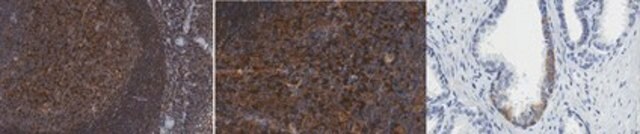
Immunohistochemistry Analysis: A 1:250 dilution from a representative lot detected PD-L2 in human prostate tissue.

Immunohistochemistry Analysis: A representative lot detected PD-L2 in Immunohistochemistry applications (Sridharan, V., et. al. (2016). Cancer Immunol Res. 4(8):679-87; Roemer, M.G., et. al. (2016). J Clin Oncol. 34(23):2690-7; Chong, L.C., et. al. (2016). Blood. 128(9):1206-13; Calles, A., et. al. (2015). J Thorac Oncol. 10(12):1726-35).
Research Category
Apoptosis & Cancer

Biochem/physiol Actions

Clone 366C.12.9E5.E10.19.1F8 specifically detects PD-L2 in human cells. It targets an epitope within the extracellular domain.

Physical form

Format: Purified
Protein G purified
Purified mouse monoclonal antibody IgG1 in buffer containing 0.1 M Tris-Glycine (pH 7.4), 150 mM NaCl with 0.05% sodium azide.

Preparation Note

Stable for 1 year at 2-8°C from date of receipt.

Analysis Note

Evaluated by Immunohistochemistry (Paraffin) in human tonsil tissue.

Immunohistochemistry Analysis: A 1:250 dilution of this antibody detected PD1-L2 in human tonsil tissue.

Other Notes

Concentration: Please refer to lot specific datasheet.

Disclaimer

Unless otherwise stated in our catalog or other company documentation accompanying the product(s), our products are intended for research use only and are not to be used for any other purpose, which includes but is not limited to, unauthorized commercial uses, in vitro diagnostic uses, ex vivo or in vivo therapeutic uses or any type of consumption or application to humans or animals.

Ähnliche Artikel vergleichen

Vollständigen Vergleich anzeigen

Unterschiede anzeigen

1 of 1

Dieser Artikel
MABC991MABC1115MABC980
clone

366C.12.9E5.E10.19.1F8, monoclonal

clone

10F.9G2, monoclonal

clone

5H1, monoclonal

clone

29E.2A3.C6, monoclonal

Gene Information

human ... PDCD1LG2(80380)

Gene Information

-

Gene Information

human ... CD274(29126)

Gene Information

human ... CD274(29126)

antibody form

purified immunoglobulin

antibody form

purified antibody

antibody form

purified immunoglobulin

antibody form

purified immunoglobulin

conjugate

unconjugated

conjugate

unconjugated

conjugate

unconjugated

conjugate

unconjugated

biological source

mouse

biological source

rat

biological source

mouse

biological source

mouse

species reactivity

human

species reactivity

mouse

species reactivity

human

species reactivity

rat, chimpanzee, human


Still not finding the right product?

Probieren Sie unser Produkt-Auswahlhilfe, um Ihre Auswahl einzugrenzen


Analysenzertifikate (COA)

Suchen Sie nach Analysenzertifikate (COA), indem Sie die Lot-/Chargennummer des Produkts eingeben. Lot- und Chargennummern sind auf dem Produktetikett hinter den Wörtern ‘Lot’ oder ‘Batch’ (Lot oder Charge) zu finden.

Besitzen Sie dieses Produkt bereits?

In der Dokumentenbibliothek finden Sie die Dokumentation zu den Produkten, die Sie kürzlich erworben haben.

Die Dokumentenbibliothek aufrufen


Questions

Reviews

No rating value

Active Filters