
ABT1387

Anti-Phospho-Lamin A/C (Ser404)
from rabbit
Synonym(e):
Prelamin A/C, Renal carcinoma antigen NY-REN-32
Größe auswählen
| Größe/SKU | Verfügbarkeit | Preis |
|---|---|---|
200 μL | Warenkorb auf Verfügbarkeit prüfen | € 419,00 |
Über diesen Artikel
€ 419,00
biological source
rabbit
antibody form
affinity isolated antibody
antibody product type
primary antibodies
clone
polyclonal
species reactivity
human
technique(s)
immunofluorescence: suitable, inhibition assay: suitable (peptide), western blot: suitable
isotype
IgG
NCBI accession no.
UniProt accession no.
target post-translational modification
phosphorylation (pSer404)
Gene Information
human ... LMNA(4000)
General description
Is cleaved to generate Lamin A/C. Farnesylation of prelamin-A/C facilitates nuclear envelope targeting and subsequent cleavage by ZMPSTE24/FACE1 to remove the farnesyl group produces mature Lamin-A/C that is inserted into the nuclear lamina. Lamin A and C are present in equal amounts in the lamina of mammals and they play an important role in nuclear assembly, chromatin organization, nuclear membrane and telomere dynamics. Lamins are shown to be essential for normal development of peripheral nervous system and skeletal muscle and for muscle satellite cell proliferation. Lamins also prevent fat infiltration of muscle and bone marrow, helping to maintain the volume and strength of skeletal muscle and bone. Phosphorylation of Lamins is reported to occur continuously throughout all interphase periods and takes place mainly on the assembled lamina. Phosphorylation of the major polypeptides of the lamina induces laminar disassembly during mitosis. Phosphorylated Lamin-A/C localizes to nucleoplasm. Lamin A/C undergoes phosphorylation at multiple sites and one of the best characterized phosphorylation sites is on Serine 22 and it is phosphorylated during interphase. Phosphorylation of Serine 22 stabilizes Lamin A/C. Overexpression of Lamin-A is shown to result in greater phosphorylation of Serine 22 and 390 and Lamin A/C knockdowns display reduced phosphorylation at both sites, which helps in maintaining the integrity of the diminished lamina. Lamin A/C can undergoes phosphorylation on Serine 404 by Akt1 and Ser4040 phosphorylated Lamin undergoes rapid lysosomal degradation. Mutations in LMNA gene can cause Emery-Dreifuss muscular dystrophy 2 and 3, which are characterized by weakness and atrophy of muscle without involvement of the nervous system and cardiac conduction defects. Some mutations have also been linked to familial Lipodystrophy that leads to the loss of subcutaneous adipose tissue in the lower parts of the body and accumulation of adipose tissue in the face and neck. (Ref.: Buxboim, A., et al. (2014). Curr. Biol. 24(16): 1909-1917; Toker, A., and Marmiroli, S. (2014). Adv. Biol. Regul. 55: 28-38).
Immunogen
Application
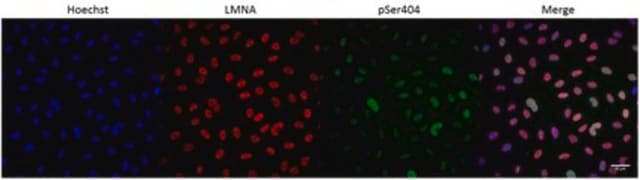
Peptide Inhibition Analysis: A 1:500 dilution from a representative lot was used with A549 cells (specific for Lamin A/C phosphorylation) for peptide block analysis.
Cell Structure
Biochem/physiol Actions
Physical form
Preparation Note
Analysis Note
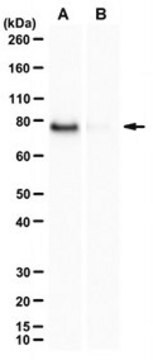
Western Blotting Analysis: A 1:500 dilution of this antibody detected Phospho-Lamin A/C (Ser404) in A549 cells (specific for Lamin A/C phosphorylation).
Other Notes
Disclaimer
1 of 1
Dieser Artikel | |||
|---|---|---|---|
| description from rabbit | description clone 4C11, from mouse | description affinity isolated antibody, buffered aqueous glycerol solution | description - |
| biological source rabbit | biological source mouse | biological source rabbit | biological source rat |
| antibody form affinity isolated antibody | antibody form purified immunoglobulin | antibody form affinity isolated antibody | antibody form purified antibody |
| species reactivity human | species reactivity human, monkey, Syrian hamster, rat, mouse | species reactivity human | species reactivity mouse |
| clone polyclonal | clone 4C11, monoclonal | clone polyclonal | clone 3C8, monoclonal |
| UniProt accession no. | UniProt accession no. | UniProt accession no. | UniProt accession no. |
| technique(s) inhibition assay: suitable (peptide), immunofluorescence: suitable, western blot: suitable | technique(s) ChIP: suitable, immunoprecipitation (IP): suitable, western blot: suitable, immunofluorescence: suitable | technique(s) immunoblotting: 0.04-0.4 μg/mL, immunohistochemistry: 1:50-1:200 | technique(s) immunofluorescence: suitable, western blot: suitable, immunocytochemistry: suitable, immunohistochemistry (frozen sections): suitable |
Still not finding the right product?
Probieren Sie unser Produkt-Auswahlhilfe, um Ihre Auswahl einzugrenzen
Lagerklasse
12 - Non Combustible Liquids
wgk
WGK 1
flash_point_f
Not applicable
flash_point_c
Not applicable
Hier finden Sie alle aktuellen Versionen:
Besitzen Sie dieses Produkt bereits?
In der Dokumentenbibliothek finden Sie die Dokumentation zu den Produkten, die Sie kürzlich erworben haben.