Saltar al contenido
Merck

Saltar a

A7054

ACCUSPIN System-Histopaque®-1077

sterile-filtered, density: 1.077 g/mL

Iniciar sesión para ver los precios por organización y contrato.

Seleccione un Tamaño

Cambiar Vistas
A ustedes/SKUDisponibilidadPrecio
12 x 15 mL
Comprobar disponibilidad del carrito
US$ 882,00

Acerca de este artículo

UNSPSC Code:
12352207
NACRES:
NA.75
MDL number:

US$ 882,00

PRECIOS SIN IMPUESTOS NACIONALES

Comprobar disponibilidad del carrito

Solicita un pedido personalizado
Servicio técnico
¿Necesita ayuda? Nuestro equipo de científicos experimentados está aquí para ayudarle.
Permítanos ayudarle


Quality Segment

sterility

aseptically filled

form

solution

shelf life

Expiry date on the label.

packaging

pkg of package 12 tubes

technique(s)

cell culture | mammalian: suitable

density

1.077 g/mL

application(s)

hematology
histology

storage temp.

2-8°C

General description

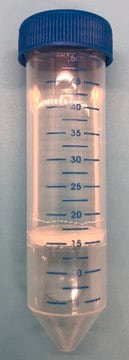
ACCUSPIN System-Histopaque-1077 products are intended for use in the isolation of lymphocytes and other mononuclear cells. The separation medium, Histopaque-1077, is a sterile-filtered, endotoxin-tested solution of polysucrose and sodium diatrizoate, adjusted to a density of 1.077 g/mL. ACCUSPIN System-HISTOPAQUE-1077 employs γ-irradiated 50 mL polypropylene centrifuge tubes specially designed with two chambers separated by a porous high-density polyethylene barrier ("frit"). Each tube is aseptically filled with 15 mL of Histopaque 1077. Each tube will separate 15-30 mL of anticoagulated blood.

Application

ACCUSPIN System-HISTOPAQUE-1077 employs centrifuge tubes specially designed with two chambers separated by a porous high-density polyethylene barrier ("frit"). The lower chamber contains HISTOPAQUE-1077 which allows the addition of anticoagulated whole blood without risk of mixing with the separation medium. On centrifugation, the whole blood descends through the frit to contact with the HISTOPAQUE-1077 below the frit, giving a clear separation of the blood components. The erythrocytes aggregate and the granulocytes become slightly hypertonic, increasing their sedimentation rate, resulting in pelleting at the bottom of the ACCUSPIN tube. Lymphocytes and other mononuclear cells, i.e., monocytes, remain at the plasma-HISTOPAQUE-1077 interface.
ACCUSPIN System-Histopaque-1077 is used for the separation of lymphocytes and other mononuclear cells from whole blood and bone marrow using density gradient separation media. [1]Histopaque-1077 has been used for:

  • human lymphocyte antigen (HLA) typing
  • initial isolation step prior to the enumeration of T, B, and ‘null’ lymphocytes.
  • preparation of pure lymphocyte suspensions for cell culture and cytotoxicity assays.
  • isolation and purification of peripheral blood mononuclear cells (PBMCs) and bone marrow mononuclear cells (BMMCs)citation
  • isolation of human lymphocytescitation
  • isolation of breast cancer circulating tumor cells (CTCs) from the whole bloodcitation

Biochem/physiol Actions

The lower chamber contains HISTOPAQUE-1077 which allows the addition of anticoagulated whole blood without risk of mixing with the separation medium. On centrifugation, the whole blood descends through the frit to contact with the HISTOPAQUE-1077 below the frit, giving a clear separation of the blood components. The erythrocytes aggregate and the granulocytes become slightly hypertonic, increasing their sedimentation rate, and resulting in pelleting at the bottom of the ACCUSPIN tube. Lymphocytes and other mononuclear cells, i.e., monocytes, remain at the plasma-HISTOPAQUE-1077 interface.

Features and Benefits

ACCUSPIN System-Histopaque®-1077 offers numerous advantages, such as:
  • Optimal recovery of viable cells
  • Permits selective separation of blood cell types
  • Prevents cell distortion
  • Preserves cell viability
  • Minimal extraneous cell interference
  • Reproducible performance from batch to batch
  • Histopaque is sterile-filtered and endotoxin-tested
  • Stable at 2-8°C for at least 2 years when protected from light

Preparation Note

Package contains 12 prefilled tubes

Legal Information

Accuspin is a trademark of Sigma-Aldrich Co. LLC
Histopaque is a registered trademark of Merck KGaA, Darmstadt, Germany

Comparar elementos similares

Ver comparación completa

Mostrar Diferencias

1 of 1

Este artículo
A0561A692910771
density

1.077 g/mL

density

1.077 g/mL

density

1.077 g/mL

density

1.077

sterility

aseptically filled

sterility

aseptically filled

sterility

aseptically filled

sterility

sterile-filtered

technique(s)

cell culture | mammalian: suitable

technique(s)

cell culture | mammalian: suitable

technique(s)

cell culture | mammalian: suitable

technique(s)

cell culture | mammalian: suitable

form

solution

form

solution

form

solution

form

liquid

Quality Level

400

Quality Level

400

Quality Level

400

Quality Level

400

shelf life

Expiry date on the label.

shelf life

Expiry date on the label.

shelf life

Expiry date on the label.

shelf life

Expiry date on the label.


Still not finding the right product?


pictograms

Health hazard

signalword

Danger

hcodes

Hazard Classifications

Resp. Sens. 1 - Skin Sens. 1

Clase de almacenamiento

12 - Non Combustible Liquids

wgk

WGK 3

flash_point_f

Not applicable

flash_point_c

Not applicable

ppe

Eyeshields, Faceshields, Gloves, type ABEK (EN14387) respirator filter


Elija entre una de las versiones más recientes:

Certificados de análisis (COA)

Lot/Batch Number

It looks like we've run into a problem, but you can still download Certificates of Analysis from our Documentos section.

Si necesita más asistencia, póngase en contacto con Atención al cliente

¿Ya tiene este producto?

Encuentre la documentación para los productos que ha comprado recientemente en la Biblioteca de documentos.

Visite la Librería de documentos


Questions

1–6 of 6 Questions  
  1. Are Accuspin tubes suitable for use after the plasma has been separated from blood?

    1 answer
    1. When blood has been centrifuged and the plasma removed, the packed blood cells will need to be diluted with isotonic PBS or a suitable cell culture media to the original volume of blood. It's important to note that the packed blood cells cannot be placed directly into the Accuspin tubes without dilution back to the original blood volume or 2X the original blood volume.

      Since the plasma, along with the anticoagulant, has been removed, it's advisable to add additional anticoagulant to the diluted blood to prevent the coagulation cascade from being initiated. If using EDTA, it's recommended to add 1.25 mg/ml to 1.75 mg/ml of EDTA to the diluted blood. If using heparin, it's suggested to add between 15 to 30 units of heparin per ml.

      Helpful?

  2. Can granulocytes be collected using the Accuspin tubes (Product A7054)?

    1 answer
    1. No.  After centrifugation, the granulocytes will end up at the bottom of the Accuspin tube - just above the packed red blood cells.

      Helpful?

  3. Does peripheral blood need to be diluted prior to loading into the Accuspin tubes (Product A7054)?

    1 answer
    1. No.  The blood may either be used without dilution or with a 1:2 dilution.   In house studies at Sigma Aldrich have showed no decrease in recovery for peripheral blood specimens loaded directly into the Accuspin tubes.

      Helpful?

  4. What is the Department of Transportation shipping information for this product?

    1 answer
    1. Transportation information can be found in Section 14 of the product's (M)SDS.To access the shipping information for this material, use the link on the product detail page for the product.

      Helpful?

  5. May buffy coats or donor packs with reduced red cell numbers be used with Accuspin tubes (Product A7054)?

    1 answer
    1. No.  For the mononuclear cells to band above the "frit", the specimen must contain a sufficient number of red cells to displace the density gradient above the "frit".

      Helpful?

  6. What are the most commonly used anticoagulants for the Accuspin tubes (Product A7054)?

    1 answer
    1. EDTA or heparin are the most commonly used anticoagulants.  Heparin however should not be used when performing RNA assays.  EDTA can interfere with certain calcium binding assays.  Other anticoagulants have been reported to give acceptable results.

      Helpful?

Reviews

No rating value

Active Filters