
F4637

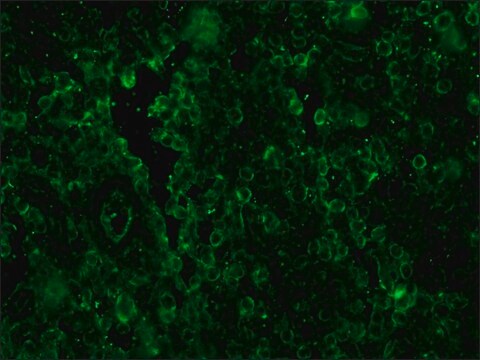
Anti-Human Polyvalent Immunoglobulins (whole molecule)−FITC antibody produced in rabbit
IgG fraction of antiserum, buffered aqueous solution
Synonym(s):
Rabbit Anti-Human Polyvalent Immunoglobulins (whole molecule)−Fluorescein isothiocyanate
Select a Size
| Size/SKU | Availability | Price |
|---|
About This Item
biological source
rabbit
Quality Segment
conjugate
FITC conjugate
antibody form
IgG fraction of antiserum
antibody product type
secondary antibodies
clone
polyclonal
form
buffered aqueous solution
storage condition
protect from light
technique(s)
ANA-indirect immunofluorescence: 1:128, direct immunofluorescence: 1:80
storage temp.
−20°C
target post-translational modification
unmodified
General description
Purified human IgA, IgG and IgM are used to develop anti-sera in rabbits. The IgG fraction of each anti-sera is purified and conjugated to Fluorescein Isothiocyanate (FITC), in an alkaline reaction. Anti-Human Polyvalent Immunoglobulins (whole molecule)-FITC antibody specifically recognizes human IgA, IgG and IgM.
Immunogen
Application
Biochem/physiol Actions
Physical form
Disclaimer
1 of 1
This Item | |||
|---|---|---|---|
| biological source rabbit | biological source rabbit | biological source rabbit | biological source goat |
| antibody form IgG fraction of antiserum | antibody form IgG fraction of antiserum | antibody form IgG fraction of antiserum | antibody form IgG fraction of antiserum |
| conjugate FITC conjugate | conjugate FITC conjugate | conjugate FITC conjugate | conjugate FITC conjugate |
| technique(s) ANA-indirect immunofluorescence: 1:128, direct immunofluorescence: 1:80 | technique(s) immunofluorescence: 1:64-1:128 using Hep2 cells | technique(s) immunohistochemistry (formalin-fixed, paraffin-embedded sections): 1:100, indirect immunofluorescence: 1:100 | technique(s) immunofluorescence: 1:32-1:64 using Hep2 cells |
| form buffered aqueous solution | form buffered aqueous solution | form buffered aqueous solution | form buffered aqueous solution |
| clone polyclonal | clone polyclonal | clone polyclonal | clone polyclonal |



Still not finding the right product?
Try our Product Selector Tool to narrow your options
Storage Class
10 - Combustible liquids
wgk
nwg
flash_point_f
Not applicable
flash_point_c
Not applicable
ppe
Eyeshields, Gloves, multi-purpose combination respirator cartridge (US)
Choose from one of the most recent versions:
Already Own This Product?
Find documentation for the products that you have recently purchased in the Document Library.