



The optimal activity for this blend is between pH 5 and 5.5. The Buffer Reference Center provides examples of buffers that work in this pH range.
SAE0020

Cellulase, enzyme blend
Synonym(s):
Cellic CTec2
Sign In to View Organizational & Contract Pricing.
Select a Size
50 ML
$210.00
About This Item
NACRES:
NA.54
UNSPSC Code:
12352204
Skip To
Related Categories
1 of 4
This Item | 219466 | C2730 | 22178 |
|---|---|---|---|
| form aqueous solution | form solid | form aqueous solution | form powder |
| shipped in ambient | shipped in ambient | shipped in - | shipped in - |
| storage temp. 2-8°C | storage temp. 2-8°C | storage temp. 2-8°C | storage temp. 2-8°C |
| Quality Level 200 | Quality Level - | Quality Level 200 | Quality Level 100 |
| density ~1.15 g/mL | density - | density 1.10-1.30 g/mL | density - |
Application
Cellulase, enzyme blend has been used for the purpose of enzymatic hydrolysis.[1]
Biochem/physiol Actions
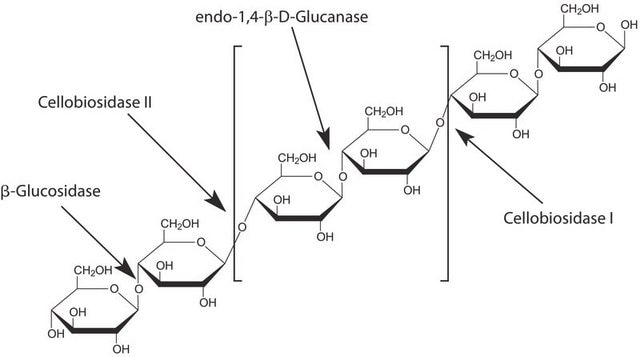
Cellulase is responsible for the breakdown of insoluble plant polymer cellulosic substrates into soluble sugars, mostly cellobiose and glucose.[2][3] It specifically catalyzes the hydrolysis of β -1,4 glucosidic bonds in cellulose.[3] Animals do not naturally possess the ability to digest cellulose, but do so with the help of gut microorganisms.[4]
General description
Cellulase is a member of glycoside hydrolase family and is produced by a number of cellulolytic microbes.[2][3]
This product contains cellulases, ß-glucosidases, and hemicellulase, for the application of degrading cellulose to fermentable sugars. This product is effective on a wide variety of pre-treated lignocellulosic bimass materials, for converting the carbohydrates in these materials into simple sugars prior to fermentation, for application in biofuels research.
Legal Information
A product of Novozyme Corp
signalword
Danger
hcodes
pcodes
Hazard Classifications
Resp. Sens. 1
Storage Class
10 - Combustible liquids
wgk
WGK 3
Choose from one of the most recent versions:
Already Own This Product?
Find documentation for the products that you have recently purchased in the Document Library.
Model of acetic acid-affected growth and poly (3-hydroxybutyrate) production by Cupriavidus necator DSM 545.
Marudkla J, et al.
Journal of Biotechnology, 268, 12-20 (2018)
Zhe Ling et al.
Bioresource technology, 305, 123025-123025 (2020-03-03)
Discovering green solvents and their inner mechanisms for efficient deconstruction of lignocellulosic biomass recalcitrance are receiving growing interests. In this work, eco-friendly levulinic acid (LA) based deep eutectic solvents (DES) were proposed for pretreatment on moso bamboo by combining acetamide
Qiulu Chu et al.
Biotechnology for biofuels, 14(1), 136-136 (2021-06-14)
Ethanol organosolv (EOS) pretreatment is one of the most efficient methods for boosting biomass saccharification as it can achieve an efficient fractionation of three major constituents in lignocellulose. However, lignin repolymerization often occurs in acid EOS pretreatment, which impairs subsequent
Angela S Machado et al.
Frontiers in bioengineering and biotechnology, 8, 826-826 (2020-08-09)
The ability of white-rot fungi to degrade polysaccharides in lignified plant cell walls makes them a suitable reservoir for CAZyme prospects. However, to date, CAZymes from these species are barely studied, which limits their use in the set of choices
Liwen He et al.
Frontiers in microbiology, 12, 690801-690801 (2021-09-14)
Vanillic acid (VA) is a phenolic acid derivative commonly found in plants and foods, with a pleasant creamy odor and pharmacologic activities, which is hypothesized to help improve silage fermentation. The silage profile of stylo silage ensiled with addition of
-
In what kind of media/buffer does this blend work at its best ? Does it work well in EtOH ? Thanks
1 answer-
Helpful?
-
-
Is this enzyme blend compatible with the feruloyl esterase enzyme ?
1 answer-
This product contains cellulases, beta-glucosidases, and hemicellulase for degrading cellulose to fermentable sugars. It is effective on a wide variety of pre-treated lignocellulosic biomass materials, converting carbohydrates into simple sugars prior to fermentation, applicable in biofuels research. The compatibility of this enzyme blend with feruloyl esterase (ferulic acid esterase; a hemicellulase) was not evaluated in-house. However, published literature indicates that ferulic acid esterase pretreatment facilitates the cellulase hydrolysis process by synergistically opening the crosslinked network structures of cell walls with other cellulases and hemicellulases. For example, see the articles by Zhao, M. et al., Carbohydrate Polymers, 313, 120885 (2023) and Xu, Z., et al., Front. Microbiol., Sec. Microbial Physiology and Metabolism, 11, 568716 (2020).
Helpful?
-
-
What is the recommended amount of Cellic CTec2 enzyme for saccharification of 1 gram cellulose?
1 answer-
Recommended enzyme trial dosages for Cellic CTec2 are 1.5%, 3.0%, 6.0%, and 30.0% weight/weight (grams enzyme per gram cellulose) for initial investigations. Further testing is necessary to refine the dose-response curve and assess the impact of time, solids loading, cellulose conversion, and enzyme dosage.
Helpful?
-
-
what is the concentration (units/ml) of the enzyme?
1 answer-
This Cellulase blend is a product of Novozymes. The analytical testing confirms that this material meets the 1000 unit/gram minimum activity, as well as the lot specific density. The density range is 1.0 - 1.3 g/mL. As an example, a 50 mL package size for a lot reporting a density of 1.2 g/mL with an activity of 1000 units per gram would have a minimum concentration of 1200 u/mL. Please see the link below to access a sample or lot specific Certificate of Analysis:
https://www.sigmaaldrich.com/product/sigma/sae0020#product-documentationHelpful?
-
-
1. How much glucose and xylose sugars are present in Cellic CTec2? 2. And how many other ingredients are included? 3. From what microorganisms do the Cellulase, β-glucosidase, and Hemicellulase enzymes originate?
1 answer-
The composition of this material is considered proprietary. This product is manufactured by fermentation of microorganisms not present in the final product. Please see the link below to a publication that may be helpful.
https://dspace.lib.cranfield.ac.uk/bitstream/handle/1826/15255/Augmented_hydrolysis_of_acid_pretreated_sugarcane_bagasse-2020.pdf;jsessionid=75390AF54DD520E2E7334DC8525A57C3?sequence=4Helpful?
-
-
What is this cellulase enzyme activity? ?FPU
1 answer-
This is a product of Novoxymes. The manufacturer notes that this cellulase will hydrolyze (1,4)-beta-D-glucoside linkages and reports the activity in Biomass hydrolysis Units or BHU-2 per gram. This activity is a minimum of 1000 BHU-2 units per gram.
Helpful?
-
-
OPTIMIZATION VALUES OF PH, T°, AND UNITS TO WORK WITH THIS ENZYME
1 answer-
The optimum temperature is 45-50°C and the optimum pH is 5.0–5.5.
Helpful?
-
-
is it possible to know the MW for the enzymes
1 answer-
This product is a proprietary blend of cellulases, ß-glucosidases, and hemicellulase. The molecular weight for this item is not determined.
Helpful?
-
Active Filters
Our team of scientists has experience in all areas of research including Life Science, Material Science, Chemical Synthesis, Chromatography, Analytical and many others.
Contact Technical Service