Skip to Content
MilliporeSigma

Skip To

SAB3500989

Anti-PRDM16 antibody produced in rabbit

affinity isolated antibody

Synonym(s):

Anti-CMD1LL, Anti-KMT8F, Anti-LVNC8, Anti-MEL1, Anti-PFM13

Sign In to View Organizational & Contract Pricing.

Select a Size

Change View
Pack SizeSKUAvailabilityPrice
100 μg
Usually ships in 5 business days. (Orders outside of US, please allow an additional 1-2 weeks for delivery)
$569.00

About This Item

NACRES:
NA.41
UNSPSC Code:
12352203
Conjugate:
unconjugated
Clone:
polyclonal
Application:
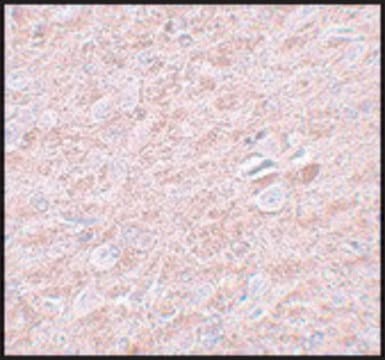
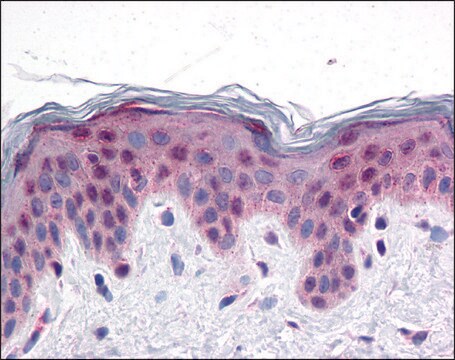
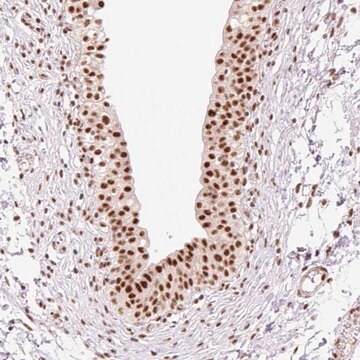
ELISA, IF, IHC
Citations:
2

$569.00


Usually ships in 5 business days. (Orders outside of US, please allow an additional 1-2 weeks for delivery)

Technical Service
Need help? Our team of experienced scientists is here for you.
Let Us Assist


biological source

rabbit

Quality Level

conjugate

unconjugated

antibody form

affinity isolated antibody

antibody product type

primary antibodies

clone

polyclonal

form

buffered aqueous solution

mol wt

predicted mol wt 109-120 kDa

species reactivity

human, mouse

concentration

1 mg/mL

technique(s)

ELISA: suitable, immunoblotting: suitable, immunofluorescence: suitable, immunohistochemistry: suitable

NCBI accession no.

UniProt accession no.

shipped in

wet ice

storage temp.

−20°C

target post-translational modification

unmodified

Gene Information

human ... PRDM16(63976)

Immunogen

Antibody was raised against a 17 amino acid synthetic peptide from near the carboxy terminus of human PRDM16.

Features and Benefits

Evaluate our antibodies with complete peace of mind. If the antibody does not perform in your application, we will issue a full credit or replacement antibody. Learn more.

Physical form

Supplied at 1 mg/mL in PBS with 0.02% sodim azide.

Other Notes

The action of this antibody can be blocked using blocking peptide SBP3500989.

Disclaimer

Unless otherwise stated in our catalog or other company documentation accompanying the product(s), our products are intended for research use only and are not to be used for any other purpose, which includes but is not limited to, unauthorized commercial uses, in vitro diagnostic uses, ex vivo or in vivo therapeutic uses or any type of consumption or application to humans or animals.

Compare Similar Items

View Full Comparison

Show Differences

1 of 1

This Item
HPA060467HPA050343SAB2900806
antibody form

affinity isolated antibody

antibody form

affinity isolated antibody

antibody form

affinity isolated antibody

antibody form

affinity isolated antibody

biological source

rabbit

biological source

rabbit

biological source

rabbit

biological source

rabbit

Quality Level

100

Quality Level

100

Quality Level

100

Quality Level

-

conjugate

unconjugated

conjugate

unconjugated

conjugate

unconjugated

conjugate

unconjugated

clone

polyclonal

clone

polyclonal

clone

polyclonal

clone

polyclonal

species reactivity

human, mouse

species reactivity

human

species reactivity

human

species reactivity

human, rat, mouse


Still not finding the right product?

or

Try our Product Selector Tool to narrow your options


Storage Class

10 - Combustible liquids

flash_point_f

Not applicable

flash_point_c

Not applicable


Choose from one of the most recent versions:

Certificates of Analysis (COA)

Lot/Batch Number

Don't see the Right Version?

If you require a particular version, you can look up a specific certificate by the Lot or Batch number.

Already Own This Product?

Find documentation for the products that you have recently purchased in the Document Library.

Visit the Document Library


Fenfen Li et al.
Nature communications, 12(1), 6838-6838 (2021-11-27)
Brown adipocytes share the same developmental origin with skeletal muscle. Here we find that a brown adipocyte-to-myocyte remodeling also exists in mature brown adipocytes, and is induced by prolonged high fat diet (HFD) feeding, leading to brown fat dysfunction. This
Bhavin V Patel et al.
Journal of molecular biology, 432(23), 6127-6145 (2020-10-16)
Mitochondrial fatty acid oxidation (FAO) contributes to the proton motive force that drives ATP synthesis in many mammalian tissues. In eutherian (placental) mammals, brown adipose tissue (BAT) can also dissipate this proton gradient through uncoupling protein 1 (UCP1) to generate


Global Trade Item Number

SKUGTIN
SBP3500989-0.05MG04061832174396
SAB3500989-100UG04061832498041

Questions

Reviews

No rating value

Active Filters