Skip to Content
Merck

PRS4123

Anti-STIM2 (ab1) antibody produced in rabbit

affinity isolated antibody, buffered aqueous solution

Synonym(s):

Anti-Stromal Interaction molecule 2

Sign In to View Organizational & Contract Pricing.

Select a Size

100 μG

₹57,353.70

₹57,353.70


Estimated to ship on14 May 2026Details


About This Item

NACRES:
NA.41
UNSPSC Code:
12352203
Conjugate:
unconjugated
Clone:
polyclonal
Application:
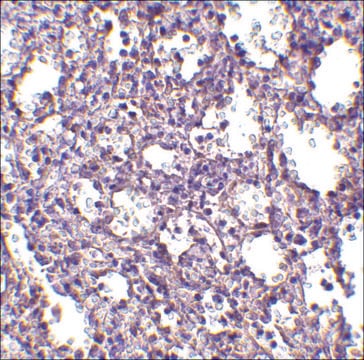
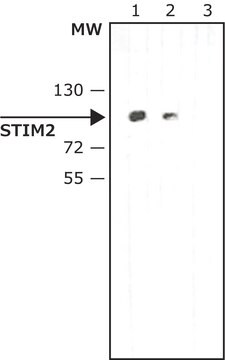
ELISA (i), IF, IHC, WB
Citations:
4

Skip To

Technical Service
Need help? Our team of experienced scientists is here for you.
Let Us Assist

biological source

rabbit

Quality Level

conjugate

unconjugated

antibody form

affinity isolated antibody

antibody product type

primary antibodies

clone

polyclonal

form

buffered aqueous solution

species reactivity

mouse, human, rat

technique(s)

immunofluorescence: suitable, immunohistochemistry: suitable, indirect ELISA: suitable, western blot: suitable

UniProt accession no.

shipped in

dry ice

storage temp.

−20°C

target post-translational modification

unmodified

Gene Information

human ... STIM2(57620)

Related Categories

Compare Similar Items

View Full Comparison

Show Differences

1 of 4

This Item
PRS4125S8572S6072
conjugate

unconjugated

conjugate

unconjugated

conjugate

unconjugated

conjugate

unconjugated

biological source

rabbit

biological source

rabbit

biological source

rabbit

biological source

rabbit

Quality Level

100

Quality Level

100

Quality Level

200

Quality Level

200

antibody form

affinity isolated antibody

antibody form

affinity isolated antibody

antibody form

affinity isolated antibody

antibody form

affinity isolated antibody

shipped in

dry ice

shipped in

dry ice

shipped in

dry ice

shipped in

dry ice

form

buffered aqueous solution

form

buffered aqueous solution

form

buffered aqueous solution

form

buffered aqueous solution

Immunogen

a 18 amino acid peptide from near the carboxy-terminus of human STIM2.

Physical form

Solution in phosphate buffered saline containing 0.02% sodium azide

Other Notes

The action of this antibody can be blocked using blocking peptide SBP4123.

Disclaimer

Unless otherwise stated in our catalog or other company documentation accompanying the product(s), our products are intended for research use only and are not to be used for any other purpose, which includes but is not limited to, unauthorized commercial uses, in vitro diagnostic uses, ex vivo or in vivo therapeutic uses or any type of consumption or application to humans or animals.

Not finding the right product?  

Try our Product Selector Tool.

related product

Product No.
Description
Pricing

Storage Class

10 - Combustible liquids

wgk

WGK 2

flash_point_f

Not applicable

flash_point_c

Not applicable


Choose from one of the most recent versions:

Certificates of Analysis (COA)

Lot/Batch Number

Don't see the Right Version?

If you require a particular version, you can look up a specific certificate by the Lot or Batch number.

Already Own This Product?

Find documentation for the products that you have recently purchased in the Document Library.

Visit the Document Library

Estella Zuccolo et al.
Oncotarget, 9(57), 31098-31119 (2018-08-21)
Store-operated Ca2+ entry (SOCE) provides a major Ca2+ entry route in cancer cells. SOCE is mediated by the assembly of Stim and Orai proteins at endoplasmic reticulum (ER)-plasma membrane junctions upon depletion of the ER Ca2+ store. Additionally, Stim and
Silvia Dragoni et al.
PloS one, 9(3), e91099-e91099 (2014-03-08)
An increase in the frequency of circulating endothelial colony forming cells (ECFCs), the only subset of endothelial progenitor cells (EPCs) truly belonging to the endothelial phenotype, occurs in patients affected by primary myelofibrosis (PMF). Herein, they might contribute to the
Francesco Lodola et al.
Oncotarget, 8(56), 95223-95246 (2017-12-10)
Endothelial colony forming cells (ECFCs) represent a population of truly endothelial precursors that promote the angiogenic switch in solid tumors, such as breast cancer (BC). The intracellular Ca2+ toolkit, which drives the pro-angiogenic response to VEGF, is remodelled in tumor-associated
Estella Zuccolo et al.
Journal of cellular physiology, 234(4), 4540-4562 (2018-09-08)
Basal forebrain neurons control cerebral blood flow (CBF) by releasing acetylcholine (Ach), which binds to endothelial muscarinic receptors to induce nitric (NO) release and vasodilation in intraparenchymal arterioles. Nevertheless, the mechanism whereby Ach stimulates human brain microvascular endothelial cells to

Global Trade Item Number

SKUGTIN
SBP4123-0.05MG04061832163178
PRS4123-100UG04061832509846

Questions

Reviews

No rating value

Active Filters

Our team of scientists has experience in all areas of research including Life Science, Material Science, Chemical Synthesis, Chromatography, Analytical and many others.

Contact Technical Service