Skip to Content
MilliporeSigma

I7256

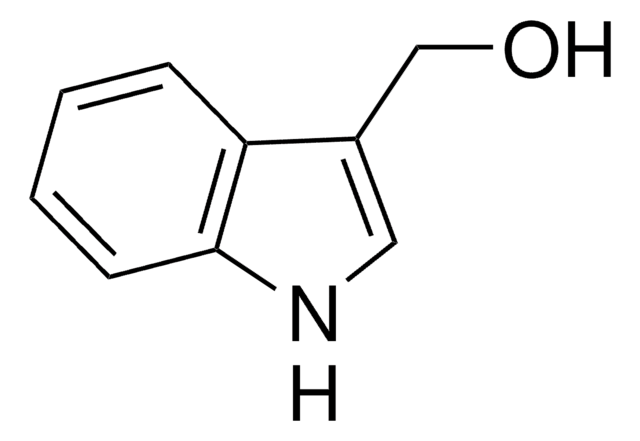
Indole-3-carbinol

Synonym(s):

3-Indolemethanol

Sign In to View Organizational & Contract Pricing.

Select a Size

1 G

$89.30

5 G

$160.00

25 G

$478.00

$89.30


Please contact Customer Service for Availability

Request a Bulk Order

About This Item

Empirical Formula (Hill Notation):
C9H9NO
CAS Number:
Molecular Weight:
147.17
NACRES:
NA.25
PubChem Substance ID:
UNSPSC Code:
12352005
EC Number:
211-836-2
MDL number:

Skip To

Technical Service
Need help? Our team of experienced scientists is here for you.
Let Us Assist

InChI key

IVYPNXXAYMYVSP-UHFFFAOYSA-N

InChI

1S/C9H9NO/c11-6-7-5-10-9-4-2-1-3-8(7)9/h1-5,10-11H,6H2

SMILES string

OCc1c[nH]c2ccccc12

mp

96-99 °C (lit.)

storage temp.

2-8°C

Quality Level

Looking for similar products? Visit Product Comparison Guide

Compare Similar Items

View Full Comparison

Show Differences

1 of 4

This Item
SMB00149SMB0054717793
Quality Level

100

Quality Level

200

Quality Level

-

Quality Level

100

storage temp.

2-8°C

storage temp.

−20°C

storage temp.

−20°C

storage temp.

−20°C

mp

96-99 °C (lit.)

mp

-

mp

-

mp

-

Application

Indole-3-carbinol has been used for encapsulation with poly-lactic-co-glycolic acid (PLGA), to study its in-vitro anti-cancerogenic effects on breast adenocarcinoma epithelial (MCF7), colon adenocarcinoma epithelial (Caco2), prostate carcinoma epithelial (PC3) cells.[1] It has also been used as a cytochrome P4501A (CYP1A) inducer.[2]

Biochem/physiol Actions

Indole-3-carbinol (I3C) activates aryl hydrocarbon receptor (AhR) and induces G1 cell cycle arrest and apoptosis. Thus, it acts as a potential anti-cancer agent.[3] In addition, it induces estradiol metabolism by stimulating cytochrome P450 enzymes.[4] Therefore, I3C is considered to be a potent chemotherapeutic for various types of cancer including, breast,[5] prostate, colon cancer,[1] and leukemia.[3]
Inhibits cancinogenesis at the initiation stage. Has be shown to inhibit carcinogenesis in several animal species, but it enhances tumor incidence if administered at a post-initiation stage. Found in cruciferous vegetables.

General description

Indole-3-carbinol is a novel secondary plant metabolite produced in cruciferous vegetables,[5] such as cabbage, cauliflower and brussels sprouts.[6]

pictograms

Exclamation mark

signalword

Warning

hcodes

Hazard Classifications

Eye Irrit. 2 - Skin Irrit. 2

Storage Class

11 - Combustible Solids

wgk

WGK 3

ppe

dust mask type N95 (US), Eyeshields, Gloves


Choose from one of the most recent versions:

Certificates of Analysis (COA)

Lot/Batch Number

Don't see the Right Version?

If you require a particular version, you can look up a specific certificate by the Lot or Batch number.

Already Own This Product?

Find documentation for the products that you have recently purchased in the Document Library.

Visit the Document Library

Chemoprevention of chemically-induced mammary carcinogenesis by indole-3-carbinol.
Grubbs CJ, et al.
Anticancer Research, 15(3), 709-716 (1995)
Young S Kim et al.
The Journal of nutritional biochemistry, 16(2), 65-73 (2005-02-01)
Mounting preclinical and clinical evidence indicate that indole-3-carbinol (I3C), a key bioactive food component in cruciferous vegetables, has multiple anticarcinogenic and antitumorigenic properties. Evidence that p21, p27, cyclin-dependent kinases, retinoblastoma, Bax/Bcl-2, cytochrome P-450 1A1 and GADD153 are targets for I3C
Indole-3-carbinol induces G1 cell cycle arrest and apoptosis through aryl hydrocarbon receptor in THP-1 monocytic cell line
Mohammadi S, et al.
Journal of Receptor and Signal Transduction Research, 37(5), 506-514 (2017)
Youngshim Choi et al.
The Journal of nutritional biochemistry, 23(12), 1732-1739 (2012-05-10)
Indole-3-carbinol (I3C) is a compound found in high concentrations in Brassica family vegetables, including broccoli, cauliflower and cabbage, and is regarded as a promising chemopreventive agent against various cancers. This study assesses the protective effect of I3C against diet-induced obesity
Catherine J Leader et al.
PloS one, 14(8), e0220837-e0220837 (2019-08-14)
Is global longitudinal strain (GLS) a more accurate non-invasive measure of histological myocardial fibrosis than left ventricular ejection fraction (LVEF) in a hypertensive rodent model. Hypertension results in left ventricular hypertrophy and cardiac dysfunction. Speckle-tracking echocardiography has emerged as a

Articles

Chronic inflammation is an underlying factor in the development and progression of many of the chronic diseases of aging, such as arthritis, atherosclerosis, diabetes, and cancer.

Questions

1–2 of 2 Questions  
  1. How can I determine the shelf life / expiration / retest date of this product?

    1 answer
    1. If this product has an expiration or retest date, it will be shown on the Certificate of Analysis (COA, CofA). If there is no retest or expiration date listed on the product's COA, we do not have suitable stability data to determine a shelf life. For these products, the only date on the COA will be the release date; a retest, expiration, or use-by-date will not be displayed.
      For all products, we recommend handling per defined conditions as printed in our product literature and website product descriptions. We recommend that products should be routinely inspected by customers to ensure they perform as expected.
      For products without retest or expiration dates, our standard warranty of 1 year from the date of shipment is applicable.
      For more information, please refer to the Product Dating Information document: https://www.sigmaaldrich.com/deepweb/assets/sigmaaldrich/marketing/global/documents/418/501/product-dating-information-06-25-mk.pdf

      Helpful?

  2. How is shipping temperature determined? And how is it related to the product storage temperature?

    1 answer
    1. Products may be shipped at a different temperature than the recommended long-term storage temperature. If the product quality is sensitive to short-term exposure to conditions other than the recommended long-term storage, it will be shipped on wet or dry-ice. If the product quality is NOT affected by short-term exposure to conditions other than the recommended long-term storage, it will be shipped at ambient temperature. As shipping routes are configured for minimum transit times, shipping at ambient temperature helps control shipping costs for our customers. For more information, please refer to the Storage and Transport Conditions document: https://www.sigmaaldrich.com/deepweb/assets/sigmaaldrich/marketing/global/documents/316/622/storage-transport-conditions-mk.pdf

      Helpful?

Reviews

No rating value

Active Filters

Our team of scientists has experience in all areas of research including Life Science, Material Science, Chemical Synthesis, Chromatography, Analytical and many others.

Contact Technical Service