Skip to Content
MilliporeSigma

HPA010088

Anti-CD63 antibody produced in rabbit

affinity isolated antibody, Prestige Antibodies® Powered by Atlas Antibodies, buffered aqueous glycerol solution

Synonym(s):

Anti-CD63 antigen, Anti-Granulophysin, Anti-Lamp-3, Anti-Lysosomal-associated membrane protein 3, Anti-Melanoma-associated antigen ME491, Anti-OMA81H, Anti-Ocular melanoma- associated antigen, Anti-Tetraspanin-30, Anti-Tspan-30


Sign In to View Organizational & Contract Pricing.

Select a Size

Pricing and availability is not currently available.

About This Item

UNSPSC Code:
12352203
NACRES:
NA.41
MDL number:
Human Protein Atlas Number:

Skip To

Technical Service
Need help? Our team of experienced scientists is here for you.
Let Us Assist

Product Name

Anti-CD63 antibody produced in rabbit, affinity isolated antibody, Prestige Antibodies® Powered by Atlas Antibodies, buffered aqueous glycerol solution

biological source

rabbit

conjugate

unconjugated

antibody form

affinity isolated antibody

antibody product type

primary antibodies

clone

polyclonal

product line

Prestige Antibodies® Powered by Atlas Antibodies

form

buffered aqueous glycerol solution

species reactivity

human

technique(s)

immunohistochemistry: 1:500-1:1000

immunogen sequence

RDKVMSEFNNNFRQQMENYPKNNHTASILDRMQADFKCCGAANYTDWEKIPSMSKNRVPDSCCINVTVGCGINFNEKAIHKEGCVEKIG

UniProt accession no.

application(s)

research pathology

shipped in

wet ice

storage temp.

−20°C

target post-translational modification

unmodified

Quality Level

Gene Information

human ... CD63(967)

Compare Similar Items

View Full Comparison

Show Differences

1 of 4

This Item
HPA073506SAB5700799HPA046404
biological source

rabbit

biological source

rabbit

biological source

rabbit

biological source

rabbit

antibody form

affinity isolated antibody

antibody form

affinity isolated antibody

antibody form

affinity isolated antibody

antibody form

affinity isolated antibody

conjugate

unconjugated

conjugate

unconjugated

conjugate

-

conjugate

unconjugated

Quality Level

100

Quality Level

100

Quality Level

100

Quality Level

100

product line

Prestige Antibodies® Powered by Atlas Antibodies

product line

Prestige Antibodies® Powered by Atlas Antibodies

product line

-

product line

Prestige Antibodies® Powered by Atlas Antibodies

technique(s)

immunohistochemistry: 1:500-1:1000

technique(s)

immunofluorescence: 0.25-2 μg/mL (ICC-IF)

technique(s)

immunofluorescence: 1:50-1:200, immunohistochemistry: 1:50-1:200, western blot: 1:500-1:2000

technique(s)

immunofluorescence: 0.25-2 μg/mL, immunohistochemistry: 1:2500-1:5000

Application

All Prestige Antibodies Powered by Atlas Antibodies are developed and validated by the Human Protein Atlas (HPA) project and as a result, are supported by the most extensive characterization in the industry.

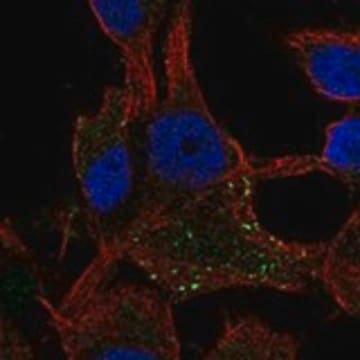
The Human Protein Atlas project can be subdivided into three efforts: Human Tissue Atlas, Cancer Atlas, and Human Cell Atlas. The antibodies that have been generated in support of the Tissue and Cancer Atlas projects have been tested by immunohistochemistry against hundreds of normal and disease tissues and through the recent efforts of the Human Cell Atlas project, many have been characterized by immunofluorescence to map the human proteome not only at the tissue level but now at the subcellular level. These images and the collection of this vast data set can be viewed on the Human Protein Atlas (HPA) site by clicking on the Image Gallery link. We also provide Prestige Antibodies® protocols and other useful information.

Biochem/physiol Actions

CD63 (cluster of differentiation) is associated with neutrophil homeostasis in a TIMP-1 (tissue inhibitor of metalloproteinases-1)-mediated manner. This protein is also involved in promoting metastasis, through the stabilization of β-catenin. It also affects the plasticity of cell. Its expression is high during early stages of melanoma, which decreases with the progression of melanoma. Thus, it functions as a tumor suppressor by inhibiting EMT (epithelial-mesenchymal transition) in melanoma. CD63, along with CD9, prevents cell-cell fusion in HIV (human immunodeficiency virus) infection, during transition from hemifusion to pore opening.

Disclaimer

Unless otherwise stated in our catalog or other company documentation accompanying the product(s), our products are intended for research use only and are not to be used for any other purpose, which includes but is not limited to, unauthorized commercial uses, in vitro diagnostic uses, ex vivo or in vivo therapeutic uses or any type of consumption or application to humans or animals.

Features and Benefits

Prestige Antibodies® are highly characterized and extensively validated antibodies with the added benefit of all available characterization data for each target being accessible via the Human Protein Atlas portal linked just below the product name at the top of this page. The uniqueness and low cross-reactivity of the Prestige Antibodies® to other proteins are due to a thorough selection of antigen regions, affinity purification, and stringent selection. Prestige antigen controls are available for every corresponding Prestige Antibody and can be found in the linkage section.

Every Prestige Antibody is tested in the following ways:
  • IHC tissue array of 44 normal human tissues and 20 of the most common cancer type tissues.
  • Protein array of 364 human recombinant protein fragments.

General description

CD63 (cluster of differentiation) is a membrane protein belonging to the tetraspanin family of proteins called LAMP (lysosome-associated membrane glycoprotein) proteins. It is localized to histamine-containing granules.
It also resides in MHC (major histocompatibility compartment) II endocytic compartment.

Immunogen

CD63 antigen recombinant protein epitope signature tag (PrEST)

Other Notes

Corresponding Antigen APREST72477

Physical form

Solution in phosphate-buffered saline, pH 7.2, containing 40% glycerol and 0.02% sodium azide

Legal Information

Prestige Antibodies is a registered trademark of Merck KGaA, Darmstadt, Germany

Not finding the right product?  

Try our Product Selector Tool.

Storage Class

10 - Combustible liquids

wgk

WGK 1

flash_point_f

Not applicable

flash_point_c

Not applicable

ppe

Eyeshields, Gloves, multi-purpose combination respirator cartridge (US)


Choose from one of the most recent versions:

Certificates of Analysis (COA)

Lot/Batch Number

Don't see the Right Version?

If you require a particular version, you can look up a specific certificate by the Lot or Batch number.

Already Own This Product?

Find documentation for the products that you have recently purchased in the Document Library.

Visit the Document Library

Shin La Shu et al.
Methods in molecular biology (Clifton, N.J.), 2265, 289-304 (2021-03-12)
Cells release extracellular vesicles (EVs) that can be detected both in vivo and in cell culture medium. Among EVs, exosomes are 50-150 nm vesicles that are systematically packaged into multivesicular bodies for release into the external environment. In cancer, these intentionally
Sandra Pinet et al.
Oncotarget, 7(31), 50349-50364 (2016-07-08)
The neurotrophin receptors are known to promote growth and proliferation of glioblastoma cells. Their functions in spreading glioblastoma cell aggressiveness to the microenvironment through exosome release from glioblastoma cells are unknown. Considering previous reports demonstrating that YKL-40 expression is associated
Bastian Seubert et al.
International journal of cancer, 136(10), 2304-2315 (2014-10-30)
The tetraspanin CD63 is implicated in pro-metastatic signaling pathways but, so far, it is unclear, how CD63 levels affect the tumor cell phenotype. Here, we investigated the effect of CD63 modulation in different metastatic tumor cell lines. In vitro, knock
Takahiro Kishikawa et al.
JCI insight, 1(8), e86646-e86646 (2016-10-05)
Pancreatic ductal adenocarcinoma (Pdac) is a malignancy with a poor prognosis due to difficulties in early detection. Although promising biomarkers are increasingly reported, such methods are not yet easy to apply clinically, mainly due to their low reproducibility or technical
Menelaos Symeonides et al.
Viruses, 6(3), 1078-1090 (2014-03-13)
Human immunodeficiency virus type 1 (HIV-1) transmission takes place primarily through cell-cell contacts known as virological synapses. Formation of these transient adhesions between infected and uninfected cells can lead to transmission of viral particles followed by separation of the cells.

Questions

Reviews

No rating value

Active Filters

Our team of scientists has experience in all areas of research including Life Science, Material Science, Chemical Synthesis, Chromatography, Analytical and many others.

Contact Technical Service