



If this product has an expiration or retest date, it will be shown on the Certificate of Analysis (COA, CofA). If there is no retest or expiration date listed on the product's COA, we do not have suitable stability data to determine a shelf life. For these products, the only date on the COA will be the release date; a retest, expiration, or use-by-date will not be displayed.
For all products, we recommend handling per defined conditions as printed in our product literature and website product descriptions. We recommend that products should be routinely inspected by customers to ensure they perform as expected.
For products without retest or expiration dates, our standard warranty of 1 year from the date of shipment is applicable.
For more information, please refer to the Product Dating Information document: https://www.sigmaaldrich.com/deepweb/assets/sigmaaldrich/marketing/global/documents/418/501/product-dating-information-06-25-mk.pdf
753009

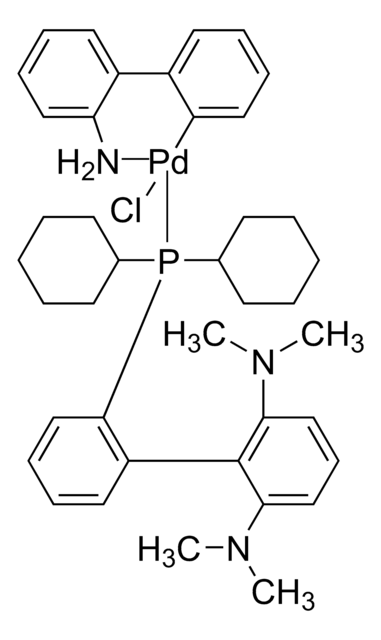
SPhos Pd G2
solid
Synonym(s):
2nd Generation SPhos Precatalyst, Chloro(2-dicyclohexylphosphino-2′,6′-dimethoxy-1,1′-biphenyl)[2-(2′-amino-1,1′-biphenyl)]palladium(II), SPhos-Pd-G2
Select a Size
| Size/SKU | Availability | Price |
|---|---|---|
250 mg | Check Cart for Availability | $72.20 |
1 g | Check Cart for Availability | $197.00 |
5 g | Check Cart for Availability | $627.00 $470.25 |
About This Item
$72.20
Product Name
SPhos Pd G2,
Quality Segment
product line
Buchwald precatalyst Generation 2
form
solid
feature
generation 2
reaction suitability
core: palladium, reaction type: Buchwald-Hartwig Cross Coupling Reaction, reaction type: Heck Reaction, reaction type: Hiyama Coupling, reaction type: Negishi Coupling, reaction type: Sonogashira Coupling, reaction type: Stille Coupling, reaction type: Suzuki-Miyaura Coupling, reagent type: catalyst
reaction type: Cross Couplings
mp
218 °C (dec.)
functional group
phosphine
SMILES string
COC1=CC=CC(OC)=C1C2=C(P(C3CCCCC3)C4CCCCC4)C=CC=C2.NC5=C(C6=C([Pd]Cl)C=CC=C6)C=CC=C5
InChI
1S/C26H35O2P.C12H10N.ClH.Pd/c1-27-23-17-11-18-24(28-2)26(23)22-16-9-10-19-25(22)29(20-12-5-3-6-13-20)21-14-7-4-8-15-21;13-12-9-5-4-8-11(12)10-6-2-1-3-7-10;;/h9-11,16-21H,3-8,12-15H2,1-2H3;1-6,8-9H,13H2;1H;/q;;;+1/p-1
InChI key
NOMWEFBAPVZIIP-UHFFFAOYSA-M
General description
Application
- Self-arylation of 1-alkyl-3-bromo-2-phenyl-2,1-borazaronaphthalenes to form 2,1-borazaronaphthols.
- Suzuki–Miyaura coupling of [Ru(bpy)2]+ with 4-carboxyphenylboronic acid.
- Suzuki–Miyaura coupling of β-borylated porphyrins with 2-iodoaniline.
1 of 1
This Item | |||
|---|---|---|---|
| description - | description 95% | description 98% | description 95% |
| reaction suitability core: palladium, reaction type: Sonogashira Coupling, reaction type: Heck Reaction, reagent type: catalyst | reaction suitability reaction type: Hiyama Coupling, reaction type: Heck Reaction, reaction type: Sonogashira Coupling, reagent type: catalyst | reaction suitability reaction type: Sonogashira Coupling, reaction type: Heck Reaction, reagent type: catalyst | reaction suitability reaction type: Heck Reaction, reaction type: Hiyama Coupling, reaction type: Stille Coupling, reaction type: Buchwald-Hartwig Cross Coupling Reaction, reaction type: Negishi Coupling, reagent type: catalyst |
| functional group phosphine | functional group phosphine | functional group phosphine | functional group phosphine |
| Quality Level 100 | Quality Level 100 | Quality Level 100 | Quality Level 100 |
| mp 218 °C (dec.) | mp 152-163 °C (decomposition) | mp 202-210 °C | mp 176-178 °C (decomposition) |
| product line Buchwald precatalyst Generation 2 | product line Buchwald precatalyst Generation 2 | product line Buchwald precatalyst Generation 2 | product line Buchwald precatalyst Generation 3 |
| feature generation 2 | feature generation 2 | feature generation 2 | feature generation 3 |
Storage Class
11 - Combustible Solids
WGK
WGK 3
Flash Point (°F)
Not applicable
Flash Point (°C)
Not applicable
Choose from one of the most recent versions:
Already Own This Product?
Find documentation for the products that you have recently purchased in the Document Library.
-
How can I determine the shelf life / expiration / retest date of this product?
1 answer-
Helpful?
-
-
How is shipping temperature determined? And how is it related to the product storage temperature?
1 answer-
Products may be shipped at a different temperature than the recommended long-term storage temperature. If the product quality is sensitive to short-term exposure to conditions other than the recommended long-term storage, it will be shipped on wet or dry-ice. If the product quality is NOT affected by short-term exposure to conditions other than the recommended long-term storage, it will be shipped at ambient temperature. As shipping routes are configured for minimum transit times, shipping at ambient temperature helps control shipping costs for our customers. For more information, please refer to the Storage and Transport Conditions document: https://www.sigmaaldrich.com/deepweb/assets/sigmaaldrich/marketing/global/documents/316/622/storage-transport-conditions-mk.pdf
Helpful?
-