



If this product has an expiration or retest date, it will be shown on the Certificate of Analysis (COA, CofA). If there is no retest or expiration date listed on the product's COA, we do not have suitable stability data to determine a shelf life. For these products, the only date on the COA will be the release date; a retest, expiration, or use-by-date will not be displayed.
For all products, we recommend handling per defined conditions as printed in our product literature and website product descriptions. We recommend that products should be routinely inspected by customers to ensure they perform as expected.
For products without retest or expiration dates, our standard warranty of 1 year from the date of shipment is applicable.
For more information, please refer to the Product Dating Information document: https://www.sigmaaldrich.com/deepweb/assets/sigmaaldrich/marketing/global/documents/418/501/product-dating-information-06-25-mk.pdf
V3700

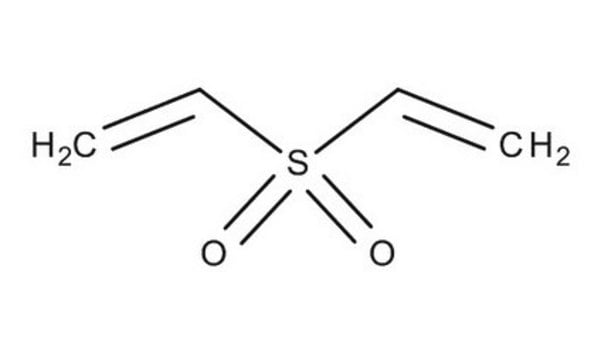
Divinyl sulfone
contains hydroquinone as inhibitor, ≥96%
Synonym(s):
Vinyl sulfone
Select a Size
| Size/SKU | Availability | Price |
|---|---|---|
5 g | Available to ship TODAYfromMILWAUKEE | $60.00 |
25 g | Available to ship TODAYfromMILWAUKEE | $152.00 |
100 g | Available to ship TODAYfromMILWAUKEE | $490.00 |
About This Item
Quality Segment
assay
≥96%
contains
hydroquinone as inhibitor
refractive index
n
bp
234 °C (lit.)
mp
−26 °C (lit.)
density
1.177 g/mL at 25 °C (lit.)
storage temp.
2-8°C
SMILES string
C=CS(=O)(=O)C=C
InChI
1S/C4H6O2S/c1-3-7(5,6)4-2/h3-4H,1-2H2
InChI key
AFOSIXZFDONLBT-UHFFFAOYSA-N
Gene Information
human ... LOC129293(129293)
General description
Application
- A cross-linking agent to synthesize divinyl sulfone-crosslinked hyaluronic acid hydrogels for specific biomedical applications, such as tissue engineering or drug delivery.
- A cross-linking agent to develop the conducting polymer film with MXene layers. This crosslinking can enhance the mechanical properties and stability of the composite film.
DVS and its mono and di-substituted derivatives are useful starting materials in the preparation of thiomorpholine 1,1-dioxides and other synthetically important macro- and the heterocycles.
DVS may be used to shrink proofing cotton by crosslinking it with cellulose.
1 of 1
This Item | |||
|---|---|---|---|
| description contains hydroquinone as inhibitor, ≥96% | description (stabilised) for synthesis | description 97% | description 96% |
| assay ≥96% | assay ≥98.0% (GC) | assay 97% | assay 96% |
| storage temp. 2-8°C | storage temp. 2-8°C | storage temp. - | storage temp. - |
| density 1.177 g/mL at 25 °C (lit.) | density 1.18 g/cm3 at 20 °C | density - | density 0.869 g/mL at 25 °C (lit.) |
| refractive index n | refractive index - | refractive index - | refractive index n |
| mp −26 °C (lit.) | mp -26 °C | mp 175-177 °C (lit.) | mp - |
| bp 234 °C (lit.) | bp 234.3 °C/1013 hPa | bp - | bp 91-92 °C (lit.) |
Still not finding the right product?
Explore all of our products under Divinyl sulfone
signalword
Danger
Hazard Classifications
Acute Tox. 1 Dermal - Acute Tox. 2 Oral - Aquatic Chronic 3 - Eye Dam. 1 - Skin Irrit. 2 - STOT SE 3
target_organs
Respiratory system
Storage Class
6.1A - Combustible acute toxic Cat. 1 and 2 / very toxic hazardous materials
flash_point_f
215.6 °F - closed cup
flash_point_c
102 °C - closed cup
ppe
Faceshields, Gloves, Goggles, type ABEK (EN14387) respirator filter
Choose from one of the most recent versions:
Already Own This Product?
Find documentation for the products that you have recently purchased in the Document Library.
-
How can I determine the shelf life / expiration / retest date of this product?
1 answer-
Helpful?
-
-
How is shipping temperature determined? And how is it related to the product storage temperature?
1 answer-
Products may be shipped at a different temperature than the recommended long-term storage temperature. If the product quality is sensitive to short-term exposure to conditions other than the recommended long-term storage, it will be shipped on wet or dry-ice. If the product quality is NOT affected by short-term exposure to conditions other than the recommended long-term storage, it will be shipped at ambient temperature. As shipping routes are configured for minimum transit times, shipping at ambient temperature helps control shipping costs for our customers. For more information, please refer to the Storage and Transport Conditions document: https://www.sigmaaldrich.com/deepweb/assets/sigmaaldrich/marketing/global/documents/316/622/storage-transport-conditions-mk.pdf
Helpful?
-