
483265

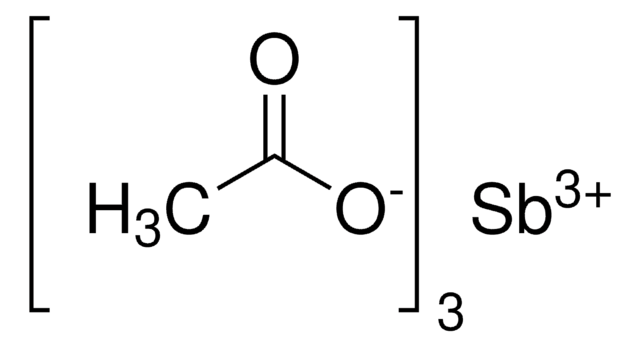
Antimony(III) acetate
99.99% trace metals basis
Synonym(s):
Antimony acetate, Antimony triacetate, Triacetoxystibine
Select a Size
| Size/SKU | Availability | Price |
|---|---|---|
100 g | Available to ship TODAYfromMILWAUKEE | $71.10 $60.43 |
About This Item
$60.43
List Price$71.10Save 15%Available to ship TODAYDetails
Quality Segment
assay
99.99% trace metals basis
reaction suitability
core: antimony, reagent type: catalyst
mp
126-131 °C (lit.)
density
1.22 g/mL at 25 °C (lit.)
SMILES string
CC(=O)O[Sb](OC(C)=O)OC(C)=O
InChI
1S/3C2H4O2.Sb/c3*1-2(3)4;/h3*1H3,(H,3,4);/q;;;+3/p-3
InChI key
JVLRYPRBKSMEBF-UHFFFAOYSA-K
General description
Application
- New Complexes of Antimony(III) with Tridentate O,E,O-Ligands: Explores new antimony(III) complexes providing insights into their bonding and potential applications in materials science (U Böhme, M Herbig, 2023).
- Antimony (III) acetate as a catalyst for synthesis of xanthenes: Details the use of antimony(III) acetate as a catalyst in the synthesis of biologically active compounds, showcasing its efficiency in organic chemistry (F Hakimi, A Hassanabadi, 2015).
Features and Benefits
- 99.99% trace metals basis (<150 ppm) ensures minimal contamination with consistent performance in critical applications, leading to better outcomes.
- Suitable catalyst to produce synthetic fibres. It is moderately soluble in water
- Suitable for solvent free reactions.
1 of 1
This Item | |||
|---|---|---|---|
| description 99.99% trace metals basis | description beads, ≤5 mm, low oxide, 99.999% trace metals basis | description 99.99% trace metals basis | description 99.99% trace metals basis |
| assay 99.99% trace metals basis | assay 99.999% trace metals basis | assay 99.99% trace metals basis | assay 99.99% trace metals basis |
| density 1.22 g/mL at 25 °C (lit.) | density 6.69 g/mL at 25 °C (lit.) | density - | density - |
| mp 126-131 °C (lit.) | mp - | mp 270 °C (dec.) (lit.) | mp 298 °C (dec.) (lit.) |
| Quality Level 100 | Quality Level 100 | Quality Level 100 | Quality Level 200 |
| reaction suitability core: antimony, reagent type: catalyst | reaction suitability core: antimony | reaction suitability core: indium, reagent type: catalyst | reaction suitability core: cobalt |


signalword
Warning
hcodes
Hazard Classifications
Acute Tox. 4 Inhalation - Acute Tox. 4 Oral - Aquatic Chronic 2
Storage Class
11 - Combustible Solids
wgk
WGK 2
flash_point_f
Not applicable
flash_point_c
Not applicable
Choose from one of the most recent versions:
Already Own This Product?
Find documentation for the products that you have recently purchased in the Document Library.