
45463

Diuron
PESTANAL®, analytical standard
Synonym(s):
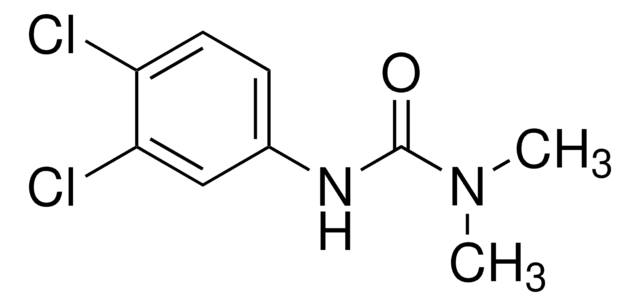
3-(3,4-Dichlorophenyl)-1,1-dimethylurea
Select a Size
| Pack Size | SKU | Availability | Price |
|---|
About This Item
grade
analytical standard
Quality Level
product line
PESTANAL®
shelf life
limited shelf life, expiry date on the label
technique(s)
HPLC: suitable, gas chromatography (GC): suitable
application(s)
agriculture
cleaning products
cosmetics
environmental
food and beverages
personal care
format
neat
SMILES string
CN(C)C(=O)Nc1ccc(Cl)c(Cl)c1
InChI
1S/C9H10Cl2N2O/c1-13(2)9(14)12-6-3-4-7(10)8(11)5-6/h3-5H,1-2H3,(H,12,14)
InChI key
XMTQQYYKAHVGBJ-UHFFFAOYSA-N
Application
Legal Information
1 of 1
This Item | |||
|---|---|---|---|
| application(s) agriculture | application(s) agriculture | application(s) agriculture | application(s) agriculture |
| technique(s) HPLC: suitable, gas chromatography (GC): suitable | technique(s) HPLC: suitable, gas chromatography (GC): suitable | technique(s) HPLC: suitable, gas chromatography (GC): suitable | technique(s) HPLC: suitable, gas chromatography (GC): suitable |
| Quality Level 100 | Quality Level 100 | Quality Level 100 | Quality Level 100 |
| grade analytical standard | grade analytical standard | grade analytical standard | grade analytical standard |
| shelf life limited shelf life, expiry date on the label | shelf life limited shelf life, expiry date on the label | shelf life limited shelf life, expiry date on the label | shelf life limited shelf life, expiry date on the label |
| product line PESTANAL® | product line PESTANAL® | product line PESTANAL® | product line PESTANAL® |
Still not finding the right product?
Explore all of our products under Diuron


target_organs
Blood
wgk
WGK 3
flash_point_f
Not applicable
flash_point_c
Not applicable
ppe
dust mask type N95 (US), Eyeshields, Faceshields, Gloves
signalword
Danger
hcodes
Hazard Classifications
Acute Tox. 4 Oral - Aquatic Acute 1 - Aquatic Chronic 1 - Carc. 1B - STOT RE 2 Inhalation
Storage Class
6.1C - Combustible acute toxic Cat.3 / toxic compounds or compounds which causing chronic effects
Choose from one of the most recent versions:
Already Own This Product?
Find documentation for the products that you have recently purchased in the Document Library.
Global Trade Item Number
| SKU | GTIN |
|---|---|
| 45463-250MG | 04061835377336 |