Skip to Content
MilliporeSigma

Skip To

MBD0028

Porphyromonas gingivalis FISH probe - ATTO488

Probe for fluorescence in situ hybridization (FISH)

Synonym(s):

POGI

Sign In to View Organizational & Contract Pricing.

Select a Size

Change View
Size/SKUAvailabilityPrice
50 μL
Check Cart for Availability
$1,370.00

About This Item

NACRES:
NA.51
UNSPSC Code:
12352200
Form:
liquid
Storage temp.:
−20°C

$1,370.00


Check Cart for Availability

Technical Service
Need help? Our team of experienced scientists is here for you.
Let Us Assist


Quality Segment

form

liquid

concentration

20 μM

technique(s)

FISH: suitable

shipped in

dry ice

storage temp.

−20°C

General description

Fluorescent In Situ Hybridization technique (FISH) is based on the hybridization of fluorescent labeled oligonucleotide probe to a specific complementary DNA or RNA sequence in whole and intact cells.1 Microbial FISH allows the visualization, identification and isolation of bacteria due to recognition of ribosomal RNA also in unculturable samples.2

FISH technique can serve as a powerful tool in the microbiome research field by allowing the observation of native microbial populations in diverse microbiome environments, such as samples from human origin (blood3 and tissue4), microbial ecology (solid biofilms 5 and aquatic systems6) and plants7. It is strongly recommended to include positive and negative controls in FISH assays to ensure specific binding of the probe of interest and appropriate protocol conditions. We offer positive (MBD0032/33) and negative control (MBD0034/35) probes, that accompany the specific probe of interest.

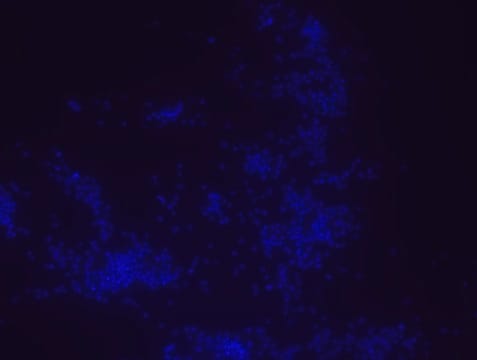
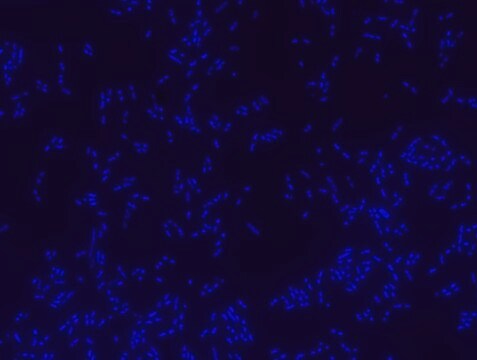
Porphyromonas gingivalis probe specifically recognizes P. gingivalis cells. P. gingivalis, is a gram negative bacterium which is an etiologic agent of adult periodontitis, a chronic inflammatory disease characterized by the destruction of the supportive tissue surrounding teeth. Studies have shown that LPS from P. gingivalis plays an important role in this disease.8-11 The association of the oral microbiota, including P. gingivalis, with various pathological states has been reported. These include development of Alzheimer′s disease12, role in oral cancers13, preterm birth14 and rheumatoid arthritis15. FISH technique was successfully used to identify P. gingivalis with the probe in various samples such as pure culture (as described in the figure legends), dental implants16,17 , periapical tooth lesions18, saliva19, brain tissue20, gingival and aortic tissues21, biofilms from voice prostheses22, subgingival biofilm23, aortic wall tissue24, and infected HeLa cells25. Moreover, FISH can be implicated to identify P. gingivalis in tumor tissue26, multispecies biofilm27, multispecies oral biofilms28 and pure culture and buccal epithelial cells29.

Application

Probe for fluorescence in situ hybridization (FISH),recognizes Porphyromonas gingivalis cells

Features and Benefits

  • Visualize, identify and isolate Porphyromonas gingivalis cells.
  • Observe native P. gingivalis cell populations in diverse microbiome environments.
  • Specific, sensitive and robust identification of P. gingivalis in bacterial mixed population.
  • Specific, sensitive and robust identification even when P. gingivalis is in low abundance in the sample.
  • FISH can complete PCR based detection methods by avoiding contaminant bacteria detection.
  • Provides information on P. gingivalis morphology and allows to study biofilm architecture.
  • Identify P. gingivalis in clinical samples such as, tumor and brain tissues (for example in formalin-fixed paraffin-embedded (FFPE) samples), saliva and oral cavity and medical equipment such as, dental implants and voice prostheses.
  • The ability to detect P. gingivalis in its natural habitat is an essential tool for studying host-microbiome interaction.

Compare Similar Items

View Full Comparison

Show Differences

1 of 1

This Item
MBD0029MBD0034MBD0039
description

Probe for fluorescence in situ hybridization (FISH)

description

Probe for fluorescence in situ hybridization (FISH),20 μM in water

description

Probe for fluorescence in situ hybridization (FISH),20 μM in water

description

Probe for fluorescence in situ hybridization (FISH),20 μM in water

Quality Level

200

Quality Level

200

Quality Level

200

Quality Level

200

form

liquid

form

-

form

-

form

-

shipped in

dry ice

shipped in

dry ice

shipped in

dry ice

shipped in

dry ice

storage temp.

−20°C

storage temp.

−20°C

storage temp.

−20°C

storage temp.

−20°C

concentration

20 μM

concentration

-

concentration

-

concentration

-

technique(s)

FISH: suitable

technique(s)

FISH: suitable

technique(s)

FISH: suitable

technique(s)

FISH: suitable


Storage Class

12 - Non Combustible Liquids

wgk

nwg


Choose from one of the most recent versions:

Certificates of Analysis (COA)

Lot/Batch Number

It looks like we've run into a problem, but you can still download Certificates of Analysis from our Documents section.

If you need assistance, please contact Customer Support

Already Own This Product?

Find documentation for the products that you have recently purchased in the Document Library.

Visit the Document Library


Questions

  1. I am interested in detecting Porphyromonas gulae in tissues, which is a very similar bacterium genetically to P. gingivalis and shares many virulence factors. Do you know if this probe may be suitable for detecting P. gulae?

    1 answer
    1. This product specifically recognizes P. gingivalis cells. The ability to detect P. gulae has not been determined and is an application that will need to be validated by the end user.

      To discuss further, please navigate to the link https://www.sigmaaldrich.com/techservice, click on "Product Technical Inquiries" under the Products Section, and respond with all the required information so that a member of the Technical Service team can reach out to assist further. Thank you.

      Helpful?

Reviews

No rating value

Active Filters