
P6374

p53 human
recombinant, expressed in baculovirus infected Sf21 cells
Sign In to View Organizational & Contract Pricing.
Select a Size
Change View
| Size/SKU | Availability | Price |
|---|---|---|
20 μg | Check Cart for Availability | $788.00 |
About This Item
NACRES:
NA.25
UNSPSC Code:
12352202
Form:
aqueous solution
Assay:
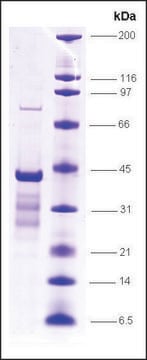
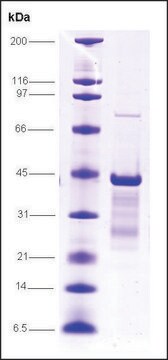
≥90% (SDS-PAGE)
Biological source:
human
Recombinant:
expressed in baculovirus infected Sf21 cells
biological source
human
Quality Segment
recombinant
expressed in baculovirus infected Sf21 cells
assay
≥90% (SDS-PAGE)
form
aqueous solution
technique(s)
dot blot: suitable
UniProt accession no.
application(s)
genomic analysis
shipped in
dry ice
storage temp.
−70°C
Gene Information
human ... TP53(7157)
General description
Histidine-tagged, full length human p53
p53 protein is composed of an N-terminal domain with a transactivation domain and proline-rich region, a central core-DNA binding domain, and a C-terminal domain with tetramerization and regulatory domains. The TP53 gene which encodes for the p53 protein is mapped on the human chromosome at 17p13.1.[1]
Application
Useful for the study of postranslational modification of p53, or protein-protein interaction studies.
p53 human has been used in dot blot.[2]
Biochem/physiol Actions
In addition, p53 was recently shown to induce differentiation of human embryonic stem cells. The effect is dependent on the DNA binding activity of p53. [3]
p53 gene is highly conserved and expressed in normal tissues. It is the most commonly mutated gene in human cancer and more then 500 gene mutations have been described in various types of malignancies, hematologic as well as solid tumors. Intact p53 function is essential for the maintenance of the non-tumorogenic phenotype of cells. Thus, p53 plays a vital role in suppressing the development of cancer.
p53 protein acts as a transcription factor that participates in regulating positively or negatively the expression of several responsive genes. It plays a role in regulating angiogenesis, cellular senescence, autophagy, cell survival, differentiation, and oxidative stress. Mutations in the TP53 gene lead to Li Fraumeni cancer syndrome.[4]
Physical form
Supplied as a solution in 20 mM Tris-HCl, pH 8.0, 20% glycerol, 100 mM KCl, 0.2 mM EDTA, and 1 mM DTT.
1 of 1
This Item | |||
|---|---|---|---|
| biological source human | biological source human | biological source human | biological source human |
| recombinant expressed in baculovirus infected Sf21 cells | recombinant expressed in E. coli | recombinant expressed in E. coli | recombinant expressed in E. coli |
| technique(s) dot blot: suitable | technique(s) - | technique(s) western blot: suitable | technique(s) - |
| assay ≥90% (SDS-PAGE) | assay ≥90% (SDS-PAGE) | assay ≥80% (SDS-PAGE) | assay ≥80% (SDS-PAGE) |
| form aqueous solution | form buffered aqueous glycerol solution | form frozen liquid | form frozen liquid |
| UniProt accession no. | UniProt accession no. | UniProt accession no. | UniProt accession no. |

Still not finding the right product?
Explore all of our products under p53 human
Storage Class
10 - Combustible liquids
wgk
WGK 3
flash_point_f
Not applicable
flash_point_c
Not applicable
Choose from one of the most recent versions:
Already Own This Product?
Find documentation for the products that you have recently purchased in the Document Library.