Przejdź do zawartości
Merck

Przejdź do

MAB3802

Anti-53BP1 Antibody, clone BP13

clone BP13, Chemicon®, from mouse

Synonim(y):

p53 Binding Protein 1

Zaloguj się, aby wyświetlić ceny organizacyjne i kontraktowe.

Wybierz wielkość

Zmień widok
Gabaryty przesyłkiSKUDostępnośćCena netto
100 μg

Przewidywany termin wysyłki19 maja 2026zKuehne + Nagel Sp. z o.o.

1810,00 zł

Informacje o tej pozycji

UNSPSC Code:
12352203
NACRES:
NA.41
eCl@ss:
32160702
Conjugate:
unconjugated
Clone:
BP13, monoclonal
Application:
IF, WB
Citations:
76

1810,00 zł


Przewidywany termin wysyłki19 maja 2026Szczegóły

Rekombinowane, niezawierające konserwantów przeciwciało jest dostępne dla Twojego celu. Wypróbuj ZMS1044

Zamów zamówienie zbiorcze
Pomoc techniczna
Potrzebujesz pomocy? Nasz zespół doświadczonych naukowców chętnie Ci pomoże.
Pozwól nam pomóc


biological source

mouse

Quality Level

conjugate

unconjugated

antibody form

purified immunoglobulin

antibody product type

primary antibodies

clone

BP13, monoclonal

species reactivity

human

manufacturer/tradename

Chemicon®

technique(s)

immunofluorescence: suitable, western blot: suitable

isotype

IgG1

NCBI accession no.

UniProt accession no.

shipped in

wet ice

target post-translational modification

unmodified

Gene Information

human ... TP53BP1(7158)

General description

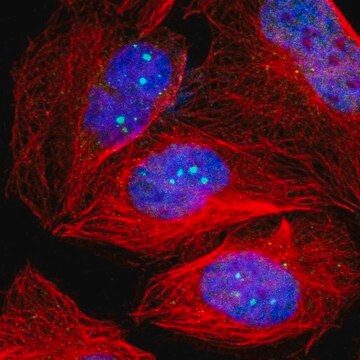
P53-binding protein 1 (53BP1) plays a critical role in tumor suppression and is a putative substrate of ATM kinase. Upon DNA damage, it is phosphorylated and relocalizes to the presumptive sites of damage, specifically, double-strand breaks. This also suggests a role in DNA repair, and maintaining genomic stability. It is sequence specific transcription factor that plays a central role in the the response of mammalian cells to genotoxic stress. Also, 53BP1 localizes to kinetochores in mitotic cells, suggesting a potential function in mitotic checkpoint signaling.

Immunogen

Recombinant human 53BP1 proteins.

Application

Detect 53BP1 also known as p53 Binding Protein 1 with Anti-53BP1 Antibody, clone BP13 (Mouse Monoclonal Antibody) validated in IF & WB.
Research Category
Epigenetics & Nuclear Function
Research Sub Category
Cell Cycle, DNA Replication & Repair
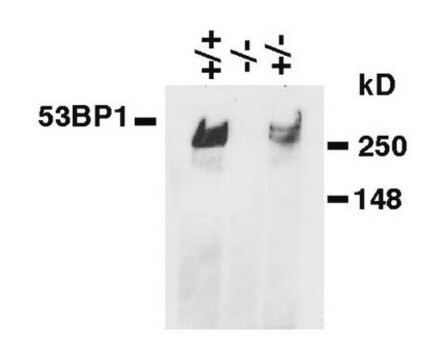
Western blot. Recognizes a protein of >250 kD. Suggested dilution buffer is TBST. Suggested blocking buffer is 5% non-fat dry milk.

Immunoprecipitation. Expected size in immunoblot is >250 kD. Suggested lysis buffer is NETN. Suggested capture agent is Protein A + rabbit anti-mouse linker antibody.

Optimal working dilutions must be determined by the end user.

Biochem/physiol Actions

53BP1

Physical form

Format: Purified
Purified immunoglobulin. Liquid in PBS, containing sodium azide.

Preparation Note

Maintain at 2-8°C in undiluted aliquots for up to 12 months from date of receipt.

Legal Information

CHEMICON is a registered trademark of Merck KGaA, Darmstadt, Germany

Disclaimer

Unless otherwise stated in our catalog or other company documentation accompanying the product(s), our products are intended for research use only and are not to be used for any other purpose, which includes but is not limited to, unauthorized commercial uses, in vitro diagnostic uses, ex vivo or in vivo therapeutic uses or any type of consumption or application to humans or animals.
Ta strona może zawierać tekst przetłumaczony maszynowo.

Porównaj podobne pozycje

Wyświetl pełne porównanie

Pokaż różnice

1 of 1

Ta pozycja
MAB3804SAB4503016HPA008788
conjugate

unconjugated

conjugate

unconjugated

conjugate

unconjugated

conjugate

unconjugated

antibody form

purified immunoglobulin

antibody form

ascites fluid

antibody form

affinity isolated antibody

antibody form

affinity isolated antibody

Gene Information

human ... TP53BP1(7158)

Gene Information

human ... TP53BP1(7158)

Gene Information

human ... TP53BP1(7158)

Gene Information

human ... TP53BP1(7158)

clone

BP13, monoclonal

clone

BP18, monoclonal

clone

polyclonal

clone

polyclonal

biological source

mouse

biological source

mouse

biological source

rabbit

biological source

rabbit

species reactivity

human

species reactivity

mouse, human

species reactivity

rat, mouse, human

species reactivity

human


Still not finding the right product?

Explore all of our products under

lub

Wypróbuj nasze narzędzie Narzędzie selektora produktów, aby zawęzić opcje.


Klasa składowania

12 - Non Combustible Liquids

wgk

WGK 2

flash_point_f

Not applicable

flash_point_c

Not applicable


Certyfikaty analizy (CoA)

Poszukaj Certyfikaty analizy (CoA), wpisując numer partii/serii produktów. Numery serii i partii można znaleźć na etykiecie produktu po słowach „seria” lub „partia”.

Masz już ten produkt?

Dokumenty związane z niedawno zakupionymi produktami zostały zamieszczone w Bibliotece dokumentów.

Odwiedź Bibliotekę dokumentów


Ankana Tiwari et al.
Nature communications, 9(1), 677-677 (2018-02-16)
Chromosome missegregation acts as one of the driving forces for chromosome instability and cancer development. Here, we find that in human cancer cells, HeLa and U2OS, depletion of 53BP1 (p53-binding protein 1) exacerbates chromosome non-disjunction resulting from a new type
Shankar J Chinta et al.
Cell reports, 22(4), 930-940 (2018-02-02)
Exposure to the herbicide paraquat (PQ) is associated with an increased risk of idiopathic Parkinson's disease (PD). Therapies based on PQ's presumed mechanisms of action have not, however, yielded effective disease therapies. Cellular senescence is an anticancer mechanism that arrests
Dominika Kwasna et al.
Molecular cell, 70(1), 150-164 (2018-03-27)
Deubiquitinating enzymes (DUBs) are important regulators of ubiquitin signaling. Here, we report the discovery of deubiquitinating activity in ZUFSP/C6orf113. High-resolution crystal structures of ZUFSP in complex with ubiquitin reveal several distinctive features of ubiquitin recognition and catalysis. Our analyses reveal


Numer pozycji handlu globalnego

SKUNUMER GTIN
MAB380204053252614620

Questions

Reviews

No rating value

Active Filters