Przejdź do zawartości
Merck

Przejdź do

MAB2253

Anti-Integrin β1 Antibody, clone 6S6

clone 6S6, Chemicon®, from mouse

Synonim(y):

CD29

Zaloguj się, aby wyświetlić ceny organizacyjne i kontraktowe.

Wybierz wielkość

Zmień widok
Gabaryty przesyłkiSKUDostępnośćCena netto
100 μg

Przewidywany termin wysyłki04 maja 2026zKuehne + Nagel Sp. z o.o.

1950,00 zł

Informacje o tej pozycji

UNSPSC Code:
12352203
NACRES:
NA.41
eCl@ss:
32160702
Clone:
6S6, monoclonal
Species reactivity:
human
Application:
FACS, IHC, IP
Citations:
75

1950,00 zł


Przewidywany termin wysyłki04 maja 2026Szczegóły

Rekombinowane, niezawierające konserwantów przeciwciało jest dostępne dla Twojego celu. Wypróbuj ZMS1034

Zamów zamówienie zbiorcze
Pomoc techniczna
Potrzebujesz pomocy? Nasz zespół doświadczonych naukowców chętnie Ci pomoże.
Pozwól nam pomóc


biological source

mouse

Quality Level

antibody form

purified immunoglobulin

antibody product type

primary antibodies

clone

6S6, monoclonal

species reactivity

human

manufacturer/tradename

Chemicon®

technique(s)

flow cytometry: suitable, immunohistochemistry: suitable, immunoprecipitation (IP): suitable

isotype

IgG1

NCBI accession no.

UniProt accession no.

shipped in

wet ice

target post-translational modification

unmodified

Gene Information

human ... ITGB1(3688)

General description

88 kDa
Integrin beta 1, also known as CD29, is a 130 kDa transmembrane glycoprotein that forms noncovalent complexes with various Integrin alpha subunits (including alpha 1, alpha 2, alpha 3, alpha 4, alpha 5, and alpha 6) to form the functional receptors that bind to specific extracellular matrix proteins. Integrin receptors are involved in the regulation of a variety of important biological functions, including embryonic development, wound repair, hemostasis, and prevention of programmed cell death. They are also implicated in abnormal pathological states such as tumor directed angiogenesis, tumor cell growth, and metastasis. These heterodimeric receptors bridge the cytoplasmic actin cytoskeleton with proteins present in the extracellular matrix and/or on adjacent cells. Interactions between integrins and the extracellular matrix lead to activation of signal transduction pathways and regulation of gene expression.

Immunogen

Human synovial cells

Application

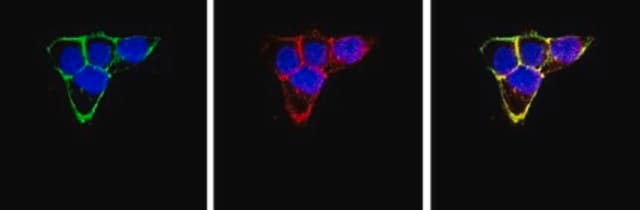
Detect Integrin β1 using this Anti-Integrin β1 Antibody, clone 6S6 validated for use in FC, IH & IP.
Immunoprecipitation

Immunohistochemistry on frozen sections

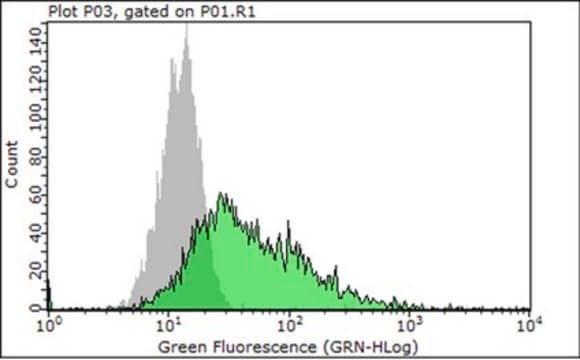
Flow cytometry

Blocks adhesion of cells to extracellular matrix proteins

Induces aggregation of certain lymphoid cells

Does not bind reduced beta1 integrin on Western blot

Optimal working dilutions must be determined by end user.
Research Category
Cell Structure
Research Sub Category
Integrins

Biochem/physiol Actions

Reacts with the human integrin beta1 subunit. Specificity verified by preclearing of beta1in immunoprecipitation, flow cytometry on transfectant cells displaying human beta1 integrin, and reactivity with purified beta1. Similar in behavior and characteristics to antibody clone 3S3 (Wilkins et al., 1996).

Physical form

Format: Purified
Protein A Purified mouse immunoglobulin in 20 mM sodium phosphate, 250 mM NaCl, pH. 7.6, with 0.1% sodium azide as a preservative.
Protein A purified

Preparation Note

Maintain for 1 year at 2–8°C from date of shipment. Aliquot to avoid repeated freezing and thawing. For maximum recovery of product, centrifuge the original vial after thawing and prior to removing the cap.

Analysis Note

Control
Tonsil, human skin tissue

Other Notes

Concentration: Please refer to the Certificate of Analysis for the lot-specific concentration.

Legal Information

CHEMICON is a registered trademark of Merck KGaA, Darmstadt, Germany

Disclaimer

Unless otherwise stated in our catalog or other company documentation accompanying the product(s), our products are intended for research use only and are not to be used for any other purpose, which includes but is not limited to, unauthorized commercial uses, in vitro diagnostic uses, ex vivo or in vivo therapeutic uses or any type of consumption or application to humans or animals.
Ta strona może zawierać tekst przetłumaczony maszynowo.

Porównaj podobne pozycje

Wyświetl pełne porównanie

Pokaż różnice

1 of 1

Ta pozycja
MAB2253ZMAB1959MAB1959Z
biological source

mouse

biological source

mouse

biological source

mouse

biological source

mouse

antibody form

purified immunoglobulin

antibody form

purified immunoglobulin

antibody form

purified immunoglobulin

antibody form

purified antibody

clone

6S6, monoclonal

clone

6S6, monoclonal

clone

P5D2, monoclonal

clone

P5D2, monoclonal

Gene Information

human ... ITGB1(3688)

Gene Information

human ... ITGB1(3688)

Gene Information

human ... ITGB1(3688)

Gene Information

human ... ITGB1(3688)

species reactivity

human

species reactivity

human

species reactivity

human

species reactivity

human

Quality Level

100

Quality Level

100

Quality Level

100

Quality Level

100


Still not finding the right product?

Wypróbuj nasze narzędzie Narzędzie selektora produktów, aby zawęzić opcje.


wgk

WGK 2

flash_point_f

Not applicable

flash_point_c

Not applicable

Klasa składowania

12 - Non Combustible Liquids


Certyfikaty analizy (CoA)

Poszukaj Certyfikaty analizy (CoA), wpisując numer partii/serii produktów. Numery serii i partii można znaleźć na etykiecie produktu po słowach „seria” lub „partia”.

Masz już ten produkt?

Dokumenty związane z niedawno zakupionymi produktami zostały zamieszczone w Bibliotece dokumentów.

Odwiedź Bibliotekę dokumentów


M L Albert et al.
The Journal of experimental medicine, 188(7), 1359-1368 (1998-10-09)
Dendritic cells, but not macrophages, efficiently phagocytose apoptotic cells and cross-present viral, tumor, and self-antigens to CD8(+) T cells. This in vitro pathway corresponds to the in vivo phenomena of cross-priming and cross-tolerance. Here, we demonstrate that phagocytosis of apoptotic
A power-law dependence of bacterial invasion on mammalian host receptors.
Lee, TJ; Wong, J; Bae, S; Lee, AJ; Lopatkin, A; Yuan, F; You, L
PLoS Computational Biology null
Sung Wook Park et al.
Diabetes, 63(9), 3057-3068 (2014-04-12)
Pericyte loss is an early characteristic change in diabetic retinopathy (DR). Despite accumulating evidence that hyperglycemia-induced angiopoietin 2 (Ang2) has a central role in pericyte loss, the precise molecular mechanism has not been elucidated. This study investigated the role of


Numer pozycji handlu globalnego

SKUNUMER GTIN
MAB225304053252399022

Questions

Reviews

No rating value

Active Filters