Przejdź do zawartości
Merck

Przejdź do

ABS551

Przeciwciało przeciwko receptorowi glukagonu

from rabbit, purified by affinity chromatography

Synonim(y):

GL-R, Glucagon receptor

Zaloguj się, aby wyświetlić ceny organizacyjne i kontraktowe.

Wybierz wielkość

Zmień widok
Gabaryty przesyłkiSKUDostępnośćCena netto
100 μg

Przewidywany termin wysyłki08 kwietnia 2026zKuehne + Nagel Sp. z o.o.

1890,00 zł

Informacje o tej pozycji

UNSPSC Code:
12352203
NACRES:
NA.41
eCl@ss:
32160702
Conjugate:
unconjugated
Clone:
polyclonal
Application:
IHC, WB
Citations:
-

1890,00 zł


Przewidywany termin wysyłki08 kwietnia 2026Szczegóły


Zamów zamówienie zbiorcze
Pomoc techniczna
Potrzebujesz pomocy? Nasz zespół doświadczonych naukowców chętnie Ci pomoże.
Pozwól nam pomóc

biological source

rabbit

Quality Level

conjugate

unconjugated

antibody form

affinity isolated antibody

antibody product type

primary antibodies

clone

polyclonal

purified by

affinity chromatography

species reactivity

human

species reactivity (predicted by homology)

primate (based on 100% sequence homology)

technique(s)

immunohistochemistry: suitable (paraffin), western blot: suitable

Porównaj podobne pozycje

Wyświetl pełne porównanie

Pokaż różnice

1 of 1

Ta pozycja
SAB4501138SAB4501137SAB1410515
biological source

rabbit

biological source

rabbit

biological source

rabbit

biological source

rabbit

conjugate

unconjugated

conjugate

unconjugated

conjugate

unconjugated

conjugate

unconjugated

Quality Level

100

Quality Level

100

Quality Level

100

Quality Level

-

antibody form

affinity isolated antibody

antibody form

affinity isolated antibody

antibody form

affinity isolated antibody

antibody form

purified immunoglobulin

technique(s)

immunohistochemistry: suitable (paraffin), western blot: suitable

technique(s)

ELISA: 1:1000, immunofluorescence: 1:100-1:500, western blot: 1:500-1:1000

technique(s)

ELISA: 1:5000, immunofluorescence: 1:100-1:500, western blot: 1:500-1:1000

technique(s)

western blot: 1 μg/mL

clone

polyclonal

clone

polyclonal

clone

polyclonal

clone

polyclonal

General description

Receptor glukagonu lub GL-R (UniProt P47871) jest kodowany przez gen GCGR (znany również jako GGR) (identyfikator genu 2642) u człowieka. Glukagon jest 29-aminokwasowym peptydem, który stymuluje glikogenolizę i glukoneogenezę w wątrobie w celu zwiększenia stężenia glukozy we krwi. Receptor dla glukagonu jest receptorem klasy 2 (lub klasy B) sprzężonym z białkiem G (GPCR), który sygnalizuje poprzez Gs w celu stymulowania produkcji cAMP. Myszy pozbawione receptora glukagonu mają łagodną hipoglikemię po poście i wykazują przerost komórek alfa trzustki. Ze względu na swoją rolę w promowaniu hiperglikemii, receptor glukagonu stanowi potencjalny cel w leczeniu cukrzycy.
Zaobserwowano ~59 kDa. Pasmo docelowe wydaje się większe niż obliczona masa cząsteczkowa 54,0 kDa (preforma) i 51,3 kDa (dojrzała) z powodu glikozylacji. Można również zaobserwować pasmo(a) degradacji o niższej masie cząsteczkowej (Iwanij, V., et al. (1990). J. Biol Chem. 265(34):21302-21308).

Immunogen

Epitop: Czwarta domena cytoplazmatyczna
Liniowy peptyd sprzężony z KLH odpowiadający cytoplazmatycznej domenie ludzkiego receptora glukagonu.

Application

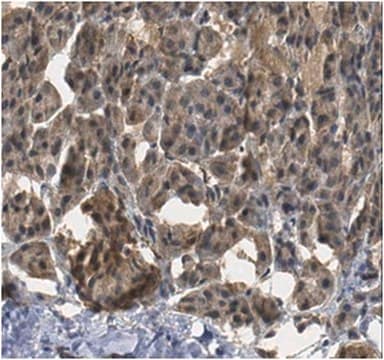
Analiza immunohistochemiczna: Rozcieńczenie 1:50 z reprezentatywnej partii wykryło receptor glukagonu w ludzkiej trzustce.
To przeciwciało przeciwko receptorowi glukagonu zostało zatwierdzone do stosowania w Western Blotting, immunohistochemii (parafina) do wykrywania receptora glukagonu.

Analysis Note

Evaluated by Western Blotting in human liver tissue lysate.

Western Blotting Analysis: 0.2 µg/mL of this antibody detected Glucagon receptor in 10 µg of human liver tissue lysate.

Other Notes

Stężenie: Należy zapoznać się z arkuszem danych dla konkretnej partii.
Ta strona może zawierać tekst przetłumaczony maszynowo.

Nie możesz znaleźć właściwego produktu?  

Wypróbuj nasz Narzędzie selektora produktów.

Klasa składowania

12 - Non Combustible Liquids

wgk

WGK 1

flash_point_f

Not applicable

flash_point_c

Not applicable


Certyfikaty analizy (CoA)

Poszukaj Certyfikaty analizy (CoA), wpisując numer partii/serii produktów. Numery serii i partii można znaleźć na etykiecie produktu po słowach „seria” lub „partia”.

Masz już ten produkt?

Dokumenty związane z niedawno zakupionymi produktami zostały zamieszczone w Bibliotece dokumentów.

Odwiedź Bibliotekę dokumentów

Powiązane treści

A major focus of breast cancer research is to understand the mechanisms responsible for disease progression and drug resistance. Toward that end, it has been found that approximately two thirds of all human breast carcinomas overexpress the Estrogen Receptor α (ERα) protein and it remains the primary pharmacological target for endocrine therapy1,2. The normal cellular function of ERα is as a transcription factor that mediates a wide variety of physiological processes, many of which are dependent upon phosphorylation of the receptor at specific amino acid residues3,4. Indeed, ERα is known to be phosphorylated at a multitude of different sites, yet how these all correlate to disease remains unclear5. Here, we interrogated multiple sites of ERα for phosphorylation status by screening an extensive panel of different breast cancer patient samples and other non-breast cancer tissue microarray (TMA) slide samples to determine their relevance to disease.

"Mods – modifications – small alterations can have a big impact on form and function. In the motorsports world, stock vehicles are modified to enhance their performance. Modifications, or mods, to the engine, drive train, intake and exhaust components add up to provide phenomenal performance gains that can be measured as horsepower and torque increases, which yield a competitive advantage, and result in reduced run times. In biology, proteins undergo modifications that alter their function. Some proteins require the modifications in order to perform their function effectively, whether it’s a pro-protein that is cleaved to produce an active enzyme, or a protein that is phosphorylated to facilitate a signaling process. Other proteins, such as histones, undergo modifications that regulate gene expression and alter cellular function. There are several post translational modifications such as acetylation, methylation, phosphorylation, and ubiquitination that impact protein function and activity. As a result, the analysis of proteins and their post-translational modifications are particularly important for the study of normal and disease-associated processes. New antibodies to detect phospho Histidines are now available from EMD Millipore."

Numer pozycji handlu globalnego

SKUNUMER GTIN
ABS55104055977277357

Questions

Reviews

No rating value

Active Filters

Nasz zespół naukowców ma doświadczenie we wszystkich obszarach badań, w tym w naukach przyrodniczych, materiałoznawstwie, syntezie chemicznej, chromatografii, analityce i wielu innych dziedzinach.

Skontaktuj się z zespołem ds. pomocy technicznej