Przejdź do zawartości
Merck

Przejdź do

AB5622-I

Anti-MAP-2

from rabbit, purified by affinity chromatography

Synonim(y):

Mirotubule associated protein 2

Zaloguj się, aby wyświetlić ceny organizacyjne i kontraktowe.

Wybierz wielkość

Zmień widok
Do Państwa/SKUDostępnośćCena netto
100 μg

Dostępne do wysyłki DZISIAJzKuehne + Nagel Sp. z o.o.

1980,00 zł

Informacje o tej pozycji

UNSPSC Code:
12352203
NACRES:
NA.41
eCl@ss:
32160702
Conjugate:
unconjugated
Clone:
polyclonal
Application:
ICC, IHC, WB
Citations:
11

1980,00 zł


Dostępne do wysyłki DZISIAJSzczegóły


Zamów zamówienie zbiorcze
Pomoc techniczna
Potrzebujesz pomocy? Nasz zespół doświadczonych naukowców chętnie Ci pomoże.
Pozwól nam pomóc


biological source

rabbit

Quality Segment

conjugate

unconjugated

antibody form

affinity isolated antibody

antibody product type

primary antibodies

clone

polyclonal

purified by

affinity chromatography

species reactivity

rat, mouse

technique(s)

immunocytochemistry: suitable, immunohistochemistry: suitable (paraffin), western blot: suitable

NCBI accession no.

UniProt accession no.

shipped in

ambient

target post-translational modification

unmodified

Gene Information

rat ... Map2(25595)

General description

Microtubule-associated protein 2 (UniProt: P15146; also known as MAP-2) is encoded by the Map2 (also known as Mtap2) gene (Gene ID: 25595) in Rat. MAPs are a family of proteins that bind to and stabilize microtubules. MAP4 is expressed ubiquitously while MAP1 and MAP2 are expressed primarily in neurons. MAP2 are cytoskeletal proteins that stabilize microtubules and prevents their depolymerization and may also have a stiffening effect on microtubules. MAP-2 plays an important role in brain neuron microtubule assembly. It also associates with neurofilaments and actin filaments and thereby guides interaction among microtubules, other cytoskeletal elements, and cytoplasmic organelles. Four different isoforms of MAP2 have been described that bind to microtubules through a domain near the carboxyl terminus. MAP2 isoforms are expressed only in neuronal cells and specifically in the cell bodies and dendrites. In the central nervous system, MAP-2 is confined to neuronal cell bodies and dendrites. However, some axons may also have small amounts of MAP-2. MAP-2 usually consists of MAP-2a and MAP-2b, ~280kDa each, and lower molecular weight MAP2c, which is present during neuronal differentiation in the developing nervous system. MAP-2 is a marker for neurons and is uniformly distributed throughout the cell when first expressed in cultured neurons. However, later it is selectively localized as dendritic development proceeds. MAP-2 can be phosphorylated at serine residues in K-X-G-S motifs by MAP/microtubule affinity-regulating kinase (MARK1 or MARK2) that results in detachment from microtubules, and their disassembly.
~280 kDa observed; 202.41 kDa calculated. Uncharacterized bands may be observed in some lysate(s).

Immunogen

KLH-conjugated three peptides from N-and C-terminal regions of rat MAP-2.

Application

Anti-MAP-2, Cat. No. AB5622-I, is a highly specific rabbit polyclonal antibody that targets microtubule-associated protein 2 and has been tested in Immunocytochemistry, Immunohistochemistry (Paraffin), and Western Blotting.
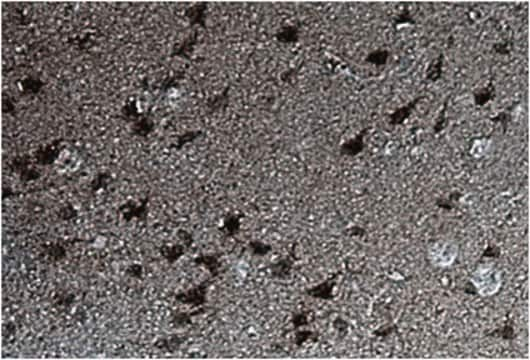
Immunohistochemistry Analysis: A 1:1,000 dilution from a representative lot detected MAP-2 in rat cerebral cortex and rat kidney tissue.

Western Blotting Analysis: 2 µg/mL from a representative lot detected MAP-2 in 10 µg of rat brain microsomal preparations.

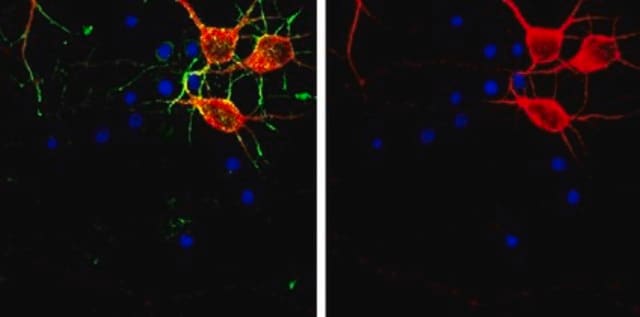
Immunocytochemistry Analysis: 1 µg/mL from a representative lot detected MAP-2 in rat primary cortex cells.
Research Category
Neuroscience

Biochem/physiol Actions

This polyclonal antibody detects MAP2 in Mouse and Rat tissues.

Physical form

Affinity Purified
Purified rabbit polyclonal antibody in buffer containing 0.1 M Tris-Glycine (pH 7.4), 150 mM NaCl with 0.05% sodium azide.

Preparation Note

Stable for 1 year at 2-8°C from date of receipt.

Analysis Note

Evaluated by Immunohistochemistry in mouse cerebellum tissue.

Immunohistochemistry Analysis: A 1:1,000 dilution of this antibody detected MAP-2 in mouse cerebellum tissue.

Other Notes

Concentration: Please refer to lot specific datasheet.

Disclaimer

Unless otherwise stated in our catalog or other company documentation accompanying the product(s), our products are intended for research use only and are not to be used for any other purpose, which includes but is not limited to, unauthorized commercial uses, in vitro diagnostic uses, ex vivo or in vivo therapeutic uses or any type of consumption or application to humans or animals.
Ta strona może zawierać tekst przetłumaczony maszynowo.

Porównaj podobne pozycje

Wyświetl pełne porównanie

Pokaż różnice

1 of 1

Ta pozycja
AB5622AB2290MAB3418B
biological source

rabbit

biological source

rabbit

biological source

rabbit

biological source

mouse

Quality Level

100

Quality Level

100

Quality Level

100

Quality Level

100

conjugate

unconjugated

conjugate

-

conjugate

unconjugated

conjugate

biotin conjugate

antibody form

affinity isolated antibody

antibody form

saturated ammonium sulfate (SAS) precipitated

antibody form

affinity isolated antibody

antibody form

purified antibody

technique(s)

immunocytochemistry: suitable, western blot: suitable, immunohistochemistry: suitable (paraffin)

technique(s)

ELISA: suitable, immunocytochemistry: suitable, immunohistochemistry (formalin-fixed, paraffin-embedded sections): suitable, western blot: suitable

technique(s)

immunocytochemistry: suitable, immunohistochemistry: suitable (paraffin), western blot: suitable

technique(s)

immunocytochemistry: suitable

UniProt accession no.

P15146

UniProt accession no.

P11137

UniProt accession no.

P15146

UniProt accession no.

Q0IIA8


Still not finding the right product?

Wypróbuj nasze narzędzie Narzędzie selektora produktów, aby zawęzić opcje.


Klasa składowania

12 - Non Combustible Liquids

wgk

WGK 1

flash_point_f

Not applicable

flash_point_c

Not applicable


Certyfikaty analizy (CoA)

Poszukaj Certyfikaty analizy (CoA), wpisując numer partii/serii produktów. Numery serii i partii można znaleźć na etykiecie produktu po słowach „seria” lub „partia”.

Masz już ten produkt?

Dokumenty związane z niedawno zakupionymi produktami zostały zamieszczone w Bibliotece dokumentów.

Odwiedź Bibliotekę dokumentów


Questions

Reviews

No rating value

Active Filters