
AB19026

Anti-ADAM 10 Antibody, CT
Chemicon®, from rabbit
Synonim(y):
A disintegrin and metalloproteinase domain 10, ADAM metallopeptidase domain 10, CD156c antigen, Kuzbanian protein homolog, Mammalian disintegrin-metalloprotease, a disintegrin and metalloprotease domain 10
Wybierz wielkość
| Gabaryty przesyłki | SKU | Dostępność | Cena netto |
|---|---|---|---|
| 100 μg | Dostępne do wysyłki DZISIAJzKuehne + Nagel Sp. z o.o. | 2180,00 zł |
Informacje o tej pozycji
2180,00 zł
Dostępne do wysyłki DZISIAJSzczegóły
biological source
rabbit
Quality Level
conjugate
unconjugated
antibody form
purified antibody
antibody product type
primary antibodies
clone
polyclonal
species reactivity
bovine, mouse, human
species reactivity (predicted by homology)
rat
manufacturer/tradename
Chemicon®
technique(s)
immunofluorescence: suitable, immunohistochemistry: suitable (paraffin), western blot: suitable
NCBI accession no.
UniProt accession no.
shipped in
wet ice
target post-translational modification
unmodified
Gene Information
rat ... Adam10(29650)
General description
Tumor-necrosis factor alpha is a proinflammatory cytokine and contributes to a variety of inflammatory disease responses and programmed cell death. Notch receptor and its ligand participate in cell fate decisions during vertebrate development and are associated with several human disorders, including a T-cell lymphoma. TNA-alpha, notch and its ligand delta are all membrane-bond molecules, which are cleaved by proteases to release mature proteins or functional receptor. ADAM10-, a metalloprotease-disintegrin in the family of mammalian ADAM (for a disintegrin and metalloproteinase domain), was recently identified to cleave TNF-alpha, notch and its ligand delta (1-3). The genes encoding human, mouse, and bovine ADAM10 were recently cloned and designated ADAM10, kuzbanian (KUZ), and MADM, respectively, (1,2,4). ADAM10mRNA is expressed in a variety of human and bovine tissues.
Immunogen
Application
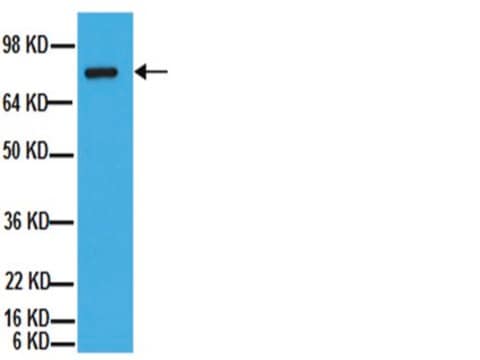
1:500 - 1:2,000 dilution. Jurkat whole cell lysate can be used as a positive control and an 85 kDa band can be detected which may represent precursor. A 60 kDa faint band was detected in some cell lines including Jurkat, which appears to be the processed mature protein. Overloading of the primary antibody can lead to multiple bands appearing in some preparations. The presence of glycosylated forms and breakdown products can lead to other bands. A prominent proform at near 80-85 is usually seen, with bands at 60, and below 50 kDa in most cases. The immunogen peptide is available (Cat. No. AG533) for performing antibody blocking studies.
Optimal working dilutions must be determined by end user.
Immunohistochemistry:
A previous lot of this antibody was used to detect ADAM10 in formalin-fixed, paraffin-embedded renal tissue and renal cell carcinoma tissue (Gutwein, P., et al. EUROPEAN JOURNAL OF CANCER. 45(2009):478–489).
Immunofluorescence:
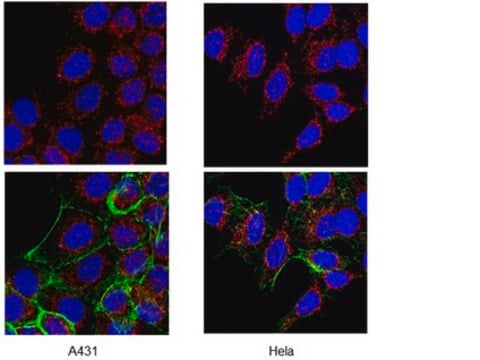
A previous lot of this antibody was used to detect ADAM10 in RCC4 (renal cell carcinoma) and A498 cells (Gutwein, P., et al. EUROPEAN JOURNAL OF CANCER. 45(2009):478–489).
Biochem/physiol Actions
Physical form
Preparation Note
Handling Recommendations:
Upon receipt, and prior to removing the cap, centrifuge the vial and gently mix the solution. Aliquot into microcentrifuge tubes and store at -20°C. Avoid repeated freeze/thaw cycles, which may damage IgG and affect product performance.
Analysis Note
ADAM 10 is ubiquitously expressed. MDA-MB231 (Human breast cancer cell line known to express high levels of ADAM 10).
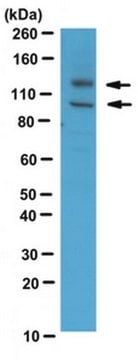
Western Blot: 1:500 dilution of this lot detected ADAM 10 on 10 μg of RAW264.7 lysates
Other Notes
Legal Information
1 of 1
Ta pozycja | |||
|---|---|---|---|
| Quality Level 100 | Quality Level 100 | Quality Level 100 | Quality Level 100 |
| antibody form purified antibody | antibody form purified antibody | antibody form purified immunoglobulin | antibody form serum |
| conjugate unconjugated | conjugate unconjugated | conjugate unconjugated | conjugate unconjugated |
| biological source rabbit | biological source rabbit | biological source mouse | biological source rabbit |
| clone polyclonal | clone polyclonal | clone 16C11.1, monoclonal | clone polyclonal |
| technique(s) immunofluorescence: suitable, western blot: suitable, immunohistochemistry: suitable (paraffin) | technique(s) immunocytochemistry: suitable, western blot: suitable | technique(s) immunohistochemistry: suitable (paraffin), western blot: suitable | technique(s) immunocytochemistry: suitable, western blot: suitable |

Still not finding the right product?
Wypróbuj nasze narzędzie Narzędzie selektora produktów, aby zawęzić opcje.
Klasa składowania
12 - Non Combustible Liquids
wgk
WGK 2
flash_point_f
Not applicable
flash_point_c
Not applicable
Certyfikaty analizy (CoA)
Poszukaj Certyfikaty analizy (CoA), wpisując numer partii/serii produktów. Numery serii i partii można znaleźć na etykiecie produktu po słowach „seria” lub „partia”.
Masz już ten produkt?
Dokumenty związane z niedawno zakupionymi produktami zostały zamieszczone w Bibliotece dokumentów.
Powiązane treści
Numer pozycji handlu globalnego
| SKU | NUMER GTIN |
|---|---|
| AB19026 | 08436037125058 |