Przejdź do zawartości
Merck

Przejdź do

AB15810

Anti-Substance P Receptor Antibody

Chemicon®, from guinea pig

Synonim(y):

Substance-P receptor, Neurokinin-1 receptor, NK-1 receptor, NK-1R, SPR, Tachykinin receptor 1

Zaloguj się, aby wyświetlić ceny organizacyjne i kontraktowe.

Wybierz wielkość

Zmień widok
Gabaryty przesyłkiSKUDostępnośćCena netto
50 μL

Przewidywany termin wysyłki29 maja 2026zKuehne + Nagel Sp. z o.o.

1820,00 zł

Informacje o tej pozycji

UNSPSC Code:
12352203
NACRES:
NA.41
eCl@ss:
32160702
Conjugate:
unconjugated
Clone:
polyclonal
Application:
IHC, WB
Citations:
12

1820,00 zł


Przewidywany termin wysyłki29 maja 2026Szczegóły


Zamów zamówienie zbiorcze
Pomoc techniczna
Potrzebujesz pomocy? Nasz zespół doświadczonych naukowców chętnie Ci pomoże.
Pozwól nam pomóc


biological source

guinea pig

Quality Segment

conjugate

unconjugated

antibody form

unpurified

antibody product type

primary antibodies

clone

polyclonal

species reactivity

rat, mouse, human

manufacturer/tradename

Chemicon®

technique(s)

immunohistochemistry: suitable, western blot: suitable

NCBI accession no.

UniProt accession no.

shipped in

wet ice

target post-translational modification

unmodified

Gene Information

human ... TACR1(6869)

General description

Substance-P receptor (UniProt P14600; also known as Neurokinin-1 receptor, NK-1 receptor, NK-1R, SPR, Tachykinin receptor 1) is encoded by the Tacr1 (also known as Nk1r, Tac1r) gene (Gene ID 24807) in rat species. NK-1, NK-2 and NK-3 are receptors that mediate the biological activities of tachykinins, including substance P (SP), neurokinin A (NKA), neurokinin B (NKB), ranakinin, kassinin, neuropeptide gamma, and eledoisin, widely distributed in the central and peripheral nervous systems. SP shows the highest affinity toward NK-1R (substance-P receptor) and exerts its biological activities via NK-1R, including addition, depression, chronic inflammation, and cancer progression. The involvement of NK-1R in acute pancreatitis through mediating neurogenic inflammation has also been reported. Upon stimulation by SP, the NK-1R interacts with multiple G proteins, including Gαs, Gαq/11, Gαi/o, Gα12, and Gα13, generating second messengers and activating downstream effector molecules. After binding NK-1R, SP induces a clathrin-dependent internalization of the receptor-ligand complex, SP is then degraded and the receptor is recycled to the cell surface. NK-1R is a 7-transmembrane (32-54, 65-86, 107-128, 149-169, 195-219, 249-270, 284-308) GPCR, having its N-terminal end (a.a. 1-31) at the extracelluar side and C-terminal end (a.a. 309-407) at the cytoplasmic side. There exist a second alternatively spliced human NK-1R isoform that lacks the C-terminal cytoplasmic domain (a.a. 312-407 missing). The full-length form enhances the growth of cancer cells and stimulates the production of cytokines, which up-regulate the truncated form. The truncated form mediates malignancy and is more abundant in colonic epithelial cells from patients with colitis-associated cancer. In cancer cells, the NK-1 receptor is mainly localized on the plasma membrane and in cytoplasm, and occasionally also in the nucleus.
~58/54 kDa observed. Target band size appears larger than the calculated molecular weights of 46.25/46.32/46.37 kDa (human/mouse/rat) due to glycosylation. Uncharacterized bands may be observed in some lysate(s).

Immunogen

Epitope: C-Terminus
KLH-conjugated linear peptide corresponding to the C-terminal end sequence of rat substance P receptor.

Application

Research Category
Neuroscience
Research Sub Category
Synapse & Synaptic Biology
This Guinea pig polyclonal Anti-Substance P Receptor Antibody, Cat. No. AB15810 detects levels of Substance P receptor, and has been published and validated for use in Immunohistochemistry, and Western Blotting.
Western Blotting Analysis: A 1:1,000 dilution from a representative lot detected substance P receptor in 10 µg of human brain tissue lysate.

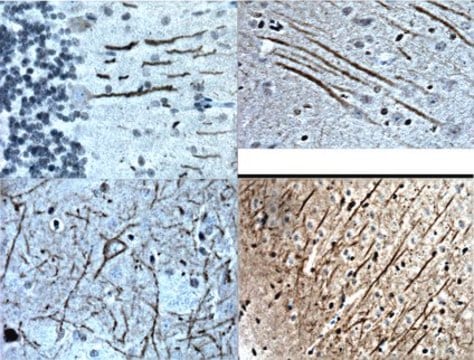
Immunohistochemistry Analysis: A 1:500 dilution from a representative lot detected substance P receptor in rat brain tissue sections.

Biochem/physiol Actions

This guinea pig polyclonal antiserum targets substance P receptor C-terminal end sequence. Target region is absent in human spliced isoform 2.

Physical form

Format: Unpurified
Guinea Pig polyclonal antibody serum with 0.05% sodium azide
Unpurified.

Preparation Note

Stable for 1 year at -20°C from date of receipt.

Handling Recommendations: Upon receipt and prior to removing the cap, centrifuge the vial and gently mix the solution. Aliquot into microcentrifuge tubes and store at -20°C. Avoid repeated freeze/thaw cycles, which may damage IgG and affect product performance.

Analysis Note

Control
Rat brain tissue lysate
Evaluated by Western Blotting in rat brain tissue lysate.

Western Blotting Analysis: A 1:5000 dilution from a representative lot detected substance-P receptor in 10 µg of rat brain tissue lysate.

Legal Information

CHEMICON is a registered trademark of Merck KGaA, Darmstadt, Germany

Disclaimer

Unless otherwise stated in our catalog or other company documentation accompanying the product(s), our products are intended for research use only and are not to be used for any other purpose, which includes but is not limited to, unauthorized commercial uses, in vitro diagnostic uses, ex vivo or in vivo therapeutic uses or any type of consumption or application to humans or animals.
Ta strona może zawierać tekst przetłumaczony maszynowo.

Porównaj podobne pozycje

Wyświetl pełne porównanie

Pokaż różnice

1 of 1

Ta pozycja
ABN1369S8305AB5060
Quality Level

100

Quality Level

100

Quality Level

200

Quality Level

100

biological source

guinea pig

biological source

rabbit

biological source

rabbit

biological source

rabbit

conjugate

unconjugated

conjugate

unconjugated

conjugate

unconjugated

conjugate

unconjugated

antibody form

unpurified

antibody form

affinity isolated antibody

antibody form

IgG fraction of antiserum

antibody form

serum

species reactivity

rat, mouse, human

species reactivity

rat, human, mouse

species reactivity

human, rat, mouse, guinea pig

species reactivity

rat, guinea pig, mouse

technique(s)

immunohistochemistry: suitable, western blot: suitable

technique(s)

immunohistochemistry: suitable, western blot: suitable

technique(s)

immunohistochemistry (frozen sections): 1:5,000 using 4% paraformaldehyde (with picric acid/glutaraldehyde)-fixed, frozen, rat brain sections., microarray: suitable, western blot (chemiluminescent): 1:2,000 using a rat brain membrane fraction extract

technique(s)

immunofluorescence: suitable, immunohistochemistry: suitable, western blot: suitable


Still not finding the right product?

Wypróbuj nasze narzędzie Narzędzie selektora produktów, aby zawęzić opcje.


Klasa składowania

12 - Non Combustible Liquids

wgk

WGK 1

flash_point_f

Not applicable

flash_point_c

Not applicable


Certyfikaty analizy (CoA)

Poszukaj Certyfikaty analizy (CoA), wpisując numer partii/serii produktów. Numery serii i partii można znaleźć na etykiecie produktu po słowach „seria” lub „partia”.

Masz już ten produkt?

Dokumenty związane z niedawno zakupionymi produktami zostały zamieszczone w Bibliotece dokumentów.

Odwiedź Bibliotekę dokumentów


Numer pozycji handlu globalnego

SKUNUMER GTIN
AB1581004053252668951

Questions

Reviews

No rating value

Active Filters