
ABE386

Anti-Flightless-1 homolog Antibody
serum, from rabbit
Synonym(s):
Protein flightless-1 homolog, Fli1, Anti-Flightless-1 homolog Antibody
Select a Size
| Size/SKU | Availability | Price |
|---|---|---|
100 μL | Estimated to ship onJune 05, 2026fromKuehne + Nagel Sp. z o.o. | PLN 1,650.00 |
About This Item
biological source
rabbit
Quality Segment
conjugate
unconjugated
antibody form
serum
antibody product type
primary antibodies
clone
polyclonal
species reactivity
mouse, rat, human
technique(s)
immunoprecipitation (IP): suitable, western blot: suitable
NCBI accession no.
UniProt accession no.
shipped in
wet ice
target post-translational modification
unmodified
Gene Information
human ... FLII(2314)
General description
Immunogen
Application
Analysis Note
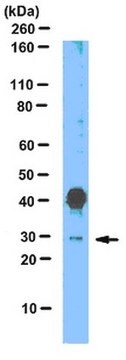
Western Blotting Analysis: A 1:1,000 dilution of this antibody detected Flightless-1 homolog in 10 µg of A431 cell lysate.
Other Notes
1 of 1
This Item | |||
|---|---|---|---|
| Quality Level 100 | Quality Level 100 | Quality Level 100 | Quality Level 100 |
| biological source rabbit | biological source rabbit | biological source rabbit | biological source rabbit |
| conjugate unconjugated | conjugate unconjugated | conjugate unconjugated | conjugate unconjugated |
| antibody form serum | antibody form affinity isolated antibody | antibody form affinity isolated antibody | antibody form serum |
| technique(s) immunoprecipitation (IP): suitable, western blot: suitable | technique(s) immunoblotting: 0.04-0.4 μg/mL, immunofluorescence: 0.25-2 μg/mL, immunohistochemistry: 1:50-1:200 | technique(s) western blot: suitable | technique(s) electron microscopy: suitable, immunocytochemistry: suitable, immunoprecipitation (IP): suitable, western blot: suitable |
| species reactivity mouse, rat, human | species reactivity human, mouse | species reactivity mouse, rat | species reactivity human, monkey, mouse |


Still not finding the right product?
Try our Product Selector Tool to narrow your options
Storage Class
10 - Combustible liquids
wgk
WGK 1
Certificates of Analysis (COA)
Search for Certificates of Analysis (COA) by entering the products Lot/Batch Number. Lot and Batch Numbers can be found on a product’s label following the words ‘Lot’ or ‘Batch’.
Already Own This Product?
Find documentation for the products that you have recently purchased in the Document Library.