Direkt zum Inhalt
Merck

Fortfahren mit

MABC616

Anti-NOX4 Antibody, clone 10A8.1

culture supernatant, clone 10A8.1, from mouse

Synonym(e):

NADPH oxidase 4, Kidney oxidase-1, Kidney superoxide-producing NADPH oxidase, KOX-1, Renal NAD(P)H-oxidase, NOX4

Anmelden zur Ansicht der Organisations- und Vertragspreise.

Größe auswählen

Ansicht ändern
PackungsgrößeSKUVerfügbarkeitPreis

Über diesen Artikel

UNSPSC Code:
12352203
NACRES:
NA.41
eCl@ss:
32160702
Conjugate:
unconjugated
Clone:
10A8.1, monoclonal
Application:
IHC, WB
Citations:
4
Preise und Verfügbarkeit sind derzeit nicht verfügbar.
Technischer Dienst
Benötigen Sie Hilfe? Unser Team von erfahrenen Wissenschaftlern ist für Sie da.
Unterstützung erhalten


biological source

mouse

Quality Level

conjugate

unconjugated

antibody form

culture supernatant

antibody product type

primary antibodies

clone

10A8.1, monoclonal

species reactivity

human

technique(s)

immunohistochemistry: suitable, western blot: suitable

isotype

IgG2bκ

NCBI accession no.

UniProt accession no.

shipped in

dry ice

target post-translational modification

unmodified

Gene Information

human ... NOX4(50507)

General description

NADPH oxidase 4 (UniProt Q9NPH5; also known as Kidney oxidase-1, Kidney superoxide-producing NADPH oxidase, KOX-1, Renal NAD(P)H-oxidase) is encoded by the NOX4 (also known as RENOX) gene (Gene ID 50507) in human. NOX4 belongs to the family of NADPH oxidases that modulate redox-dependent cellular signalling pathways via intracellular reactive oxygen species (ROS) generation. Seven family members have been identified in mammals (NOX1–5 and DUOX1/2) with member-specific cellular distribution, intracellular location, mechanisms of action and types of ROS produced. NOX4 produces predominantly H2O2, and is widely expressed in many cell types and adult tissues, including kidney, liver, heart and aorta. NOX4 plays an important role in homocysteine (Hcy) metabolism, which in turns is a determining factor that impacts on defence against environmental toxins. Nox-knocout in mice results in significantly decreased total plasma Hcy levels, causing markedly increased susceptibility to acetaminophen- (APAP-, paracetamol-) induced hepatoxicity as a result of significantly decreased cysteine production and hepatic GSH stores. Human NOX4 is a six-transmembrane (a.a. 17-37, 63-83, 104-124, 155-175, 189-209, 425-445) protein, having both its N- and C-terminal ends at the cytoplasmic side (a.a. 1-16 & 446-578).
~67 kDa observed. 66.93 kDa (isoform 1), 58.41 kDa (isoform 2; Nox4A), 64.10 kDa (isoform 8), 27.63 kDa (isoform 3; Nox4E), 31.81 kDa (isoform 4; Nox4D), 62.75 kDa (isoform 6; Nox4B) calculated.

Immunogen

Epitope: Third extracellular loop.
GST-tagged recombinant protein corresponding to a fragment from the third extracellular loop of human NOX4.

Application

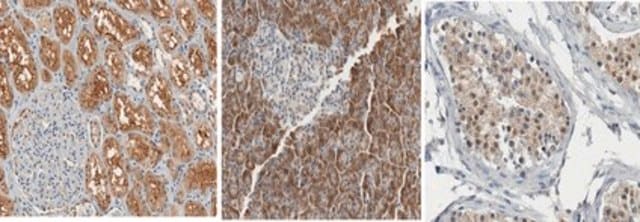
Immunohistochemistry Analysis: A 1:50 dilution from a representative lot detected NOX4 in human kidney, pancreas, and testis tissue sections.
Research Category
Apoptosis & Cancer
Research Sub Category
Toxicology & Drug Resistance
This Anti-NOX4 Antibody, clone 10A8.1 is validated for use in Western Blotting, Immunohistochemistry for the detection of NOX4.

Biochem/physiol Actions

Immunogen construct region is present in human NOX4 spliced isoform 1, 2 (Nox4A), and 8, missing in isoform 5 (Nox4C), 7, and 9, partially truncated in isoform 3 (Nox4E), 4 (Nox4D), and 6 (Nox4B) reported by UniProt (Q9NPH5).

Physical form

Mouse monoclonal IgG2bκ hybridoma culture supernatant without preservatives.
Unpurified.

Preparation Note

Stable for 1 year at -20°C from date of receipt.
Handling Recommendations: Upon receipt and prior to removing the cap, centrifuge the vial and gently mix the solution. Aliquot into microcentrifuge tubes and store at -20°C. Avoid repeated freeze/thaw cycles, which may damage IgG and affect product performance.

Analysis Note

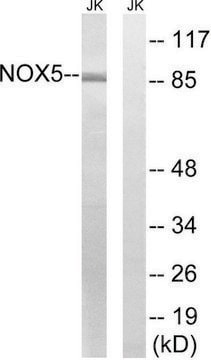
Evaluated by Western Blotting in human kidney tissue lysate.

Western Blotting Analysis: A 1:1,000 dilution of this antibody detected NOX4 in 10 µg of human kidney tissue lysate.

Other Notes

Concentration: Please refer to lot specific datasheet.

Disclaimer

Unless otherwise stated in our catalog or other company documentation accompanying the product(s), our products are intended for research use only and are not to be used for any other purpose, which includes but is not limited to, unauthorized commercial uses, in vitro diagnostic uses, ex vivo or in vivo therapeutic uses or any type of consumption or application to humans or animals.

Ähnliche Artikel vergleichen

Vollständigen Vergleich anzeigen

Unterschiede anzeigen

1 of 1

Dieser Artikel
ABC459SAB5700950SAB4200097
species reactivity

human

species reactivity

human, mouse

species reactivity

mouse, human, rat

species reactivity

human

conjugate

unconjugated

conjugate

unconjugated

conjugate

unconjugated

conjugate

unconjugated

biological source

mouse

biological source

rabbit

biological source

rabbit

biological source

rabbit

clone

10A8.1, monoclonal

clone

polyclonal

clone

polyclonal

clone

polyclonal

antibody form

culture supernatant

antibody form

purified antibody

antibody form

-

antibody form

affinity isolated antibody

Gene Information

human ... NOX4(50507)

Gene Information

human ... NOX4(50507)

Gene Information

human ... NOX4(50507)

Gene Information

human ... NOX1(27035)
mouse ... Nox1(237038)
rat ... Nox1(114243)


Still not finding the right product?

Probieren Sie unser Produkt-Auswahlhilfe, um Ihre Auswahl einzugrenzen


Lagerklasse

10 - Combustible liquids

wgk

WGK 2


Analysenzertifikate (COA)

Suchen Sie nach Analysenzertifikate (COA), indem Sie die Lot-/Chargennummer des Produkts eingeben. Lot- und Chargennummern sind auf dem Produktetikett hinter den Wörtern ‘Lot’ oder ‘Batch’ (Lot oder Charge) zu finden.

Besitzen Sie dieses Produkt bereits?

In der Dokumentenbibliothek finden Sie die Dokumentation zu den Produkten, die Sie kürzlich erworben haben.

Die Dokumentenbibliothek aufrufen


Dae Joong Ma et al.
Antioxidants (Basel, Switzerland), 12(6) (2023-06-28)
Human corneal-endothelial cells (hCEnCs) are located on the inner layer of the cornea. Injury to CEnCs leads to permanent corneal edema, requiring corneal transplantation. NADPH oxidase 4 (NOX4) has been reported to be implicated in the pathogenesis of CEnCs diseases.
null
Jin Sun Hwang et al.
Investigative ophthalmology & visual science, 61(4), 21-21 (2020-04-18)
Human corneal endothelial cells (hCECs) have limited regenerative capacity in vivo. Reduced hCEC density results in bullous keratopathy requiring corneal transplantation. This study reveals the role of transcription factor 4 (TCF4) in hCEC diseases and suggests that TCF4 may be


Global Trade Item Number

SKUGTIN
MABC61604055977355413

Questions

Reviews

No rating value

Active Filters