
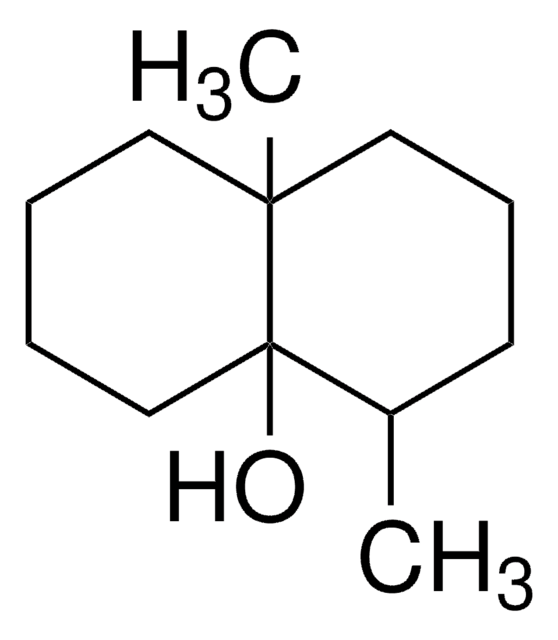
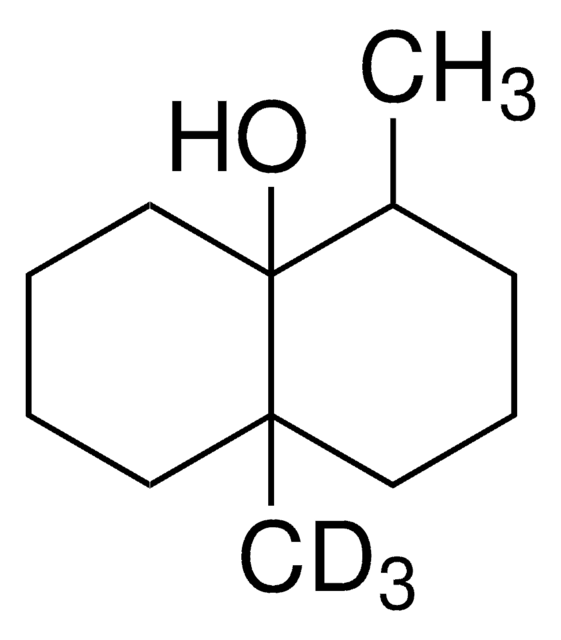

The geosmin products listed by Sigma-Aldrich (CAS Registry number [16423-19-1]) are synthetic, and would be exactly a 50:50 mixture of the (+) and (-) isomers. Specifically, the natural (-) isomer is (4S,4aS,8aR)-4,8a-Dimethyl-1,2,3,4,5,6,7,8-octahydronaphthalen-4a-ol. Therefore, the unnatural (+) isomer (the mirror image) is (4R,4aR,8aS)-4,8a-Dimethyl-1,2,3,4,5,6,7,8-octahydronaphthalen-4a-ol.This information has not been confirmed by a specific rotation measurement or chiral analysis, but is known based on the method of preparation.
UC18

(±)-Geosmin
≥97% (GC), liquid (oil)
Synonym(s):
2β,6α-Dimethylbicyclo[4.4.0]decan-1β-ol
Sign In to View Organizational & Contract Pricing.
Select a Size
Change View
| Size/SKU | Availability | Price |
|---|---|---|
5 mg | Available to ship TODAYfromMILWAUKEE | $628.00 |
10 mg | Available to ship TODAYfromMILWAUKEE | $833.00 |
About This Item
Empirical Formula (Hill Notation):
C12H22O
CAS Number:
Molecular Weight:
182.30
UNSPSC Code:
12161501
PubChem Substance ID:
NACRES:
NA.77
MDL number:
Assay:
≥97% (GC)
Form:
liquid (oil)
Product Name
(±)-Geosmin, ≥97% (GC)
Quality Segment
assay
≥97% (GC)
form
liquid (oil)
color
colorless
storage temp.
2-8°C
SMILES string
CC1CCCC2(C)CCCCC12O
InChI
1S/C12H22O/c1-10-6-5-8-11(2)7-3-4-9-12(10,11)13/h10,13H,3-9H2,1-2H3
InChI key
JLPUXFOGCDVKGO-UHFFFAOYSA-N
Application
(±)-Geosmin has been used as a standard for GC-MS based analytical techniques[1]. Geosmin has also been used to study its adsorption on activated carbon.
Biochem/physiol Actions
Geosmin is a naturally occurring biomolecule that contributes to the earthy or musty flavor and odor in water supplies[2]. This water contaminant can be detected by humans at ng/l (parts per trillion) concentrations[3].
(±)-Geosmin is produced by Streptomyces coelicolor and cyanobacteria.[4]
1 of 1
This Item | |||
|---|---|---|---|
| form liquid (oil) | form liquid | form powder | form powder |
| assay ≥97% (GC) | assay 97% (CP) | assay ≥98% (HPLC) | assay ≥95% (HPLC) |
| Quality Level 200 | Quality Level - | Quality Level - | Quality Level - |
| storage temp. 2-8°C | storage temp. - | storage temp. −20°C | storage temp. −20°C |
| color colorless | color - | color white to beige | color white to beige |
signalword
Warning
hcodes
Hazard Classifications
Eye Irrit. 2
Storage Class
10 - Combustible liquids
wgk
WGK 3
flash_point_f
Not applicable
flash_point_c
Not applicable
ppe
dust mask type N95 (US), Eyeshields, Gloves
Choose from one of the most recent versions:
Already Own This Product?
Find documentation for the products that you have recently purchased in the Document Library.
-
What can you tell me about the stereochemistry of Sigma-Aldrich's (±)-Geosmin products?
1 answer-
Helpful?
-
-
What is the Department of Transportation shipping information for this product?
1 answer-
Transportation information can be found in Section 14 of the product's (M)SDS.To access the shipping information for this material, use the link on the product detail page for the product.
Helpful?
-