
3010

Transcreener® ADP2 FP Assay
Sinonimo/i:
Transcreener assay
Autenticati per visualizzare i prezzi organizzativi e contrattuali.
Scegli un formato
Cambia visualizzazione
| Taglio della confezione | SKU | Disponibilità | Prezzo |
|---|---|---|---|
| 1000 assays | Per conoscere la disponibilità, visualizza il carrello | CHF 754.00 | |
| 10000 assays | Per conoscere la disponibilità, visualizza il carrello | CHF 4’160.00 |
Informazioni su questo articolo
NACRES:
NA.81
UNSPSC Code:
41122100
CHF 754.00
Per conoscere la disponibilità, visualizza il carrello
Servizio Tecnico
Hai bisogno di aiuto? Il nostro team di scienziati qualificati è a tua disposizione.
Permettici di aiutartishipped in
dry ice
storage temp.
−20°C
General description
The Transcreener® HTS Assay platform overcomes the need for time-consuming, one-off assay development for individual members within a group transfer enzyme family by utilizing a single set of assay reagents that detect an invariant product. The generic nature of the Transcreener® HTS Assay platform eliminates delays involved in assay development for new HTS targets, and greatly simplifies compound and inhibitor profiling across multiple target families.
The Transcreener® ADP2 FP Assay is a far-red, competitive fluorescence polarization (FP) assay based on the detection of ADP and therefore is compatible with any enzyme class that produces ADP, including protein, lipid, and carbohydrate kinases, ATPases, DNA helicases, carboxylases and glutamine synthetase. The Transcreener® ADP2 Assay is a simple one step homogenous detection assay, and is extremely flexible with regard to ATP concentration (0.1 to 1,000 μM ATP). The assay provides excellent signal at low substrate conversion, with a Z′ = 0.7 and = 85 polarization shift (mP) at 10% ATP conversion using 1 μM ATP.
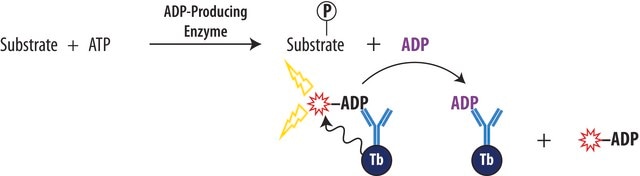
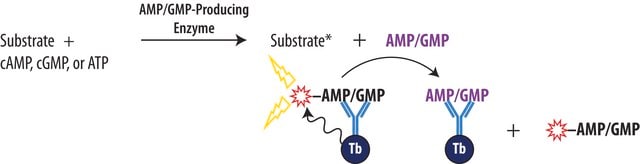
The Transcreener® ADP2 FP Assay was developed to follow the progress of any enzyme that produces ADP. The Transcreener® ADP Detection Mixture comprises an ADP Alexa633 Tracer bound to an ADP2 Antibody. The tracer is displaced by ADP, the invariant product generated during the enzyme reaction.The displaced tracer freely rotates leading to a decrease in fluorescence polarization. The assay uses a far red tracer to minimize interference from fluorescent compounds and light scattering.
View full Transcreener® product list
The Transcreener® ADP2 FP Assay is a far-red, competitive fluorescence polarization (FP) assay based on the detection of ADP and therefore is compatible with any enzyme class that produces ADP, including protein, lipid, and carbohydrate kinases, ATPases, DNA helicases, carboxylases and glutamine synthetase. The Transcreener® ADP2 Assay is a simple one step homogenous detection assay, and is extremely flexible with regard to ATP concentration (0.1 to 1,000 μM ATP). The assay provides excellent signal at low substrate conversion, with a Z′ = 0.7 and = 85 polarization shift (mP) at 10% ATP conversion using 1 μM ATP.
The Transcreener® ADP2 FP Assay was developed to follow the progress of any enzyme that produces ADP. The Transcreener® ADP Detection Mixture comprises an ADP Alexa633 Tracer bound to an ADP2 Antibody. The tracer is displaced by ADP, the invariant product generated during the enzyme reaction.The displaced tracer freely rotates leading to a decrease in fluorescence polarization. The assay uses a far red tracer to minimize interference from fluorescent compounds and light scattering.
View full Transcreener® product list
Physical form
Kit with buffered aqueous solutions
Preparation Note
3010-1K = 1,000 assay, 384-well
3010-10K = 10,000 assay, 384-well
3010-10K = 10,000 assay, 384-well
Legal Information
Transcreener is a registered trademark of BellBrook Labs
1 of 1
Questo articolo | |||
|---|---|---|---|
| shipped in dry ice | shipped in dry ice | shipped in dry ice | shipped in dry ice |
| storage temp. −20°C | storage temp. −20°C | storage temp. −20°C | storage temp. −20°C |


signalword
Warning
Classe di stoccaggio
12 - Non Combustible Liquids
wgk
WGK 3
flash_point_f
Not applicable
flash_point_c
Not applicable
target_organs
Respiratory Tract


hcodes
Hazard Classifications
Eye Irrit. 2 - STOT RE 2 Inhalation
Scegli una delle versioni più recenti:
Possiedi già questo prodotto?
I documenti relativi ai prodotti acquistati recentemente sono disponibili nell’Archivio dei documenti.
Protocolli
Jump dilution protocol to determine the residence time of a drug (or drug candidate) during its interaction with a kinase using a fluorescence polarization assay based on the detection of ADP.
Peng Su et al.
International journal of clinical and experimental pathology, 7(6), 3008-3017 (2014-07-18)
IMP3 plays an important role in tumor invasion and metastasis, to which epithelial to mesenchymal transition (EMT) also contributes. The purpose of this study was to investigate whether IMP3 can regulate invasion and metastasis through EMT in breast cancers. The
Nathalie Boone et al.
PloS one, 5(12), e15590-e15590 (2010-12-29)
Familial dysautonomia (FD) is a hereditary neuropathy caused by mutations in the IKBKAP gene, the most common of which results in variable tissue-specific mRNA splicing with skipping of exon 20. Defective splicing is especially severe in nervous tissue, leading to
Founders of the first Hungarian Physiological Association in 1891.
E Monos et al.
Acta physiologica Hungarica, 97(1), 60-61 (2010-03-18)
Numero articolo commerciale globale
| SKU | GTIN |
|---|---|
| 151815-10X0.75ML | 04061838739575 |
| 151815-10X1ML | 04061838739582 |
| 175870-25G | 04061838752574 |
| 175870-10X0.8ML-N | 04061837613401 |
| 175978-10G | 04061838752611 |
| 175978-50G | 04061838752628 |
| 175870-5G | 04061837613425 |
| 48940-U | 04061832401669 |
| 1017660009 | 04022536024455 |
| 1017890000 | 04061839633506 |
| 570680-50G | 04061832597393 |
| 151815-50G | 04061837648861 |
| 151815-10X50G-N | 04061837648854 |
| 151815-100G | 04061837648847 |
| 151815-25G | 04061838739599 |
| 151815-10G-AMP | 04061837613098 |
| 151815-10G-GL | 04061838739568 |
| 175870-10X1ML | 04061837613418 |
| 175870-10X0.5ML | 04061838752567 |