Direkt zum Inhalt
Merck

F9902

Monoclonal Anti-Fibrinogen antibody produced in mouse

clone 85D4, ascites fluid

Synonym(e):

Anti-Fib2

Anmelden zur Ansicht der Organisations- und Vertragspreise.

Größe auswählen

0.2 ML

CHF 1’150.00

CHF 1’150.00


Warenkorb auf Verfügbarkeit prüfen

Großbestellung anfragen

Über diesen Artikel

UNSPSC Code:
12352203
NACRES:
NA.41
MDL number:
Conjugate:
unconjugated
Clone:
85D4, monoclonal
Application:
DB, ELISA (i), WB
Citations:
12

Fortfahren mit

Technischer Dienst
Benötigen Sie Hilfe? Unser Team von erfahrenen Wissenschaftlern ist für Sie da.
Unterstützung erhalten

biological source

mouse

conjugate

unconjugated

antibody form

ascites fluid

antibody product type

primary antibodies

clone

85D4, monoclonal

contains

15 mM sodium azide

species reactivity

pig, sheep, rabbit, bovine, baboon, human, goat, canine

technique(s)

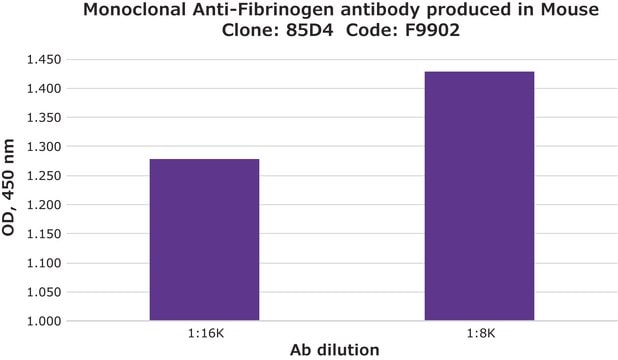
dot blot: suitable, indirect ELISA: 1:8,000, western blot: suitable

isotype

IgG1

UniProt accession no.

shipped in

dry ice

storage temp.

−20°C

target post-translational modification

unmodified

Quality Level

Gene Information

Suchen Sie nach ähnlichen Produkten? Aufrufen Leitfaden zum Produktvergleich

Ähnliche Artikel vergleichen

Vollständigen Vergleich anzeigen

Unterschiede anzeigen

1 of 4

Dieser Artikel
F4639F0791A6684
species reactivity

pig, sheep, rabbit, bovine, baboon, human, goat, canine

species reactivity

human, baboon

species reactivity

goat, canine, human, chicken, sheep, rabbit, bovine

species reactivity

gibbon, baboon, human, rhesus monkey

Gene Information

human ... FGA(2243), FGB(2244), FGG(2266)

Gene Information

human ... FGA(2243), FGB(2244), FGG(2266)

Gene Information

human ... FN1(2335)

Gene Information

human ... ALB(213)

biological source

mouse

biological source

mouse

biological source

mouse

biological source

mouse

conjugate

unconjugated

conjugate

unconjugated

conjugate

unconjugated

conjugate

unconjugated

clone

85D4, monoclonal

clone

FG-21, monoclonal

clone

IST-3, monoclonal

clone

HSA-11, monoclonal

antibody form

ascites fluid

antibody form

ascites fluid

antibody form

ascites fluid

antibody form

ascites fluid

General description

Fibrinogen is a blood coagulation protein that consists of Aα, Bβ and γ polypeptide chains. Fibrinogen expression is induced by acute-inflammatory responses and has also been associated with the risk of cardiovascular disorders. Monoclonal Anti-Fibrinogen antibody recognizes a conformational epitope, which is destroyed by the cleavage of the γ (302-303) bond. This epitope is found in fibrinogen and in fibrin monomers (devoid of either fibrinopeptide A, or both A and B fibrinopeptides), when they are immobilized on ELISA plates. The antibody reacts with the D-dimer and D-fragment. It does not recognize individual fibrinogen/fibrin chains in denatured-reduced forms or their proteolytic fragments. The E fragment is not recognized by the antibody. The antibody reacts with greater avidity with protofibrils than with wider fibrin fibers in electron microscopic analysis. Monoclonal Anti-Fibrinogen is specific for fibrinogen and fibrin in humans, baboons, bovines, sheep, goats, pigs, rabbits and dogs.
Fibrinogen was the first blood coagulation factor to be identified, and it is a precursor of fibrin protein. The three polypeptide chains are coded by three genes located on human chromosome 4q23-q32, and spans 51kb.

Immunogen

human fibrin degradation products

Application

Applications in which this antibody has been used successfully, and the associated peer-reviewed papers, are given below.
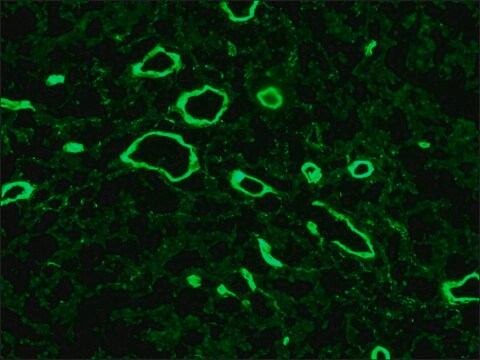
Immunofluorescence (1 paper)
Monoclonal Anti-Fibrinogen antibody is suitable for use in indirect ELISA, dot blot (1:1000 using human fibrinogen), and western blot.
Monoclonal Anti-Fibrinogen antibody produced in mouse has been used in immunohistochemistry and confocal laser scanning microscopy.[1]

Biochem/physiol Actions

Fibrinogen is an acute-phase inflammatory protein, which plays an essential role in blood clotting.
The product recognizes a conformational epitope, which is destroyed by the cleavage of the γ (302-303) bond. This epitope is found in both fibrinogen and in fibrin monomers, devoid of either fibrinopeptide A, or both A and B fibrinopeptides, when they are immobilized on ELISA plates. The antibody reacts with the D-dimer and D-fragment. It does not recognize individual fibrinogen/fibrin chains in the denatured-reduced form and their proteolytic fragments. The E fragment is not recognized by the antibody. Using electron microscopy, the antibody reacts with greater avidity with protofibrils than with wider fibrin fibers.

Disclaimer

Unless otherwise stated in our catalog or other company documentation accompanying the product(s), our products are intended for research use only and are not to be used for any other purpose, which includes but is not limited to, unauthorized commercial uses, in vitro diagnostic uses, ex vivo or in vivo therapeutic uses or any type of consumption or application to humans or animals.

Sie haben nicht das passende Produkt gefunden?  

Probieren Sie unser Produkt-Auswahlhilfe. aus.

Lagerklasse

10 - Combustible liquids

wgk

nwg

flash_point_f

Not applicable

flash_point_c

Not applicable


Hier finden Sie alle aktuellen Versionen:

Analysenzertifikate (COA)

Lot/Batch Number

Die passende Version wird nicht angezeigt?

Wenn Sie eine bestimmte Version benötigen, können Sie anhand der Lot- oder Chargennummer nach einem spezifischen Zertifikat suchen.

Besitzen Sie dieses Produkt bereits?

In der Dokumentenbibliothek finden Sie die Dokumentation zu den Produkten, die Sie kürzlich erworben haben.

Die Dokumentenbibliothek aufrufen

Plasma fibrinogen lever and risk of coronary heart disease among Chinese population: a systematic review and meta-analysis
Song B, et al.
International Journal of Clinical and Experimental Medicine, 8(8), 95-95 (2015)
Martin T Matter et al.
ACS applied materials & interfaces, 13(28), 33300-33310 (2021-07-14)
Dental implant failure remains a prevalent problem around the globe. The integration of implants at the interface of soft and hard tissues is complex and susceptible to instability and infections. Modifications to the surface of titanium implants have been developed
Katharina Gegenschatz-Schmid et al.
Acta biomaterialia, 137, 331-345 (2021-10-22)
Blood-contacting medical implants made of Nitinol and other titanium alloys, such as neurovascular flow diverters and peripheral stents, have the disadvantage of being highly thrombogenic. This makes the use of systemic (dual) anti-platelet/anticoagulant therapies inevitable with related risks of device
Vincent Milleret et al.
Clinical implant dentistry and related research, 21 Suppl 1, 8-14 (2019-03-01)
Dental implants often have surface modifications that alter surface topography and chemistry to improve osseointegration and thereby increase treatment predictability. Surface contact-induced blood coagulation is associated with the onset of osseointegration. To quantitatively evaluate the thrombogenicity of two commercially available
Rodrigo Méndez Rojano et al.
PLoS computational biology, 18(10), e1010277-e1010277 (2022-10-04)
Over the past decade, much of the development of computational models of device-related thrombosis has focused on platelet activity. While those models have been successful in predicting thrombus formation in medical devices operating at high shear rates (> 5000 s-1)

Questions

Reviews

No rating value

Active Filters

Unser Team von Wissenschaftlern verfügt über Erfahrung in allen Forschungsbereichen einschließlich Life Science, Materialwissenschaften, chemischer Synthese, Chromatographie, Analytik und vielen mehr..

Setzen Sie sich mit dem technischen Dienst in Verbindung