
ABE18

Anti-Acetyl-Histon H3 (Lys9)-Antikörper
from rabbit, purified by affinity chromatography
Synonym(e):
H3 histone family, member T, histone 3, H3, histone cluster 3, H3, H3K4ac
Größe auswählen
| Packungsgröße | SKU | Verfügbarkeit | Preis |
|---|---|---|---|
| 100 μg | Warenkorb auf Verfügbarkeit prüfen | CHF 512.00 |
Über diesen Artikel
CHF 512.00
biological source
rabbit
Quality Level
antibody form
affinity isolated antibody
antibody product type
primary antibodies
clone
polyclonal
purified by
affinity chromatography
species reactivity
chicken, human, mouse
technique(s)
ChIP: suitable (ChIP-seq), dot blot: suitable, multiplexing: suitable, western blot: suitable
NCBI accession no.
UniProt accession no.
shipped in
wet ice
target post-translational modification
acetylation (Lys9)
Gene Information
human ... HIST1H3F(8968)
General description
Immunogen
Application
Eine repräsentative Charge dieses Antikörpers immunpräzipitierte Chromatin von Histon H3, das an Lys9 acetyliert ist.
ChIP-Sequenzierung:
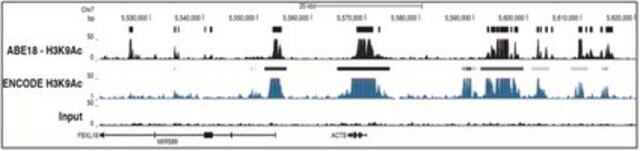
Die Chromatin-Immunpräzipitation wurde mit dem Magna ChIP HiSens-Kit (Best.-Nr. 17-10460), 2 μg einer repräsentativen Charge des Anti-Acetyl-Histon H3 (Lys9)-Antikörpers (ABE18), 20 μL Protein A/G-Beads und 1e6 quervernetztem HeLa-Zellchromatin durchgeführt, gefolgt von einer DNA-Reinigung mit Magnetbeads. Aus Input- und ChIP-DNA-Proben wurden unter Verwendung von Standardprotokollen mit barcodierten Illumina-Adaptern Bibliotheken erstellt und auf dem Illumina HiSeq-Instrument analysiert. Mehr als dreizehn Millionen Reads aus FastQ-Dateien wurden mit Bowtie (http://bowtie-bio.sourceforge.net/manual.shtml) gemappt, nachdem TagDust (http://genome.gsc.riken.jp/osc/english/dataresource/) Tags entfernt hatte. Die Peaks wurden mit MACS (http://luelab.dfci.harvard.edu/MACS/) identifiziert, wobei die Peaks und Reads als benutzerdefinierter Track im UCSC Genome Browser (http://genome.ucsc.edu) aus BigWig- und BED-Dateien visualisiert wurden.
Dot-Blot-Analyse:
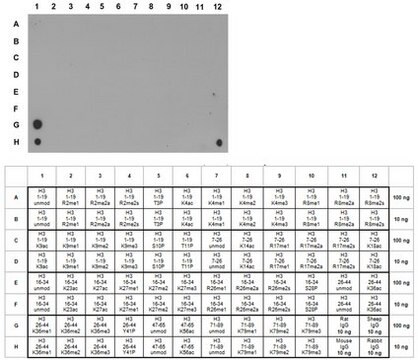
Eine repräsentative Charge dieses Antikörpers wies Histon H3 in modifizierten und nicht modifizierten Peptiden von acetyliertem und nicht-acetyliertem Histon H3 Lys9 nach.
Luminex-Analyse:
Eine repräsentative Charge dieses Antikörpers erkannte spezifisch acetyliertes Histon H3 auf Lys9 mit dem Luminex-Assay.
Epigenetik & Zellkernfunktion
Histone
Biochem/physiol Actions
Physical form
Preparation Note
Analysis Note
Western-Blot-Analyse: 0,05 µg/ml dieses Antikörpers wies Histon H3 auf 10 µg unbehandeltem und behandeltem HeLa-Säureextrakt mit Natriumbutyrat.
Natriumbutyrat unbehandelt und behandelt HeLa-Säureextrakt
Other Notes
Disclaimer
1 of 1
Dieser Artikel | |||
|---|---|---|---|
| biological source rabbit | biological source rabbit | biological source rabbit | biological source rabbit |
| Quality Level 100 | Quality Level 100 | Quality Level 100 | Quality Level 100 |
| antibody form affinity isolated antibody | antibody form affinity isolated antibody | antibody form affinity isolated antibody | antibody form affinity isolated antibody |
| technique(s) ChIP: suitable (ChIP-seq), multiplexing: suitable, dot blot: suitable, western blot: suitable | technique(s) ChIP: suitable (ChIP-seq), dot blot: suitable, immunocytochemistry: suitable, western blot: suitable | technique(s) dot blot: suitable, immunoprecipitation (IP): suitable, western blot: suitable | technique(s) dot blot: suitable, immunocytochemistry: suitable, western blot: suitable |
| clone polyclonal | clone polyclonal | clone polyclonal | clone polyclonal |
| species reactivity chicken, human, mouse | species reactivity mouse, rat, human, chicken | species reactivity mouse, human, rat | species reactivity human, mouse |

Still not finding the right product?
Explore all of our products under Anti-Acetyl-Histon H3 (Lys9)-Antikörper
— oder —
Probieren Sie unser Produkt-Auswahlhilfe, um Ihre Auswahl einzugrenzen
Lagerklasse
12 - Non Combustible Liquids
wgk
WGK 1
flash_point_f
Not applicable
flash_point_c
Not applicable
Analysenzertifikate (COA)
Suchen Sie nach Analysenzertifikate (COA), indem Sie die Lot-/Chargennummer des Produkts eingeben. Lot- und Chargennummern sind auf dem Produktetikett hinter den Wörtern ‘Lot’ oder ‘Batch’ (Lot oder Charge) zu finden.
Besitzen Sie dieses Produkt bereits?
In der Dokumentenbibliothek finden Sie die Dokumentation zu den Produkten, die Sie kürzlich erworben haben.
Verwandter Inhalt
Cancer is a complex disease manifestation. At its core, it remains a disease of abnormal cellular proliferation and inappropriate gene expression. In the early days, carcinogenesis was viewed simply as resulting from a collection of genetic mutations that altered the gene expression of key oncogenic genes or tumor suppressor genes leading to uncontrolled growth and disease (Virani, S et al 2012). Today, however, research is showing that carcinogenesis results from the successive accumulation of heritable genetic and epigenetic changes. Moreover, the success in how we predict, treat and overcome cancer will likely involve not only understanding the consequences of direct genetic changes that can cause cancer, but also how the epigenetic and environmental changes cause cancer (Johnson C et al 2015; Waldmann T et al 2013). Epigenetics is the study of heritable gene expression as it relates to changes in DNA structure that are not tied to changes in DNA sequence but, instead, are tied to how the nucleic acid material is read or processed via the myriad of protein-protein, protein-nucleic acid, and nucleic acid-nucleic acid interactions that ultimately manifest themselves into a specific expression phenotype (Ngai SC et al 2012, Johnson C et al 2015). This review will discuss some of the principal aspects of epigenetic research and how they relate to our current understanding of carcinogenesis. Because epigenetics affects phenotype and changes in epigenetics are thought to be key to environmental adaptability and thus may in fact be reversed or manipulated, understanding the integration of experimental and epidemiologic science surrounding cancer and its many manifestations should lead to more effective cancer prognostics as well as treatments (Virani S et al 2012).
Global Trade Item Number
| SKU | GTIN |
|---|---|
| ABE18 | 04053252421761 |