




At high concentrations, Alginate lyase may degrade the entire extracellular matrix too rapidly and damage the structural integrity of encapsulated cells or tissue constructs. It may also cause unwanted aggregation or precipitation of breakdown products, and the high protein concentration itself might interfere with downstream applications.
A1603

Alginate Lyase
powder, ≥10,000 units/g solid
Synonym(s):
poly-beta-D-mannuronate lyase
Sign In to View Organizational & Contract Pricing.
Select a Size
Change View
| Size/SKU | Availability | Price |
|---|---|---|
100 mg | Available to ship TODAYfromMILWAUKEE | $234.00 |
About This Item
CAS Number:
UNSPSC Code:
12352204
NACRES:
NA.54
MDL number:
Specific activity:
≥10,000 units/g solid
General description
Alginate lyases is present in several marine algae, marine mollusks and a vast range of marine and terrestrial bacteria.
Application
Alginate Lyase is used to break down alginate or alginic acid and to reduce viscosity. It is useful during follicle isolation, encapsulation, and culture [1].
Alginate Lyase has been used:
- in the pre-processing of enzyme
- to de-encapsulate cells
- to digest Pseudomonas exopolysaccharide to facilitate electroporation
Biochem/physiol Actions
Breaks down alginate or alginic acid to smaller molecules and reduces viscosity.
Alginate lyases actively participates in the saccharification of the acidic polysaccharides for the production of bioethanol.
Preparation Note
Add 0.15 mI of enzyme solution (1 un/ml) to 4.5 ml of 0.1% sodium alginate (pH 6.3). Incubate at 37 °C for 30 minutes. Terminate reaction by addition of 4.65 ml of 0.1 N NaOH.
Other Notes
One unit will produce an increase the A235nm of 1.0 per minute per mL of sodium alginate solution at pH 6.3 at 37 °C
View more information on enzymes for complex carbohydrate analysis at www.sigma-aldrich.com/enzymeexplorer
1 of 1
This Item | |||
|---|---|---|---|
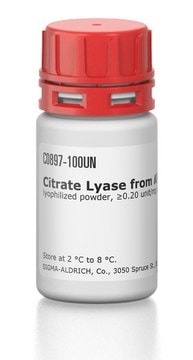
| specific activity ≥10,000 units/g solid | specific activity ≥0.25 U/mg (At 25 °C with citrate as the substrate.) | specific activity ≥0.20 unit/mg solid | specific activity ≥200 units/g solid |
| form powder | form lyophilized | form lyophilized powder | form lyophilized powder (essentially salt free) |
| storage temp. 2-8°C | storage temp. 2-8°C | storage temp. 2-8°C | storage temp. −20°C |
| Quality Level 200 | Quality Level - | Quality Level 200 | Quality Level 300 |
signalword
Danger
hcodes
pcodes
Hazard Classifications
Resp. Sens. 1
Storage Class
11 - Combustible Solids
wgk
WGK 1
flash_point_f
Not applicable
flash_point_c
Not applicable
ppe
Eyeshields, Gloves, type N95 (US)
Choose from one of the most recent versions:
Already Own This Product?
Find documentation for the products that you have recently purchased in the Document Library.
-
I read on your site, that Alginat lyase should be resuspended at a concentration of 0.05 - 1.5 u/ml in 0.1 mol/L Phosphate buffer (pH 6.3). What if I prepared 24 U/ml (1mg contains 24U). Can this be harmful for the sample?
1 answer-
Helpful?
-
-
Hi, is this enzyme a G-lyase (specific for GG-linkages) or M-lyase (specific for MM-linkages)?
1 answer-
This enzyme degrades GG linkages approximately twice as effectively as MM linkages.
Helpful?
-
-
Hi! What is the PL family, source and structure of this enzyme?
1 answer-
Most information on this enzyme is proprietary. However, it is an endo-type enzyme sourced from Flavobacterium species and functions as an endo-cleaving enzyme.
Helpful?
-
-
What are the aminoacid sequence of the enzyme, molecular weight, molar extinction and the original bacterium
1 answer-
The amino acid sequence and molar extinction of this enzyme has not been determined. The molecular weight is approximately 40,000 daltons. The specific species of the bacterium is considered proprietary.
Helpful?
-
-
Hi, could you please tell me the source of the alginate lyase and the strain in which it was expressed? Thank you!
1 answer-
This enzyme is produced by microbial fermentation. The specific species is considered proprietary.
Helpful?
-
-
I was wondering how to prepare the enzyme solution and what does the 1 un/ml mean? Is is 1 unit/mL or what does the un stand for? How do I convert the units to grams?
1 answer-
A1603 should be resuspended at a concentration of 0.05 - 1.5 u/ml in 0.1 mol/L Phosphate buffer (pH 6.3).
The specific activity of each lot (units/gram solid) is provided on the certificate of analysis. The lot specific certificate of analysis can be found here:
https://www.sigmaaldrich.com/product/sigma/a1603#product-documentation
Based on the specific activity (units/gram solid), the researcher can weigh out the appropriate amount of A1603 to achieve a 1 unit/mL solution.
un = unitHelpful?
-
-
Hi, I've ordered this product from here, but it's just saying powder, ≥10,000 units/g solid, can you please tell me the molecular weight of it? in Da or kDa?
1 answer-
The molecular weight this material is approximately 40,000 daltons.
Helpful?
-
-
I ordered the alginate lyase from your company. But the information that I received only present >=10,000U/g. And I need the 20U/m in my experiment. Could you give me more information?
1 answer-
The exact specific activity value is specified on the lot specific Certificate of Analysis. Please see this example Certificate of Analysis: https://www.sigmaaldrich.com/certificates/sapfs/PROD/sap/certificate_pdfs/COFA/Q14/A1603-BULKSLCQ2940.pdf.
Helpful?
-