Anmelden zur Ansicht der Organisations- und Vertragspreise.
Über diesen Artikel
Empirische Formel (Hill-System):
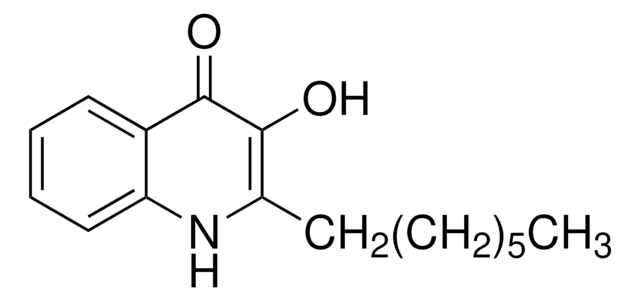
C16H21NO2
CAS-Nummer:
Molekulargewicht:
259.34
NACRES:
NA.25
PubChem Substance ID:
UNSPSC Code:
12352005
MDL number:
Fortfahren mit
Technischer Dienst
Benötigen Sie Hilfe? Unser Team von erfahrenen Wissenschaftlern ist für Sie da.
Unterstützung erhaltenQuality Level
assay
≥96.0% (HPLC)
form
powder
storage temp.
−20°C
SMILES string
CCCCCCCC1=C(O)C(=O)c2ccccc2N1
InChI
1S/C16H21NO2/c1-2-3-4-5-6-11-14-16(19)15(18)12-9-7-8-10-13(12)17-14/h7-10,19H,2-6,11H2,1H3,(H,17,18)
InChI key
CEIUIHOQDSVZJQ-UHFFFAOYSA-N
1 of 4
Dieser Artikel | |||
|---|---|---|---|
| form powder | form - | form powder | form - |
| assay ≥96.0% (HPLC) | assay ≥97.0% (GC) | assay ≥95% (HPLC) | assay 98% |
| Quality Level 100 | Quality Level 100 | Quality Level 100 | Quality Level 100 |
| storage temp. −20°C | storage temp. 2-8°C | storage temp. 2-8°C | storage temp. - |
General description
2-heptyl-3-hydroxy-4-quinolone can function as an intercellular signal[1].
Application
Quorum sensing is a signaling system used by bacteria to coordinate activity based upon their population density. The system involves the exchange of signaling molecules among bacteria via cell receptors. Heptyl-3-hydroxy-4(1H)-quinolone (PQS) is a quorum sensing-regulated virulence factor used to induce and study the regulation of virulence genes such as those involved in iron scavenging.
Packaging
Bottomless glass bottle. Contents are inside inserted fused cone.
hcodes
Hazard Classifications
Aquatic Chronic 4
Lagerklasse
11 - Combustible Solids
wgk
WGK 3
flash_point_f
Not applicable
flash_point_c
Not applicable
Hier finden Sie alle aktuellen Versionen:
Besitzen Sie dieses Produkt bereits?
In der Dokumentenbibliothek finden Sie die Dokumentation zu den Produkten, die Sie kürzlich erworben haben.
Jintae Lee et al.
Microbial biotechnology, 2(1), 75-90 (2009-01-01)
Indole is an extracellular biofilm signal for Escherichia coli, and many bacterial oxygenases readily convert indole to various oxidized compounds including 7-hydroxyindole (7HI). Here we investigate the impact of indole and 7HI on Pseudomonas aeruginosa PAO1 virulence and quorum sensing
Monique Donnert et al.
PLoS pathogens, 16(12), e1009126-e1009126 (2020-12-23)
Embedded in an extracellular matrix, biofilm-residing bacteria are protected from diverse physicochemical insults. In accordance, in the human host the general recalcitrance of biofilm-grown bacteria hinders successful eradication of chronic, biofilm-associated infections. In this study, we demonstrate that upon addition
Doreen S W Hooi et al.
Infection and immunity, 72(11), 6463-6470 (2004-10-27)
Pseudomonas aeruginosa releases a spectrum of well-regulated virulence factors, controlled by intercellular communication (quorum sensing) and mediated through the production of small diffusible quorum-sensing signal molecules (QSSM). We hypothesize that QSSM may in fact serve a dual purpose, also allowing
E C Pesci et al.
Proceedings of the National Academy of Sciences of the United States of America, 96(20), 11229-11234 (1999-09-29)
Numerous species of bacteria use an elegant regulatory mechanism known as quorum sensing to control the expression of specific genes in a cell-density dependent manner. In Gram-negative bacteria, quorum sensing systems function through a cell-to-cell signal molecule (autoinducer) that consists
Stephen P Diggle et al.
Chemistry & biology, 14(1), 87-96 (2007-01-27)
Pseudomonas aeruginosa produces 2-heptyl-3-hydroxy-4(1H)-quinolone (PQS), a quorum-sensing (QS) signal that regulates numerous virulence genes including those involved in iron scavenging. Biophysical analysis revealed that 2-alkyl-3-hydroxy-4-quinolones form complexes with iron(III) at physiological pH. The overall stability constant of 2-methyl-3-hydroxy-4-quinolone iron(III) complex
Global Trade Item Number
| SKU | GTIN |
|---|---|
| 94398-10MG | 04061833291788 |
Active Filters
Unser Team von Wissenschaftlern verfügt über Erfahrung in allen Forschungsbereichen einschließlich Life Science, Materialwissenschaften, chemischer Synthese, Chromatographie, Analytik und vielen mehr..
Setzen Sie sich mit dem technischen Dienst in Verbindung